D3 & K2 - 5000 IU D3, 180 mcg K2




Most people supplement vitamin D alone. That handles absorption and stops there. This formula pairs a repletion-level dose of D3 with 180 mcg of stabilized MK-7, because absorbing more calcium and directing it correctly are two different jobs handled by two different vitamins.
We only publish what we hold paperwork for. Here is what applies to this SKU, stated plainly and without embellishment.
Manufactured in the United States in an FDA-registered facility operating under current Good Manufacturing Practice.
The vitamin K2 is stabilized vitaMK7 Matrix from Gnosis, a named, traceable, fermentation-derived MK-7 rather than an unidentified bulk menaquinone.
Both actives are declared at their exact amounts. No proprietary blend, no filler stack, no ingredient listed without a number beside it.
Testing is performed at multiple stages of production by the manufacturer. Certificates of analysis are available on request through customer service.
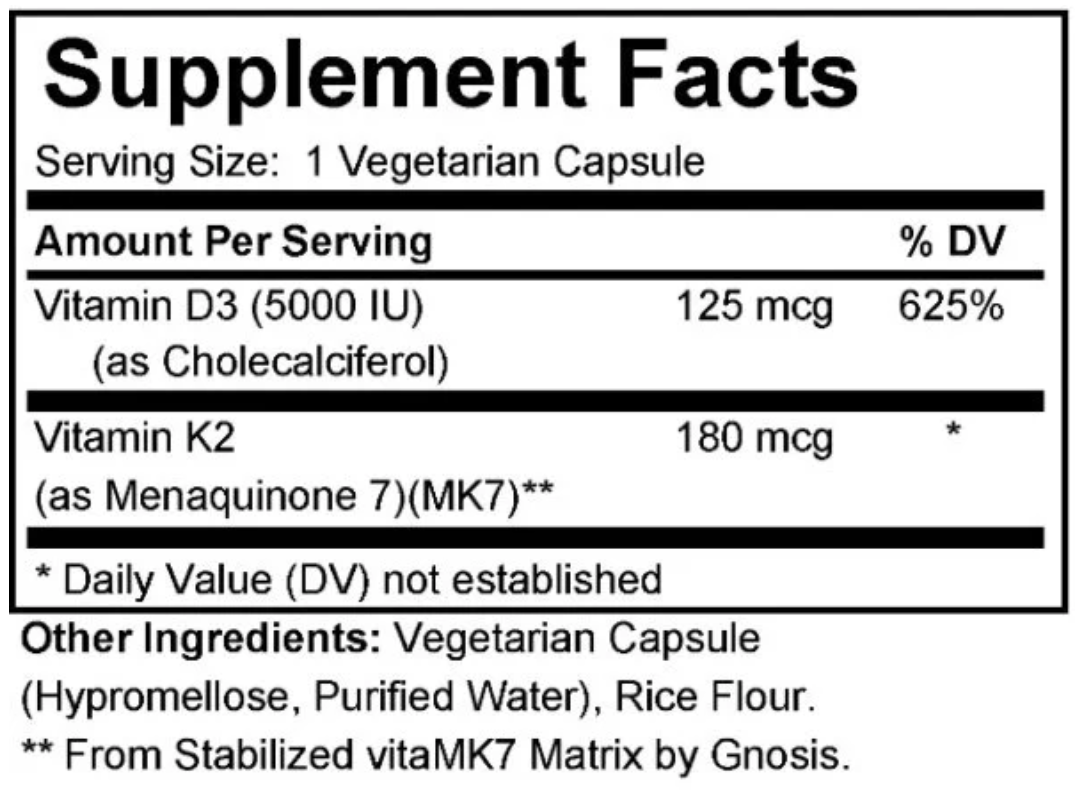
A once-daily vegetarian capsule delivering 125 mcg (5,000 IU) of vitamin D3 as cholecalciferol alongside 180 mcg of vitamin K2 as menaquinone-7, from stabilized vitaMK7 Matrix. Two actives. No blend, no filler beyond the capsule itself.
Adults with limited sun exposure, indoor work, darker skin, higher body fat, or a documented low 25(OH)D. Athletes training indoors through winter. Anyone already taking vitamin D on its own and wondering what happens to the calcium it helps absorb.
One capsule daily with a meal that contains fat. Both D3 and MK-7 are fat-soluble and absorb meaningfully better with dietary fat than on an empty stomach. Timing within the day does not matter. Consistency does.
The category has spent twenty years selling vitamin D as a single-nutrient answer. Vitamin D's job is to increase how much calcium you pull out of your food. It has no mechanism for deciding where that calcium ends up once it is in circulation. That job belongs to a family of vitamin K-dependent proteins, and those proteins do not work until vitamin K activates them.
We did not build a vitamin D product. We built a calcium-handling product that happens to start with vitamin D.
Vitamin D upregulates intestinal calcium absorption. Vitamin K2 activates osteocalcin and matrix Gla protein, the two proteins that bind calcium into bone matrix and support normal calcium handling in soft tissue. Running the first step without the second leaves the process incomplete.
The adult RDA for vitamin D is 600 to 800 IU, a figure set to cover basic requirements. This formula delivers 5,000 IU, a repletion-level dose intended for adults whose measured status calls for it. We say more about that below, including where it sits against published upper intake limits.
Published pharmacokinetic work puts the circulating half-life of MK-7 at roughly 68 hours, compared with one to two hours for vitamin K1. That is why MK-7 works at microgram amounts once daily, while MK-4 requires milligram doses taken several times a day to register.
One hundred capsules. One hundred days. Twenty-eight cents a day, or roughly 23.8 cents on subscription. A foundational nutrient should not be a line item you have to think about, and it should not be padded with ingredients that exist to lengthen the label.
Calcium is not simply good or bad. It is useful in bone and unhelpful in arterial walls, and the same mineral does both depending on how the body routes it. That routing is a three-stage process, and this formula supplies the nutrients for the first two.
Vitamin D3 is converted in the liver to 25-hydroxyvitamin D, then in the kidney to its active hormonal form. That active form binds the vitamin D receptor in intestinal cells and upregulates the calcium transport machinery. In plain terms, more of the calcium in your food crosses into circulation. This is the step almost every vitamin D product on the shelf is selling.
Supplies: 125 mcg / 5,000 IU cholecalciferolSeveral proteins in the body are built specifically to bind calcium, but they are manufactured in an inactive state. A vitamin K-dependent enzyme has to carboxylate them before they can grip calcium at all. Without adequate vitamin K, those proteins circulate uncarboxylated and inert. MK-7 is the form that stays in circulation long enough, at microgram doses, to keep that carboxylation running in tissues outside the liver.
Supplies: 180 mcg MK-7, stabilized vitaMK7 MatrixTwo of those newly activated proteins matter most here. Osteocalcin, produced by bone-building cells, binds calcium into the mineral matrix of bone. Matrix Gla protein, expressed in arterial walls and other soft tissue, supports normal calcium handling where mineral deposition is not wanted. Same nutrient, two destinations, and the routing depends on whether the proteins were activated in Stage 2.
Supported by: adequate K2 statusWhat this does not mean. Vitamin K2 does not pull calcium out of anywhere, and this is not a formula that removes or reverses anything. It supplies the cofactor a normal biological process requires in order to run properly. That distinction matters, and we would rather state it than let a diagram imply otherwise.
Cholecalciferol is the form your skin makes from UVB exposure and the form that raises and holds serum 25-hydroxyvitamin D more reliably than D2. It functions less like a vitamin and more like a hormone precursor: once converted, it binds a receptor found in intestinal tissue, immune cells, muscle, and bone.
Vitamin D supports normal immune function, calcium absorption, bone mineral density, muscle function, healthy mood, and a healthy inflammatory response. Status varies enormously between people. Latitude, season, skin pigmentation, body composition, indoor work, and certain medications all move the number, which is why the same dose produces very different blood levels in different adults.
The National Academy of Medicine sets the adult RDA for vitamin D at 600 IU through age 70 and 800 IU after, with a Tolerable Upper Intake Level of 4,000 IU per day. This capsule delivers 5,000 IU. That is a deliberate choice, and we are not going to bury it in a footnote.
Five thousand IU is a common clinical repletion dose, it is widely used in practice, and clinical guidance from endocrinology sources permits higher daily intakes than the NAM ceiling. But "common in clinical practice" is not the same as "appropriate for everyone by default." A dose at this level belongs to someone whose measured 25(OH)D supports it, taken with a physician's knowledge, and rechecked. If you have never had your vitamin D tested, the honest recommendation is to test first rather than to assume you are low.
Vitamin K2 is the cofactor for gamma-glutamyl carboxylase, the enzyme that converts vitamin K-dependent proteins from an inactive form into one that can bind calcium. Osteocalcin and matrix Gla protein are the two that drive the bone and vascular side of this formula. Neither functions until carboxylated.
Form matters more here than in almost any other nutrient. Published pharmacokinetic work reports a circulating half-life of roughly 68 hours for MK-7, against one to two hours for vitamin K1, and a single dietary-level dose of MK-4 was not measurable in serum at any timepoint in a published comparison. That is the practical case for MK-7: it is the menaquinone that reaches tissue outside the liver at a dose you can put in one capsule and take once a day.
We specified stabilized vitaMK7 Matrix from Gnosis rather than an unnamed bulk MK-7. Menaquinone-7 is sensitive to moisture and mineral salts in finished formulations, and a stabilized matrix grade is how you protect potency across shelf life instead of hoping for it.
The 180 mcg in this capsule is the same daily amount used in the three-year randomized MK-7 trials in postmenopausal women that looked at bone loss and arterial stiffness. That is a genuine dose match, and it is why we chose 180 rather than the 45 or 90 mcg that is common on retail shelves.
Those trials used MenaQ7, a different branded MK-7. This product contains vitaMK7. Both are menaquinone-7 and both are now under the same corporate parent, but they are separately manufactured ingredients, and we are not going to attribute another brand's clinical results to ours. We are telling you the dose is matched. We are not telling you the trial was run on this bottle.
That is the entire remainder of the capsule. Hypromellose is the vegetarian capsule shell. Rice flour is the flow agent that lets two microgram-scale actives be dosed accurately into a capsule, since 305 micrograms of active does not fill a capsule on its own.
No magnesium stearate, no titanium dioxide, no artificial colors, no proprietary blend, and no long tail of ingredients present in amounts too small to do anything. If we list it, it is either doing work or holding the capsule together.
Serving Size: 1 Vegetarian Capsule
Servings Per Container: 100
| Amount Per Serving | % DV |
|---|---|
| Vitamin D3 (5000 IU)(as Cholecalciferol) | 125 mcg 625% |
| Vitamin K2(as Menaquinone 7) (MK7)** | 180 mcg * |
* Daily Value (DV) not established.
Other Ingredients: Vegetarian Capsule (Hypromellose, Purified Water), Rice Flour.
** From Stabilized vitaMK7 Matrix by Gnosis.
Transcribed from the printed label, which is also shown in the product images above. 100 vegetarian capsules per bottle. One capsule per serving, 100 servings per container.
Vitamin D is not a supplement you feel working, and anyone who tells you otherwise is selling something. It is a supplement you measure. Here is how we think about the first three months, and it is built around a blood test rather than a sensation.
Ask for a serum 25-hydroxyvitamin D test. It is inexpensive, most physicians will order it, and it is the only way to know whether 5,000 IU is the right dose for you or more than you need. Starting a repletion-level dose without a baseline means you will never know what it did.
One capsule daily, with a meal containing fat. Both actives are fat-soluble. Serum 25(OH)D rises gradually and approaches a new steady state over roughly two to three months of consistent daily intake, which is why sporadic dosing produces disappointing labs.
Recheck the same lab. The number tells you whether to hold this dose, drop to a maintenance level, or look at what else is limiting it. Magnesium status is the usual culprit when the number barely moves, which is a large part of why we pair this with a mineral formula.
You do not have to buy ours. You should, however, know what separates a formulated D3 and K2 product from one built to hit a price point. Six things worth checking on any bottle in the category, including this one.
| Check | The typical off-the-shelf version | IOH D3 & K2 |
|---|---|---|
| Form of vitamin K2 | Often unspecified "vitamin K2," or MK-4, which clears circulation in roughly two hours and needs milligram doses taken several times daily | MK-7, the long-chain menaquinone with a reported half-life near 68 hours, effective at microgram amounts once daily |
| K2 amount | 45 to 100 mcg is the common shelf range, which sits below the amount used in the long-duration human MK-7 trials | 180 mcg, matching the daily amount used in the three-year randomized MK-7 research |
| K2 sourcing | No supplier named. You cannot verify purity, isomer profile, or stability of an ingredient you cannot identify | Stabilized vitaMK7 Matrix by Gnosis, named on the printed label |
| Stability engineering | Unprotected MK-7, which is vulnerable to moisture and mineral salts over shelf life | A stabilized matrix grade specified precisely to protect MK-7 potency in the finished capsule |
| Excipients | Magnesium stearate, silicon dioxide, titanium dioxide, dyes, and gelatin shells are all common | Vegetarian capsule and rice flour. That is the complete list |
| Dosing guidance | "Take one daily," with no reference to testing and no discussion of where the dose sits against published intake limits | Explicit instruction to test 25(OH)D first, plus a plain statement of how 5,000 IU compares to the published upper intake level |
Everything below is either printed on the label, verifiable from the published literature at the dose in this capsule, or a statement about how we built it. We have left out everything we could not put in one of those three categories.

I have been in practice for thirty-three years, and vitamin D is the single lab value I have watched more people get wrong in both directions than any other. Half the patients I see have never had it measured. The other half are on a dose someone guessed at, taken alone, for years.
This is what I reach for, and I take it with a meal that has fat in it, every day. But I want to be straight with you about the reason we put 5,000 IU in a capsule and then spent half this page telling you to get a blood test. It is because the dose is right for a lot of adults and wrong for some, and the only thing separating those two groups is a number you can get for the price of a copay.
We paired it with K2 because I was never comfortable telling someone to absorb more calcium without also giving them what the body uses to route it. That felt like handing someone half of an answer.

Dr. Andreas Boettcher, B.S., D.C., C.F.M.P.
Founder, It's Only Halftime
Ironman Triathlete / Master's Men's Physique Competitor / Medication-Free at 56 / 33 Years of Clinical Practice
D3 and K2 handle the mineral side of a larger process. These three cover what sits on either end of it: the cofactors that activate vitamin D in the first place, the fat that carries it in, and the protein scaffold that the mineral actually attaches to.
This is the pairing we would argue hardest for. Magnesium is a required cofactor for the hepatic and renal hydroxylase enzymes that convert cholecalciferol into its active form. If magnesium status is low, vitamin D supplementation underperforms, and the person taking it usually concludes the dose was too small when the real bottleneck was somewhere else entirely.
View 5X Chelated Minerals →D3 and MK-7 are both fat-soluble and both absorb substantially better in the presence of dietary fat. Taking this capsule alongside a fish oil softgel solves the absorption problem structurally rather than relying on you to remember what was on your plate. The two also work the same cardiovascular lane, so the pairing is not just mechanical convenience.
View Omega 3 TS →Bone is not a block of mineral. It is a collagen framework with mineral deposited onto it, and roughly a third of bone by weight is organic matrix, most of it type I collagen. D3 and K2 manage the mineral phase. Collagen peptides supply substrate for the protein phase. Supporting one without the other addresses half of the structure.
View Collagen Peptides Plus →Not without talking to the physician who manages that prescription first. This is the most important line on this page.
Warfarin and other vitamin K antagonists work by interfering with vitamin K recycling. Any change in your vitamin K intake, in either direction, can shift how that medication behaves and change your INR. Menaquinone-7 in particular stays in circulation far longer than vitamin K1, so it is not something that washes out between doses. The relevant drug class is vitamin K antagonists, which includes warfarin under its various brand names.
This does not automatically mean you cannot take vitamin K2. It means the decision belongs to your prescribing physician and needs INR monitoring, not a supplement label. Bring the bottle to your appointment and show them the 180 mcg figure.
It depends entirely on your current status, and that is not a dodge. The National Academy of Medicine sets the adult Tolerable Upper Intake Level at 4,000 IU per day, so 5,000 IU sits above it. We are not going to pretend otherwise.
In clinical practice, 5,000 IU is a routine repletion dose for adults with documented insufficiency, and endocrinology guidance has long allowed higher daily intakes than the NAM ceiling for adults at risk. But an upper limit exists for a reason, and vitamin D is fat-soluble, meaning it accumulates rather than clearing daily.
The honest answer: get a serum 25-hydroxyvitamin D test, share the result with your physician, and let that number decide whether this dose is appropriate for you and for how long. If you are already taking vitamin D from a multivitamin or another formula, add those amounts together before you start.
That footnote is on the printed label as manufactured. The FDA does publish a Daily Value for vitamin K of 120 mcg for adults, so this is a labeling point we have flagged internally and are reviewing with the manufacturer for the next print run.
For your purposes the number that matters is the one stated in micrograms: 180 mcg of vitamin K2 as MK-7 per capsule. That figure is accurate and is what we formulated to.
Yes, and specifically with food containing some fat. Both vitamin D3 and MK-7 are fat-soluble and are absorbed through the same lipid pathway as dietary fat. Taken on an empty stomach or with a fat-free meal, absorption drops meaningfully.
You do not need much. Eggs, avocado, olive oil, nuts, fatty fish, or a fish oil capsule taken at the same time all do the job.
You may not, and we would rather tell you that than sell you a timeline we cannot back up. Vitamin D repletion is not a sensation. Some people with genuinely low status notice changes in energy or mood as their level normalizes, and many people notice nothing at all while their labs move substantially.
Serum 25(OH)D rises gradually and approaches a new steady state over roughly two to three months of consistent daily intake. That is the reason we point you toward a retest at around 90 days instead of asking you to judge by feel.
In most cases yes, but check the labels for overlap first. Several multi-nutrient formulas include vitamin D, vitamin K, or both, and the totals stack. If you are taking a multivitamin alongside this, add the vitamin D amounts together and confirm the combined daily total is what you and your physician intended.
The three formulas we recommend pairing with this one are covered in the stack section above. If you want a specific combination reviewed, our customer service team can help.
The capsule is vegetarian: hypromellose and purified water, no gelatin. The MK-7 is produced by bacterial fermentation and is not animal-derived.
Vitamin D3 as cholecalciferol is most commonly manufactured from lanolin, which is sheep's wool oil, though lichen-derived D3 also exists. We label this product as vegetarian rather than vegan, and if the D3 source is a determining factor for you, contact customer service before ordering so we can confirm the current raw material for your batch.
One hundred. The bottle contains 100 vegetarian capsules and the serving size is one capsule, so at the suggested use of one per day a bottle runs a little over three months. At $28.00 that works out to 28 cents per day, or about 23.8 cents per day on the subscription price.
Talk to your physician before starting. Vitamin D increases calcium absorption, and conditions involving impaired kidney function, hypercalcemia, hyperparathyroidism, sarcoidosis, or a history of calcium-based kidney stones all change how a repletion-level vitamin D dose should be handled. Certain medications, including thiazide diuretics and digoxin, are also relevant to calcium status.
This is not a reason to assume the product is off limits. It is a reason for the decision to be made by someone who has your labs in front of them.
Vitamin D alone answers the first half of that question and leaves the second half to chance. Two actives, both at amounts we will show you, in a capsule that costs twenty-eight cents a day and lasts a little over three months.
Get the blood test. Take it with a meal. Retest in ninety days. That is the entire protocol, and it is the same one I follow.
It's Only Halftime
vitaMK7® is a registered trademark of Gnosis S.p.A. (Gnosis by Lesaffre). MenaQ7® is a registered trademark of Gnosis by Lesaffre and is referenced on this page solely to identify the branded ingredient used in the published research cited. MenaQ7® is not an ingredient in this product. All other trademarks are the property of their respective owners.
Manufactured in the United States in an FDA-registered facility operating under current Good Manufacturing Practice (cGMP). The FDA registers manufacturing facilities; it does not approve them or the dietary supplements produced in them.
Consult your physician before beginning any supplement, particularly if you are pregnant or nursing, taking prescription medication, or managing a medical condition. This product contains vitamin K2, which is relevant to anyone taking a vitamin K antagonist anticoagulant such as warfarin. Do not exceed the suggested use without physician guidance. Keep out of reach of children.
These statements have not been evaluated by the Food and Drug Administration. This product is not intended to diagnose, treat, cure, or prevent any disease.
Tastes great! Great energy boost!
Great supplement to support my body. No GI side effects
I feel the boost it gives me. No weird stimulant effect, just more energy.
Easy on the gut with no weird taste or GI upset.
No weird or fishy taste or GI upset. I take several a day and feel great compared to other omega 3 supplements I have tried.
I take it daily and am glad to have a supplement to help with my cholesterol. No GI upset.
Great way to get needed minerals. No weird taste and no GI upset.
No weird taste and no gastric upset. Best MVI I have used.
Tastes great and it mixes up really well even with hot coffee.
I’ve tried many different omega 3/fish oil supplements and IOH’s has me at my best.
Based on Dr A’s coaching and advice, IOH creatine is a supplement must!
I've been consuming chocolate whey powder for a long time. I don't make particularly tasty protein drinks. However, I do with this!
If you are looking for high purity products with actual clinical doses and a product line that doesn't need a colorful, cartoon-like label to grab your attention, then IOH products are what you should be buying.
I tend to workout early AM, and used to pound a diet soda as my pre workout. I switched to this and have found it gives a much stronger and sustained energy boost without the jitters other caffeinated options have given me before.
I've tried many different pre-workout drinks over my years of lifting and for the most part have not been happy with them, loaded with toxic ingredients, jitters, the crash that comes after, etc.
I was introduced to IOH pre-workout from a friend and decided to give it a try. Prior to ordering an analyzed the ingredients and was impressed with the makeup of the product. The fact that there are no binders, fillers, artificial sweeteners and other common ingredients that are a far cry from healthy was encouraging.
After taking the supplement, I can confidently say it's a winner. Great clean energy, that is sustainable with no crash, no jitters or side effects from harsh stimulants. The energy and the increased time to fatigue, allowing me to push more reps and the pump you get was excellent.
I've added this to my routine and would encourage anyone looking for that clean energy performance added to their workouts, to give it a try.
Great job IOH team!


