CoQ10 Ubiquinol - Ultra High Absorption
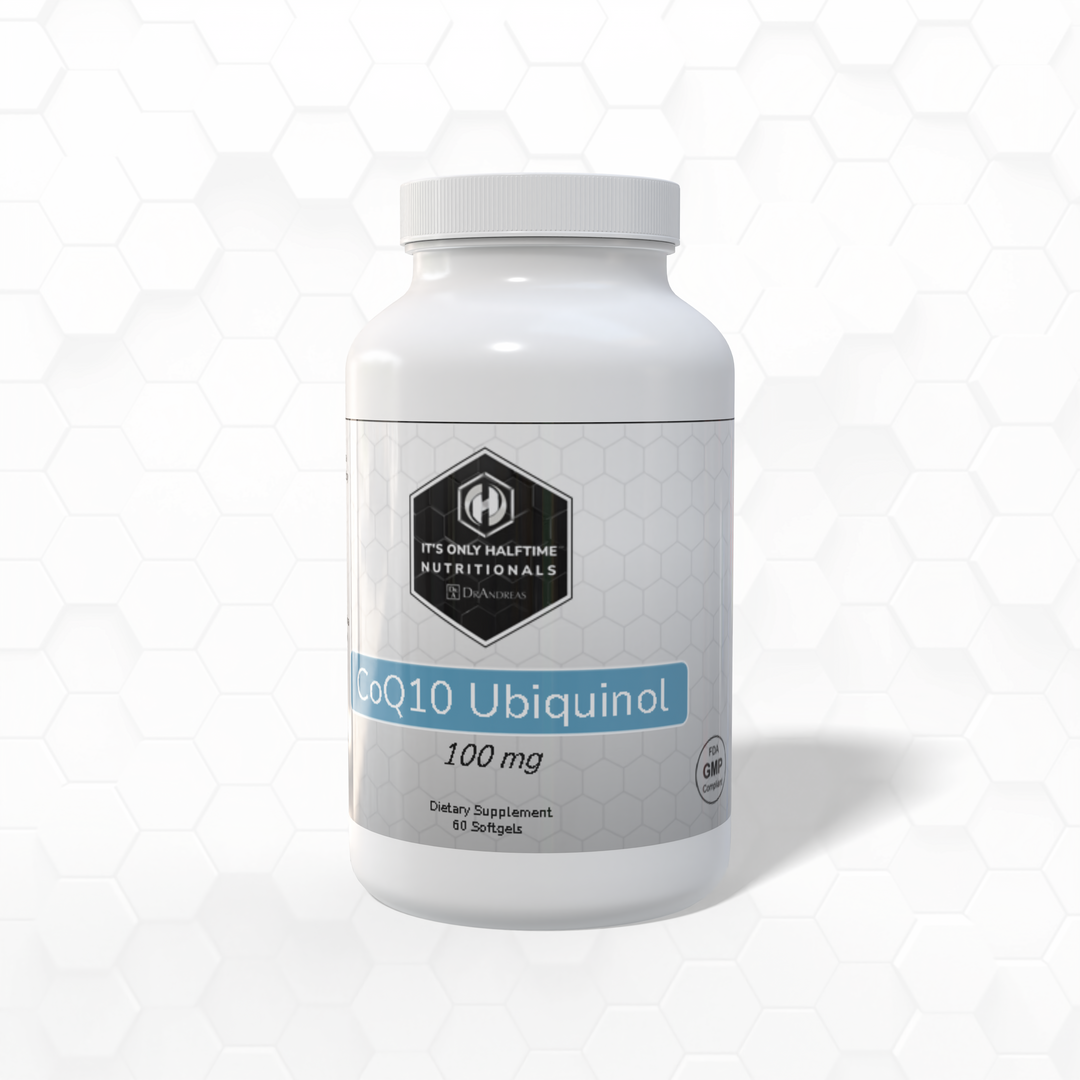


Most CoQ10 on the shelf is ubiquinone — the oxidized form, which your body has to reduce before it can use it. This is ubiquinol: the finished, already-reduced molecule that makes up the majority of the CoQ10 circulating in healthy adults.
Roughly 95 percent of the energy your body runs on is produced inside mitochondria, and CoQ10 sits in the middle of that assembly line. It shuttles electrons through the respiratory chain so ATP can be built. Take CoQ10 out of that chain and the chain stops.
CoQ10 exists in two states. Ubiquinone is the oxidized form. Ubiquinol is the reduced form — the one that carries the electron and the one that acts as an antioxidant. Your body converts back and forth between them constantly, and in healthy adults the majority of CoQ10 measured in circulation is already in the ubiquinol state.
The published literature describes CoQ10 status declining with age, and describes the body's capacity to keep CoQ10 in its reduced form declining alongside it. That is the argument for supplementing the reduced form directly instead of asking an aging system to do a conversion step it is already doing less efficiently. We are not going to put a specific age on when that shift happens, because the number you see quoted around the industry is not one we can source to a study we would stand behind.
So we skipped the conversion. Every softgel in this bottle delivers 102 mg of ubiquinol as Kaneka Ubiquinol™, suspended in a lipid carrier, in a soft capsule — because CoQ10 is fat-soluble and a dry powder in a two-piece capsule is a poor delivery choice for a fat-soluble molecule.
CoQ10 concentrates in the tissues with the highest mitochondrial density. That is where the support argument lives.
Supports mitochondrial ATP production — the process that makes the energy every cell in the body spends.
Ubiquinol is the antioxidant-active state of CoQ10. It supports the body's defenses against oxidative stress and helps protect cell membrane lipids from oxidation.
Heart tissue is among the most mitochondria-dense in the body. Ubiquinol supports cardiovascular health and healthy circulatory function.
Supports muscular endurance and recovery from hard physical exertion, and supports the body's handling of exercise-generated oxidative stress.
This is the section most brands leave out. Here is how one softgel compares to the amounts used in the published ubiquinol research, in plain numbers.
| Daily amount | What it represents |
|---|---|
| 102 mg 1 softgel |
A daily maintenance dose. Appropriate for general adult use, for someone already in reasonable shape who wants steady baseline support. This is below the amounts used in most of the published ubiquinol trials. |
| 204 mg 2 softgels |
Lands inside the range used in most of the published human work on this ingredient. Kaneka's own summarized research on plasma response, exercise, and cardiovascular markers is generally built on 200 to 300 mg per day, taken for two to six weeks or longer. |
| 300 mg+ | The upper end of what has been studied in cardiovascular and performance research. Above two softgels a day, we want you doing it under the supervision of your own physician, not because you read a page on the internet. |
One softgel a day is a maintenance dose, not a research dose. If you are buying ubiquinol specifically because of what the studies measured, the honest answer is two softgels a day — and two a day makes this a 30-day bottle rather than a 60-day bottle. That costs us margin to say out loud. We would still rather you know it than assume one capsule is doing what a 200 mg study did.
The same discipline applies to the absorption number you have seen everywhere. The widely circulated 8x figure traces back to work showing that 200 mg of Kaneka Ubiquinol™ taken daily for at least thirty days raised blood ubiquinol levels roughly eightfold compared to where those subjects started. That is a comparison to baseline, at 200 mg. It is not a claim that ubiquinol absorbs eight times better than ubiquinone, and it is not a number we can attach to a single 102 mg softgel. So we are not putting it on the label.
There is no proprietary blend here and nothing hiding behind a blend name. One active ingredient, declared at its exact amount, plus a delivery system we will explain line by line.
Supplied as Kaneka Ubiquinol™, the reduced form of Coenzyme Q10. Kaneka produces it by yeast fermentation rather than synthesis, which yields a molecule bioidentical to the ubiquinol your own cells make, in the same all-trans configuration. Kaneka manufactures its ubiquinol in the United States and it is the branded ubiquinol used across the large majority of the published human research on this ingredient.
Ubiquinol is the electron-carrying, antioxidant-active state of CoQ10. Because it is already reduced, it does not require the body to perform the ubiquinone-to-ubiquinol conversion step before it can act as an antioxidant.
Supports: mitochondrial energy production · cardiovascular health · antioxidant defense · healthy aging
These are excipients and delivery components, not actives. Their amounts are not declared on the panel, which means you should not count any of them as a functional dose. We are listing them because you deserve to know what a soft capsule is actually made of.
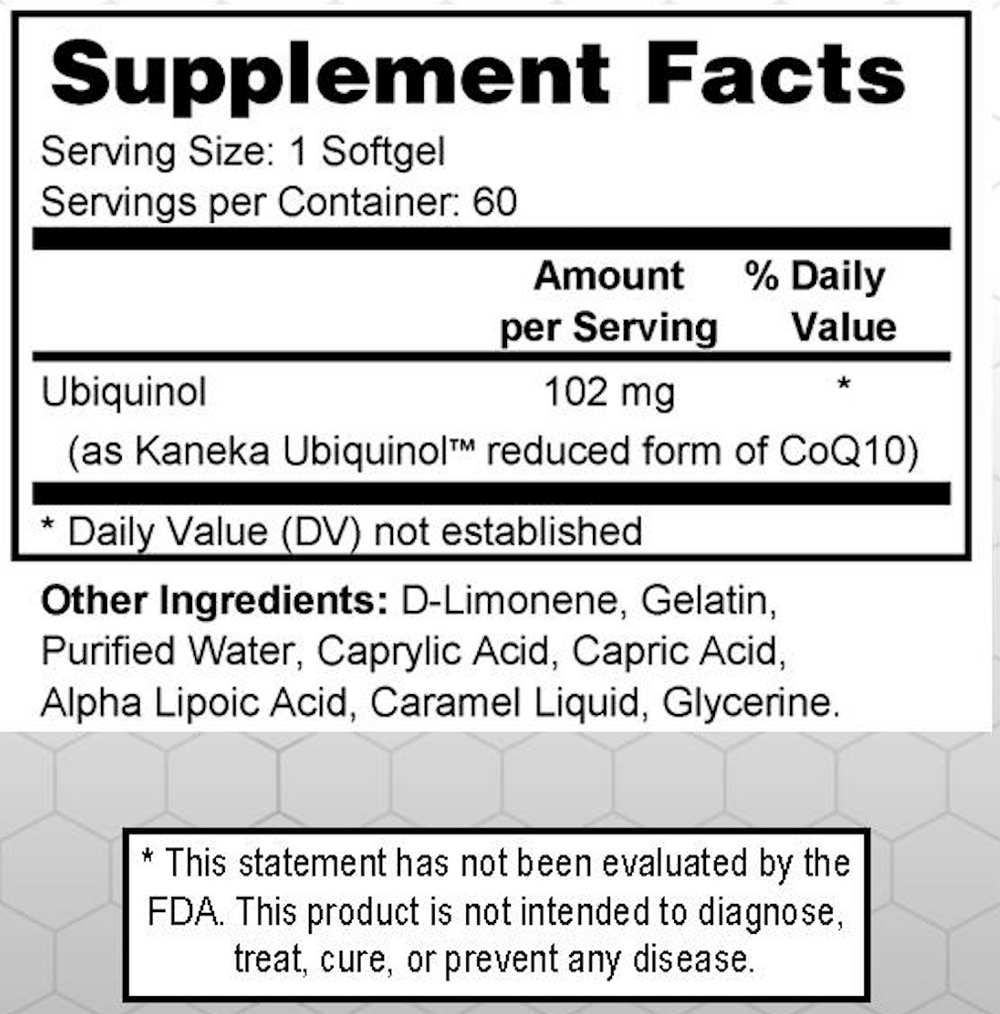
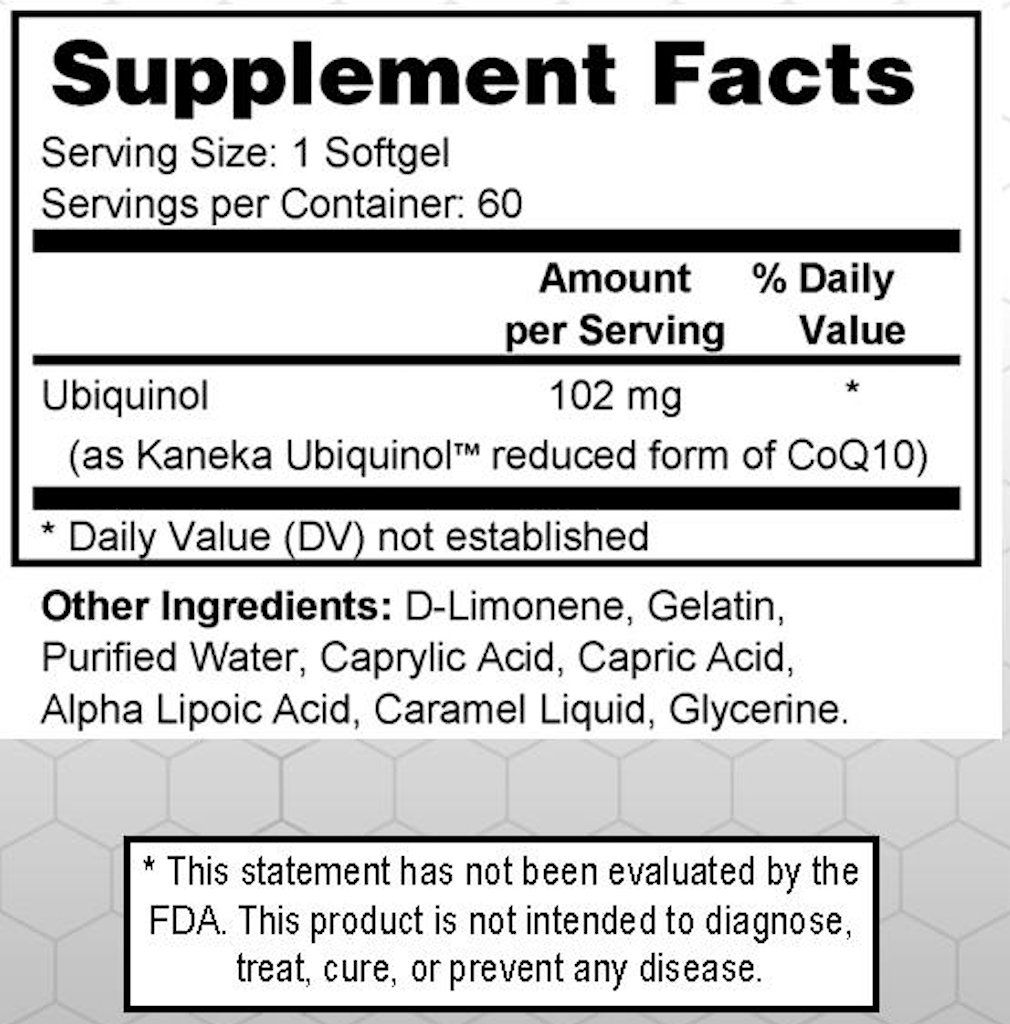
Supplement Facts
| Amount per Serving |
% Daily Value |
|
|---|---|---|
| Ubiquinol | 102 mg | * |
| (as Kaneka Ubiquinol™ reduced form of CoQ10) | ||
* Daily Value (DV) not established
Other Ingredients: D-Limonene, Gelatin, Purified Water, Caprylic Acid, Capric Acid, Alpha Lipoic Acid, Caramel Liquid, Glycerine.
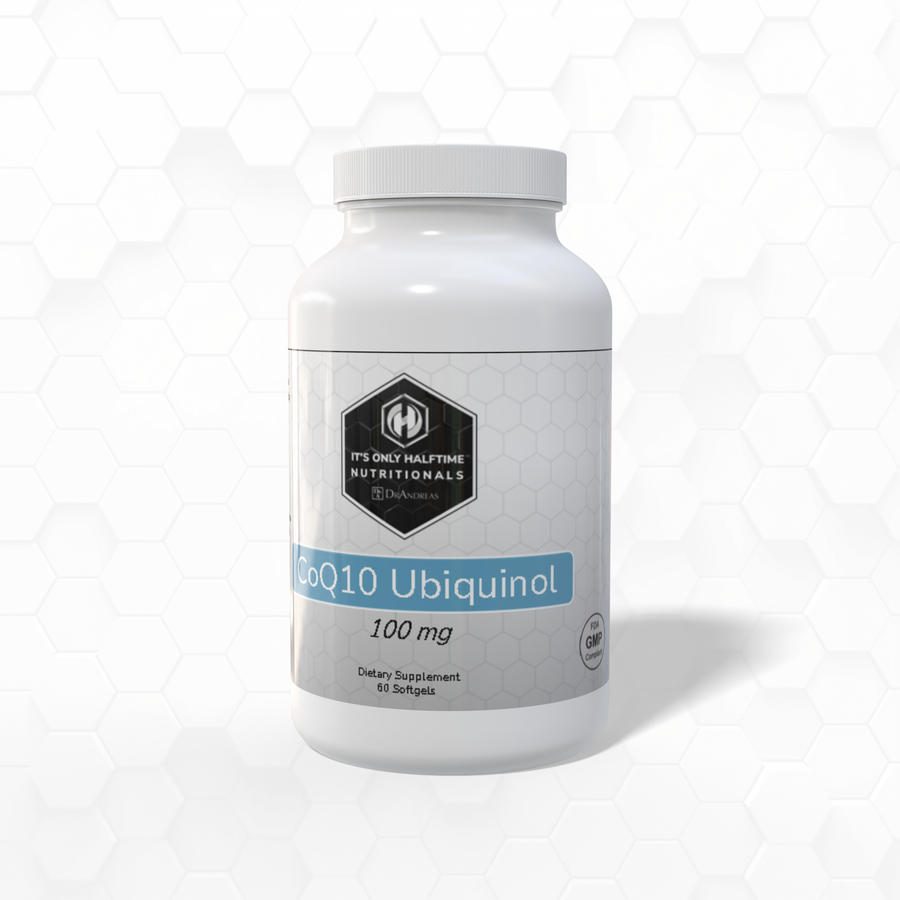
Transcribed from the printed label, which is also shown in the product images above.
A single-ingredient ubiquinol softgel. 102 mg of Kaneka Ubiquinol™ per softgel, suspended in a medium-chain lipid base.
Ubiquinol is the reduced, antioxidant-active form of CoQ10 — not the ubiquinone found in most CoQ10 products.
Supports mitochondrial energy production, cardiovascular health, antioxidant defense, and recovery from physical exertion.
It supplies the finished molecule directly, so no ubiquinone-to-ubiquinol conversion step is required.
Adults who want cellular energy and cardiovascular support and who would rather take the reduced form than the oxidized one.
Endurance and strength athletes, and anyone whose training load or workload is high.
Anyone already taking a CoQ10 product and unsure which form is actually in the bottle.
One softgel with a meal that contains fat. Two softgels daily if you are aiming for the amount used in the published research. Take it earlier in the day rather than at night.
Talk to your physician before starting, particularly if you take prescription medication. See the safety questions below.
We are not going to promise you a timeline. What we can do is tell you what the research describes about blood levels, and what people commonly report, and label clearly which is which.
Blood CoQ10 rises measurably within the first days of consistent supplementation. That is pharmacokinetics, not a feeling. Most people notice nothing at all in this window, and that is normal. Take it with food, every day, and don't grade it yet.
Plasma ubiquinol continues climbing toward a steady state across several weeks of daily use rather than jumping there. If you are going to notice anything — and some people don't — this is generally the window where training energy and recovery are the first places it shows up.
By now you have a real trial. If you have been taking one softgel and felt nothing, the next honest move is two a day rather than concluding ubiquinol doesn't work for you — one softgel is below what most of the research used. If two a day for another six weeks still does nothing, stop paying for it.
Take this to any shelf, ours included, and check these six things. Most CoQ10 products fail at least three of them.
| Check this | Typical off-the-shelf CoQ10 | IOH CoQ10 Ubiquinol |
|---|---|---|
| Which form | Says "CoQ10" or "Coenzyme Q10" — usually ubiquinone, the oxidized form, often unstated | Ubiquinol, the reduced form, named on the Supplement Facts panel |
| Ingredient identity | Unnamed CoQ10 of unstated origin | Kaneka Ubiquinol™, yeast-fermented, bioidentical, manufactured in the United States |
| Delivery format | Dry powder pressed into a tablet or filled into a two-piece capsule | Softgel with the ubiquinol suspended in a caprylic and capric acid lipid base |
| Oxidation control | Clear or untreated shell, no reducing agent disclosed in the fill | Opaque colored shell plus alpha lipoic acid in the fill to help hold the reduced state |
| Declared amount | Rounded to a marketing number; blends used to obscure the real amount | 102 mg declared exactly, one active, no proprietary blend |
| Dose honesty | Implies one capsule equals the studied dose | We publish where 102 mg sits against the amounts used in the research, and tell you when to take two |
We only make quality claims we can back for the specific product in your hand. Here is what applies to this one.
The ubiquinol is Kaneka Ubiquinol™, a branded, identity-verified ingredient produced by yeast fermentation and supplied with the manufacturer's own specification documentation.
Manufactured in a United States facility that is registered with the FDA and operates to current Good Manufacturing Practice standards. Registered is the accurate word. The FDA registers facilities; it does not approve them.
Testing is performed at multiple stages of production, and IOH formulas are produced to meet or exceed cGMP quality requirements.
What you will not find on this page: a batch-specific certificate of analysis claim or a third-party seal for this SKU. If we publish a lot-specific COA for this product, it will appear in the product images and this section will be updated to say so. Until then we are not going to imply one exists.

Dr. Andreas Boettcher. Photo shown for context only. It is not a claim about this product.
"I've spent 33 years watching people chase energy with stimulants and wonder why they still feel flat at four in the afternoon. Caffeine borrows energy. Mitochondria make it. Ubiquinol is one of the few things I take specifically for the machinery rather than the sensation — and I take two."

Dr. Andreas Boettcher, B.S., D.C., C.F.M.P.
Founder, It's Only Halftime
Ironman Triathlete / Master's Men's Physique Competitor / Medication-Free at 56 / 33 Years of Clinical Practice
A stack should have a mechanism behind it, not just two products in the same cart. Here are three where the biochemistry actually connects.
This is the textbook pairing. When vitamin E neutralizes a lipid radical in a cell membrane, it becomes a tocopheroxyl radical itself and has to be regenerated. Ubiquinol is one of the molecules that does that regenerating. Running them together supports the same membrane-level antioxidant network from two directions instead of one.
View E Essentials PlusTwo reasons. First, practical: CoQ10 is fat-soluble and absorbs better with dietary fat present, so taking both with the same meal helps. Second, mechanistic: EPA and DHA get incorporated into cell membranes as polyunsaturated fats, which are exactly the lipids most vulnerable to oxidation — and ubiquinol is a membrane-resident antioxidant. You are supplying the fats and the protection for them together.
View Omega 3 TSHeart tissue carries one of the highest mitochondrial densities in the body, which is why cardiac muscle is CoQ10-hungry in the first place. Pairing ubiquinol's energy-and-antioxidant role with a formula built around circulatory and endurance support covers both sides of the same system: the tissue's fuel supply and the vessels delivering it.
View Cardiac HealthI take two of these a day, with breakfast, and I have for years. I put the honest dose math on this page because I'd rather sell you fewer bottles than have you take one softgel a day for six months and decide ubiquinol was a waste of money.
Stay Strong,
Dr. Andreas
Dr. Andreas Boettcher, B.S., D.C., C.F.M.P.
They are the same molecule in two different oxidation states. Ubiquinone is oxidized. Ubiquinol is reduced — it is carrying two extra electrons, which is what makes it the antioxidant-active state. Your body interconverts them continuously as CoQ10 does its job in the electron transport chain, and in healthy adults the majority of CoQ10 measured in circulation is in the ubiquinol state.
Most CoQ10 products on the shelf contain ubiquinone. Supplying ubiquinol means the reduction step has already been done before the molecule reaches you.
One softgel, 102 mg, is a daily maintenance amount. Two softgels, 204 mg, lands inside the range most of the published human research on this ingredient has used, which is generally 200 to 300 mg per day.
If you are taking it as general daily support, one is a reasonable place to start. If you bought it because of something specific you read about ubiquinol in the research, take two. Either way, take it with a meal that contains fat and talk to your own physician about what makes sense for you.
Have this conversation with the physician or pharmacist who manages your prescriptions before you start. There are several drug classes where CoQ10 interactions are documented and where the decision is not ours to make.
Warfarin and other vitamin K antagonist anticoagulants: CoQ10 is structurally similar to vitamin K and has been reported to reduce anticoagulant effect in some patients. If you are on warfarin, do not start this without your prescriber's involvement and INR monitoring.
Blood pressure medication: CoQ10 has been studied for effects on blood pressure, so an additive effect alongside antihypertensive therapy is possible. Your prescriber should know you are taking it.
Diabetes medication and insulin: blood glucose effects have been reported. If you monitor glucose, keep monitoring while you start.
Chemotherapy and radiation: some oncology protocols ask patients to avoid supplemental antioxidants during active treatment. That is a conversation for your oncologist, not for a product page.
Statins: statin therapy and CoQ10 status have a well-described relationship in the literature. That is a discussion to have with the physician who prescribed the statin, and nothing on this page is a reason to change how you take a prescribed medication.
Take it earlier in the day, with food. Some people find CoQ10 energizing, and taking it in the evening can interfere with sleep for those individuals. If you are taking two a day, breakfast and lunch works better than breakfast and dinner.
The "with food" part is not optional advice. CoQ10 is fat-soluble. It absorbs meaningfully better when there is dietary fat in the meal.
No. The softgel shell is gelatin-based, so this product is not suitable for vegetarians or vegans. The ubiquinol itself is produced by yeast fermentation, but the capsule it is delivered in is not plant-derived.
Because 102 mg is what the fill delivers. Rounding a declared amount down to a tidier number would misstate the label, and rounding up would be worse. We publish the number the formula actually produces.
That is not what the eightfold figure measured. The commonly cited number comes from work showing that 200 mg of Kaneka Ubiquinol™ taken daily for at least a month raised subjects' blood ubiquinol levels roughly eight times above their own starting levels. That is a before-and-after comparison at 200 mg, not a head-to-head absorption ratio against ubiquinone.
Ubiquinol is generally described in the literature as the better-absorbed form, and we think that is a fair statement. Putting a specific multiplier on the front of a 102 mg bottle is not, so we don't.
It is there as a formulation antioxidant, to help keep the ubiquinol in its reduced state on the shelf. Ubiquinol is oxidation-sensitive by design, so protecting it inside the capsule matters.
Its amount is not declared on the panel and it is not there as a therapeutic dose of ALA. Do not count this product toward an alpha lipoic acid intake goal.
Sixty softgels. At one a day, sixty days. At two a day, thirty days. We would rather state both numbers than quietly print the more flattering one.
Every cell you have runs on machinery that needs CoQ10 to work, and that machinery does not get more efficient with age. You can buy the oxidized form and ask your body to do the conversion, or you can supply the reduced form directly and skip the step.
102 mg of Kaneka Ubiquinol™ per softgel. One active ingredient. A lipid delivery system that respects the fact that this molecule is fat-soluble. And a page that told you exactly where the dose sits against the research, before you spent a dollar.
Take it with breakfast. Give it ninety days. Judge it honestly.
Kaneka Ubiquinol™ is a trademark of Kaneka Corporation. All other trademarks are the property of their respective owners.
Manufactured in the United States in a facility that is FDA-registered and operates to current Good Manufacturing Practice (cGMP) standards. Testing is performed at multiple stages of production. Keep out of reach of children. Store in a cool, dry place away from direct light. Do not use if the safety seal is broken.
Consult your physician before use, particularly if you are pregnant or nursing, have a diagnosed medical condition, or take prescription medication — including anticoagulants, blood pressure medication, or diabetes medication. This product contains gelatin and is not suitable for vegetarians or vegans.
These statements have not been evaluated by the Food and Drug Administration. This product is not intended to diagnose, treat, cure, or prevent any disease.
Tastes great! Great energy boost!
Great supplement to support my body. No GI side effects
I feel the boost it gives me. No weird stimulant effect, just more energy.
Easy on the gut with no weird taste or GI upset.
No weird or fishy taste or GI upset. I take several a day and feel great compared to other omega 3 supplements I have tried.
I take it daily and am glad to have a supplement to help with my cholesterol. No GI upset.
Great way to get needed minerals. No weird taste and no GI upset.
No weird taste and no gastric upset. Best MVI I have used.
Tastes great and it mixes up really well even with hot coffee.
I’ve tried many different omega 3/fish oil supplements and IOH’s has me at my best.
Based on Dr A’s coaching and advice, IOH creatine is a supplement must!
I've been consuming chocolate whey powder for a long time. I don't make particularly tasty protein drinks. However, I do with this!
If you are looking for high purity products with actual clinical doses and a product line that doesn't need a colorful, cartoon-like label to grab your attention, then IOH products are what you should be buying.
I tend to workout early AM, and used to pound a diet soda as my pre workout. I switched to this and have found it gives a much stronger and sustained energy boost without the jitters other caffeinated options have given me before.
I've tried many different pre-workout drinks over my years of lifting and for the most part have not been happy with them, loaded with toxic ingredients, jitters, the crash that comes after, etc.
I was introduced to IOH pre-workout from a friend and decided to give it a try. Prior to ordering an analyzed the ingredients and was impressed with the makeup of the product. The fact that there are no binders, fillers, artificial sweeteners and other common ingredients that are a far cry from healthy was encouraging.
After taking the supplement, I can confidently say it's a winner. Great clean energy, that is sustainable with no crash, no jitters or side effects from harsh stimulants. The energy and the increased time to fatigue, allowing me to push more reps and the pump you get was excellent.
I've added this to my routine and would encourage anyone looking for that clean energy performance added to their workouts, to give it a try.
Great job IOH team!