Whey Protein - French Vanilla


Whey is not one thing. It is a family of proteins, and the most biologically interesting members of that family are the fragile ones. Chase the highest possible grams per scoop and you have to run the whey through processing harsh enough to strip those fractions out. We built this one the other way around: grass-fed dairy, gentle processing, the fractions named on the panel by percentage, and a finished-product certificate of analysis you can read below instead of taking on faith.
Most protein pages ask you to trust an adjective. This one hands you the finished-product certificate of analysis, control number 2025-26271, summarized in full further down the page.
Arsenic, cadmium, lead, and mercury each returned below 0.025 parts per million by ICP-MS — at or under the method's reporting threshold. That is the single most common question about any powder and it now has a printed answer.
Total plate count 200 cfu per gram against a limit of 20,000. Yeast and mold under 100 against a limit of 2,000. Salmonella, Staphylococcus aureus, and E. coli all absent.
Protein assayed at 19 grams. Whey protein blend at 21 grams of the 24 gram scoop. Every nutrient row on the panel was tested and conformed, with phosphorus, magnesium, and potassium all coming in above their label values.
Printed on the front of the label, which is where a sourcing claim has to live to mean anything. Manufactured in a United States FDA-registered, cGMP-compliant facility under 21 CFR Part 111.
Two things this card does not claim. A certificate of analysis is lot-specific, so the results below belong to the lot they were run on rather than to every tub we will ever make. And this is finished-product testing performed for the manufacturer under federal supplement regulation, not an independent certification program such as NSF or Informed Sport. Both statements are true and both are worth more to you than a vague promise of purity.
A concentrate-led grass-fed whey protein in French vanilla. 19 grams of complete protein in a 24 gram scoop at 90 calories, with 21 of those 24 grams being whey protein itself. Processed gently enough that the native bioactive whey fractions survive into the scoop instead of being discarded as the cost of chasing a bigger number.
Supplies all nine essential amino acids in a profile that sits at the top of every accepted protein quality scale, delivers 4.75 grams of branched-chain amino acids to support muscle protein synthesis and the maintenance of lean mass, and carries the intact whey fractions that support gut and immune function at the mucosal surface.
Anyone training hard. Anyone past 40 who has figured out that lean muscle is not vanity, it is infrastructure. Anyone whose protein intake collapses before lunch. And anyone who has read the back of a big-box tub and did not like what they found. Not for anyone with a milk allergy.
Adults add 1 level scoop in 8 ounces of any liquid and mix well. Post-training, or as the protein anchor of a breakfast that would otherwise be all carbohydrate. Two scoops when you want a full 35 to 40 gram protein feeding.

Dr. Andreas Boettcher, B.S., D.C., C.F.M.P. — Ironman triathlete, medication-free at 56.
I am not an executive who sits on a board, signs off on a label, and goes home to a life that looks nothing like the one being sold to you. I race Ironman. I step on a natural Master's Men's Physique stage. I am 56 years old and medication-free, and I have spent 33 years in practice watching what happens to people who treat their muscle as optional.
Here is what changed how I practice. Skeletal muscle is not just what moves you. It is the largest site of glucose disposal in the body, the body's only meaningful reserve of amino acids to draw on under stress or illness, and an endocrine organ that signals to nearly every system you own. Strength and lean mass track with healthspan more reliably than almost anything else we can measure in a clinic. That is why muscle is fairly described as the organ of longevity, and why protein stops being a gym topic somewhere around 40 and becomes a medical one.
The trouble is that the deck is stacked against you as you age. Adults lose meaningful muscle mass every decade after 30 and the rate accelerates later. Older muscle also becomes less responsive to the same amount of protein, which researchers call anabolic resistance. You need more protein to get the same signal at 56 than you needed at 26, at precisely the age when most people are eating less of it.
I do not take this because we formulated it. We formulated it because I was going to be taking something every day for the rest of my life, and nothing on the shelf was good enough to be that thing.
The protein RDA of 0.8 grams per kilogram of body weight was set to prevent deficiency in the average healthy adult. It was never designed to optimize lean mass. Published guidelines for older adults commonly recommend 1.0 to 1.2 grams per kilogram or higher, and more for anyone training seriously.
Most people load nearly all their protein into dinner and coast through breakfast on carbohydrate. Muscle responds to per-meal protein dose, not to the daily column in an app. Anchoring the first meal of the day is usually the single largest change available to you.
I would rather you eat whole food. But the breakfast you skip contributes nothing, and 19 grams of complete protein in 8 ounces of liquid takes 30 seconds. Consistency over years is what protects lean mass, and the easiest option is the one that survives a hard week.
Walk the supplement aisle and read ingredient panels instead of front labels. The pattern is consistent, and once you see it you cannot unsee it.
The industry standard
The IOH standard
Standard protein testing does not count intact protein. It measures nitrogen and multiplies. Anything nitrogen-containing reads as protein, whether or not your body can build muscle with it.
Glycine, taurine, creatine, and free amino acids cost a fraction of what whey costs and carry plenty of nitrogen. Add a few grams and the assay reports a bigger protein number.
The front of the tub is not lying about the test result. It is lying about what you get. The amino acids that actually drive muscle protein synthesis were never the ones added.
How to check any protein powder in ten seconds: read the ingredient list, not the front panel. If you see free glycine, taurine, creatine, or individual amino acids listed alongside a headline protein number, ask why they are there. On this label there are two protein sources, whey concentrate and whey isolate, and not a single free amino acid among them — and the certificate of analysis assays the whey blend itself at 21 grams, separately from the 19 gram protein figure.
All nine essential amino acids in a profile that scores 1.0 on PDCAAS, the ceiling of the scale still used for protein claims on United States labels. On DIAAS, the newer method the FAO recommends because it is not capped at 1.0, whey protein concentrate as a raw material class scores 1.09 — above chicken breast, ahead of every plant protein measured.
Immunoglobulin G, alpha-lactalbumin, glycomacropeptide, and proteose peptone 5 are the fractions that make whey more than an amino acid delivery system. They are also the first casualties of aggressive processing. Here they are printed on the panel with approximate percentages, which is a claim we can be held to.
Those native fractions do their work at the gut lining, the mucosal surface where the majority of your immune tissue lives. This is the part of whey no free-form amino acid blend can reproduce, because amino acids alone are not proteins.
4.75 grams of branched-chain amino acids per serving at 25 percent of protein content, leucine included — the signal that tells muscle to start building. Whey carries one of the highest leucine densities of any food protein and it digests fast, which is exactly what you want after training and at the meal that anchors your day.
There is a well-funded corner of this industry built on convincing you that whey protein is metabolic dead weight and that a tablet of free-form amino acids replaces it. Some of what they say is true. Most of the headline numbers are not. Here is the honest version, including where the other side has a point.
Individual essential amino acids in free form, requiring no digestion. Appears in the bloodstream fast and almost completely.
Very low calorie, very fast, useful when digestion is compromised, when calories are severely restricted, or when a clinician is working around a protein-restricted diet. This is a real tool and I am not going to pretend otherwise.
Deliver a single bioactive protein fraction. No immunoglobulin G, no glycomacropeptide, no alpha-lactalbumin. It also excludes cysteine and glutamic acid, because neither is classified as essential — which is a problem, since cysteine is the rate-limiting substrate for your body's own glutathione production and the glutamine family is the preferred fuel of the cells lining your gut. This label discloses glutamic acid at roughly 19 percent of the concentrate protein, about 3.5 grams a serving.
The published research showing the biggest anabolic response from free-form amino acids typically adds them to whey. It does not replace whey with them.
Whey pushed through ion-exchange resins and pH swings to maximize protein percentage by weight and strip nearly everything else.
The highest grams per scoop, the lowest lactose and fat, and the cheapest cost per gram of protein at scale. If the only number that matters to you is grams, this wins the spreadsheet.
Look at what happens to the fraction profile. On this label the isolate carries roughly 2 percent immunoglobulin G and 2 percent glycomacropeptide, while the concentrate carries roughly 3 percent immunoglobulin G and 15 percent glycomacropeptide. Same milk. Different processing. The isolate's higher protein percentage is bought by removing the fractions.
Ion exchange does not simply concentrate whey, it changes which whey proteins survive — skewing the profile toward beta-lactoglobulin and away from the fractions that mirror human milk.
A concentrate-led formula with a smaller isolate addition, from grass-fed dairy, handled gently enough to keep the native fractions. 19 grams of complete protein in a 24 gram scoop at 90 calories, with 2 grams of naturally occurring milk sugar and nothing added.
Top-of-scale amino acid quality plus the bioactive fractions, in one scoop, as food rather than as a chemistry set. Complete protein, satiety, gut and immune support, and recovery from the same serving — with the fraction percentages printed where you can check them and the lot assayed where you can read it.
Fewer grams of protein per scoop than a stripped isolate, and a small amount of naturally occurring lactose. If you have a milk allergy this is the wrong product for you, and no amount of copywriting changes that.
This is not the cheapest protein per gram on the market. It was never trying to be. It is the one in my own kitchen, and I am the customer we designed it for.
That figure comes from a proprietary net nitrogen utilization model developed by the same person who developed a free-form amino acid tablet. It is not a method used by the FAO, the World Health Organization, or any regulator, and it is not how protein quality is measured anywhere in the peer-reviewed literature. It was built on a calculation that happened to rank its author's own product first.
The two methods actually in use tell a different story. On PDCAAS, the score still required for protein claims on United States labels, whey scores 1.0 — the top of a scale capped at 1.0. On DIAAS, the newer FAO-recommended method that measures absorption at the end of the small intestine and is not capped, whey protein concentrate scores 1.09 as a raw material class, ahead of chicken breast and far ahead of soy, pea, and rice.
There is a detail on this panel worth pointing out here. Protein is listed at 38 percent Daily Value. Under FDA rules a percent Daily Value for protein has to be corrected for protein quality using PDCAAS, so a 19 gram serving can only claim 38 percent of the 50 gram Daily Value if the protein scores at or near 1.0. A lower-quality protein would have to print a smaller number for the same grams. The regulation itself refuses to treat 19 grams of whey and 19 grams of rice protein as equivalent.
And the amino acids dismissed as waste are not waste. Whey is unusually rich in cysteine, the rate-limiting amino acid for your own glutathione synthesis, and in glutamic acid — disclosed on this label at roughly 19 percent of the concentrate protein, about 3.5 grams a serving — which feeds the glutamine pool that the enterocytes lining your intestine run on. Free-form essential amino acid formulas contain neither, by definition.
Whey does raise insulin. That part is accurate. What gets left out is why, and what it means.
The insulin response to whey is driven by leucine acting directly on the pancreatic beta cell and by the incretin hormones GIP and GLP-1. That is a normal nutrient-handling signal, the same signal that moves amino acids into muscle. It is not a pathological spike, and it arrives with almost no glycemic load attached: this serving carries 2 grams of total carbohydrate, all of it naturally occurring milk sugar, with nothing added.
Here is the part that ends the argument. Leucine is one of the most insulinotropic amino acids there is. A leucine-forward free-form amino acid product provokes the same beta-cell response. You cannot sell leucine as the anabolic trigger and simultaneously sell the insulin response to leucine as a defect.
Worth knowing as well: this insulin and incretin effect is precisely why whey has been studied so heavily as a protein taken before a meal in glycemic research. The property being marketed to you as whey's flaw is the property researchers deliberately study.
Concentrate and isolate describe protein percentage by weight. They do not describe quality, purity, or how gently the material was handled. A concentrate produced with low-heat filtration is a more intact protein than an isolate driven through ion-exchange resins, even though the isolate wins on the percentage.
This label lets you see it directly. The concentrate carries about five times the glycomacropeptide of the isolate and half again the immunoglobulin G, while the isolate carries nearly twice the beta-lactoglobulin. That is not two grades of the same thing. That is two different fraction profiles, and we chose to lead with the one that kept more of them.
Whey is not a single molecule, it is a set of proteins with distinct jobs. The reason we accepted a lower protein-per-scoop number is that these are the ones we refused to lose. Percentages below are the approximate fraction percentages printed on the label. They overlap, because branched-chain amino acids and glutamic acid are amino acids counted inside the protein fractions rather than separate ingredients — so do not try to add them to 100.
The base of the formula and the source of most of the protein on the panel. Concentrate means the material was filtered rather than driven through ion-exchange resins, which preserves the protein population closer to how it exists in milk instead of selecting for whichever fractions survive a harsher process. The label discloses what that buys you: approximately 36 percent beta-lactoglobulin, 10 percent alpha-lactalbumin, 3 percent immunoglobulin G, 15 percent glycomacropeptide, 3 percent proteose peptone 5, 25 percent branched-chain amino acids, and 19 percent glutamic acid. The dairy is grass-fed, non-GMO, and rBGH free.
Nineteen grams is a smaller number than the 24 or 25 grams printed on most tubs, and I am not going to hide from it. But run the real comparison: the certificate of analysis assays 21 grams of whey protein blend inside a 24 gram scoop, which means roughly seven eighths of what you are buying is whey. A 25 gram protein claim inside a 35 gram scoop is a very different ratio, and the difference is filler. If your target is a full 35 to 40 gram feeding, which is where I want most adults over 50 for a single meal, run two scoops or run one scoop alongside real food. Hit your protein number honestly. Do not buy a bigger digit.
A smaller isolate addition, present for protein density and mixability. Its disclosed profile is a useful illustration of what processing does: approximately 69 percent beta-lactoglobulin, 14 percent alpha-lactalbumin, 3 percent bovine serum albumin, 2 percent immunoglobulin G, 2 percent glycomacropeptide, 1 percent proteose peptone 5, 25 percent branched-chain amino acids, and 18 percent glutamic acid. Higher protein percentage, thinner fraction profile. Bovine serum albumin is worth a mention on its own — it is a cysteine-rich protein, and cysteine is the amino acid your body runs short of when it needs to build glutathione.
IgG is the same antibody class your own immune system produces, and it is the active principle behind most of colostrum's reputation. It works at the gut surface, binding microbial and antigenic material in the lumen and supporting the barrier's own defenses before that material interacts with the tissue underneath. It is also structurally fragile: heat and pH extremes denature it readily, which is why it is the first casualty of aggressive processing and why finding it disclosed on a finished protein powder at all is a processing story rather than an ingredient story. At roughly 3 percent of the concentrate protein, a 19 gram serving lands in the neighborhood of half a gram.
A peptide unique to whey and one of the more interesting molecules in the category, and at 15 percent of the concentrate protein it is a substantial presence here rather than a trace. GMP supports satiety signaling through cholecystokinin, the hormone that tells your brain you have eaten. It serves as a prebiotic-like substrate for beneficial gut bacteria. And it has been studied for the way its glycosylated surface interferes with pathogen adhesion at the intestinal wall — a decoy mechanism rather than a chemical one. It is also naturally free of phenylalanine, which is why it has a clinical literature of its own.
Compare the two protein sources on this very label and you can see what processing costs: 15 percent GMP in the concentrate, 2 percent in the isolate. That single pair of numbers is the entire argument for building this formula concentrate-first, and it is why we would not let the protein number be the deciding vote.
The dominant whey protein in human milk, and the highest-tryptophan fraction in bovine whey. Tryptophan is the precursor your body converts to serotonin and then to melatonin, so this fraction supports the pathways behind healthy mood, healthy sleep architecture, and stress resilience under cortisol load. It is also exceptionally well digested and unusually gentle on sensitive systems, which is why infant formula manufacturers pay a premium for it.
This is a supportive nutritional pathway, not a sleep aid. A protein shake is not going to sedate you, and if you have a real sleep problem you need to address the real sleep problem. What alpha-lactalbumin does is make sure the raw material is present.
The most abundant protein in bovine whey and the primary carrier of the branched-chain amino acids and cysteine that make whey what it is. It is a lipocalin, a class of proteins built to bind and transport small hydrophobic molecules such as retinol and fatty acids, and it survives digestion long enough to deliver its amino acid payload rapidly. It is also, in candor, the fraction most often implicated in cow's milk protein allergy. If dairy protein is a documented allergen for you, this is not your product.
A minor whey fraction, disclosed here because it is present rather than because it is a headline. The proteose peptone group includes glycoproteins studied for roles in immune signaling and lipid handling, and the honest state of the literature is that the human data is thin and mostly preliminary. We list it because it is in the material. We are not going to build a benefit claim on it.
The branched-chain amino acids — leucine, isoleucine, and valine — are the fraction of protein most directly tied to the machinery of muscle building. Leucine is the specific signal: it activates the pathway that switches muscle protein synthesis on. Whey carries one of the highest leucine densities of any food protein and it digests quickly, which is why it remains the reference protein in post-exercise research. Both protein sources on this label are disclosed at 25 percent branched-chain content, which is what puts 4.75 grams in a serving.
Run the math with me, because this is where most brands stop talking. Leucine is roughly half of whey's branched-chain content, so 4.75 grams of BCAA works out to somewhere in the range of 2 to 2.4 grams of leucine. Much of the research on maximizing muscle protein synthesis in a single feeding uses 2.5 to 3 grams of leucine, and older adults appear to need the top of that range because of anabolic resistance. So one scoop is a solid protein feeding. Two scoops, or one scoop with a meal, is what I use myself when the goal is specifically to maximize the anabolic signal from that sitting. Anyone telling you a 19 gram scoop maximizes muscle protein synthesis on its own is selling, not calculating.
The amino acid the free-form crowd throws out first, because it is not classified as essential. It is also the direct precursor to the glutamine pool, and glutamine is the preferred fuel of the enterocytes lining your small intestine and a primary substrate for immune cells under load. At roughly 19 percent of protein content, a serving delivers about 3.5 grams. Calling that waste is a marketing decision, not a metabolic one.
Natural vanilla, and that is the whole flavor system. French vanilla is a flavor-profile description — the rounder, softer, custard-leaning end of vanilla rather than the sharp bakery note — and it is worth being precise about what that does and does not mean here. It does not mean egg. There is no egg, no cream, and no dairy fat added for richness in this formula; the body you taste comes from the whey concentrate itself, which is exactly what a concentrate carries that a stripped isolate does not. It also does not mean artificial vanillin. The label states no artificial flavors, and vanilla is the one flavor category where the synthetic version is easiest to spot and hardest to forgive.
Vanilla is the harder flavor to get right, which is why most brands lean on artificial vanillin and sucralose to carry it. Chocolate hides a multitude of sins — cocoa is loud enough to mask the sulfur note that whey can bring and the bitterness that stevia can leave. Vanilla hides nothing. If a naturally sweetened vanilla protein tastes clean, it is because the whey and the sweetener system were both good enough to stand in the open.
Two naturally derived, non-nutritive sweeteners with no glycemic load, used together because the combination covers each one's weak spot — stevia's edge at the back of the palate, monk fruit's flatness on its own. The stevia is a Reb A leaf extract from a branded material selected specifically for the absence of the licorice note that makes most stevia-sweetened protein hard to finish. What is not in it: sucralose, aspartame, acesulfame potassium, polydextrose, sugar alcohols, and any form of added sugar, fructose, glucose, glucose polymer, or maltodextrin. That list is printed on the label, not just in the copy.
Two functional excipients, disclosed because you should know they are there. Soy lecithin at under one percent of the formula is an emulsifier and exists for one reason: instantizing, so this disperses with a spoon instead of clumping at the bottom of a shaker. Silica is an anti-caking and flow agent that keeps a powder with this much protein density from setting up like concrete in a humid kitchen. Neither is nutrition and we are not going to describe them as if they were. Both are present in the small amounts those jobs require.
Supplement Facts
| Amount Per Serving | % Daily Value | |
|---|---|---|
| Calories | 90 | |
| Total Fat | 1 g | 1%* |
| Saturated Fat | 0.5 g | 3%* |
| Cholesterol | 45 mg | 15%* |
| Sodium | 45 mg | 2% |
| Total Carbohydrate | 2 g | 1%* |
| Total Sugars | 2 g | † |
| Protein | 19 g | 38%* |
| Vitamin A | 18 mcg | 2% |
| Calcium | 130 mg | 10% |
| Iron | 0.36 mg | 2% |
| Phosphorus | 25 mg | 2% |
| Magnesium | 17 mg | 4% |
| Potassium | 170 mg | 4% |
* Percent Daily Values are based on a 2,000 calorie diet.
† Daily Value not established.
Ingredients: Whey protein concentrate (yielding approximately 36% beta-lactoglobulin, 10% alpha-lactalbumin, 3% immunoglobulin G, 15% glyco-macropeptides, 3% proteose peptone 5, 25% branched chain amino acids and 19% glutamic acid and soy lecithin), natural vanilla flavor, Stevia (Sweta brand; no licorice aftertaste), silica and luo han guo fruit extract, Whey protein isolate (yielding approximately 69% beta-lactoglobulin, 14% alpha-lactalbumin, 3% bovine serum albumin, 2% immunoglobulin G, 2% glycomacropeptide, 1% proteose peptone 5, 25% branched chain amino acids, and 18% glutamic acid).
Contains No: yeast, wheat, gluten, corn, preservatives, artificial colors or flavors.
Grass Fed. Non-GMO and rBGH free. Contains milk and dairy products, and soy lecithin for easy mixing. Soy lecithin is present at less than 1% of the formula.
Dosage: Adults add 1 level scoop in 8 oz of any liquid and mix well. Safety sealed for your protection. Do not use if the seal is broken. Store in a cool, dry place. Keep out of reach of children.
The printed label is also shown in the product images above. Net weight 340 grams.
Every protein brand says pure. Almost none of them will show you the lot report. This is the finished-product certificate of analysis for IOH Whey Protein, French Vanilla, summarized row for row from the report issued by our contract manufacturer.

| Test | Specification | Result |
|---|---|---|
| Appearance | Cream-colored powder | CONFORMS |
| Odor | Vanilla | CONFORMS |
| Taste | Conforms to standard | CONFORMS |
| Nutrient | Label per 24 g | Result | Method |
|---|---|---|---|
| Protein | 19 g | 19 g | AOAC |
| Whey protein blend concentrate + isolate |
21 g | 21 g | SOP QC-317 |
| Calories | 90 kcal | 90 kcal | Calculation |
| Total fat | 1 g | 1 g | Gravimetric |
| Saturated fat | 0.5 g | 0.5 g | GC-FID |
| Cholesterol | 45 mg | 45 mg | GC-FID |
| Total carbohydrate | 2 g | 2 g | Calculation |
| Total sugars | 2 g | 2 g | HPLC-RI |
| Vitamin A | 18 mcg | 18 mcg | HPLC |
| Sodium | 45 mg | 45 mg | ICP-MS |
| Calcium | 130 mg | 130 mg | ICP-MS |
| Iron | 0.36 mg | 0.36 mg | ICP-MS |
| Phosphorus | 25 mg | 31.10 mg | ICP-MS |
| Magnesium | 17 mg | 19.15 mg | ICP-MS |
| Potassium | 170 mg | 174.48 mg | ICP-MS |
| Element | Reporting | Result | Method |
|---|---|---|---|
| Arsenic | Report only | <0.025 ppm | ICP-MS |
| Cadmium | Report only | <0.025 ppm | ICP-MS |
| Lead | Report only | <0.025 ppm | ICP-MS |
| Mercury | Report only | <0.025 ppm | ICP-MS |
| Test | Limit | Result | Method |
|---|---|---|---|
| Total plate count | Not more than 20,000 cfu/g | 200 cfu/g | AOAC |
| Yeast and mold | Not more than 2,000 cfu/g | <100 cfu/g | AOAC |
| Salmonella species | Absent | ABSENT | USP <2022> |
| Staphylococcus aureus | Absent | ABSENT | AOAC |
| E. coli | Absent | ABSENT | AOAC |
Other ingredients verified on report: natural vanilla flavor, stevia leaf extract (Reb A), silica, luo han guo fruit extract.
Certified in compliance with 21 CFR Part 111.75 for finished product specifications. Product released under an allowance for 10 percent testing variance. Heavy metal results are reported at or below the analytical method's reporting threshold of 0.025 parts per million.
This is an IOH Nutrition summary of the finished-product certificate of analysis issued by our contract manufacturer for control number 2025-26271. It is a restatement for readability, not a substitute for the original document, and it is lot-specific. Request the full signed certificate at any time.
A certificate of analysis applies to the lot it was run on. We publish rather than describe, and we will not extend one lot's results to a lot it did not cover.
Most people do not abandon a protein powder because of the science. They abandon it because it tasted like chalk and stevia and they could not face it a third morning in a row. Vanilla is the honest test of that, because there is no cocoa in the way.
Natural vanilla on the French side of the profile — soft and creamy rather than the bright bakery note. The stevia was chosen specifically for the absence of the licorice back-note that ruins most naturally sweetened protein, paired with luo han guo to fill in the front of the palate. No sucralose or acesulfame potassium edge, and no sugar carrying the flavor.
One level scoop in 8 ounces of any liquid, mixed well. Soy lecithin under one percent and silica are in the formula strictly so it disperses and pours — no clumping, no chalk at the bottom of the glass. Vanilla is also the more useful flavor to keep on the shelf: it disappears into coffee, oats, Greek yogurt, and any fruit smoothie, where chocolate fights the fruit.
You will not feel a shake the way you feel a pre-workout, and any brand promising you will is lying. What protein does shows up in the numbers that matter over months and years: recovery between sessions, lean mass you keep, appetite that stops running your day. Consistency is the active ingredient.
These are the rows that separate a physician-grade protein from a tub engineered for a price point. Nothing here names a brand, because you do not need me to — you need the criteria.
| What to check | Typical off-the-shelf protein | IOH Whey, French Vanilla |
|---|---|---|
| Lot testing you can see | Purity described in adjectives, certificate never published | Finished-product certificate of analysis summarized on this page, control number included |
| Heavy metal results | Rarely disclosed, occasionally disclosed only after a lawsuit | Arsenic, cadmium, lead, mercury each below 0.025 ppm by ICP-MS |
| Fraction disclosure | Whey listed as one line, no indication of what survived processing | Seven fractions named with approximate percentages, for both protein sources |
| Whey as a share of the scoop | Often padded with bulking agents that never appear in the protein number | 21 g of whey protein blend assayed inside a 24 g scoop |
| Processing route | Ion-exchange or high-heat processing selected to maximize protein percentage | Concentrate-led and gently processed to keep the native protein population intact |
| Dairy sourcing | Rarely disclosed | Grass fed, non-GMO, rBGH free, printed on the front of the label |
| Sweetener system | Sucralose, acesulfame potassium, aspartame, or added sugar | Stevia leaf extract and luo han guo only, with no added sugar of any form |
| Bulking agents | Maltodextrin, glucose polymers, or dextrose padding the scoop | None — stated on the label |
| Added free amino acids | Glycine, taurine, or single amino acids that lift a nitrogen-based protein number | None — both protein sources are whey |
| Artificial colors, flavors, preservatives | Common, often all three | None, and no yeast, wheat, gluten, or corn |
| Who formulated it | A contract manufacturer's stock formula with a label on it | A practicing clinician who takes it daily, and his formulation team |

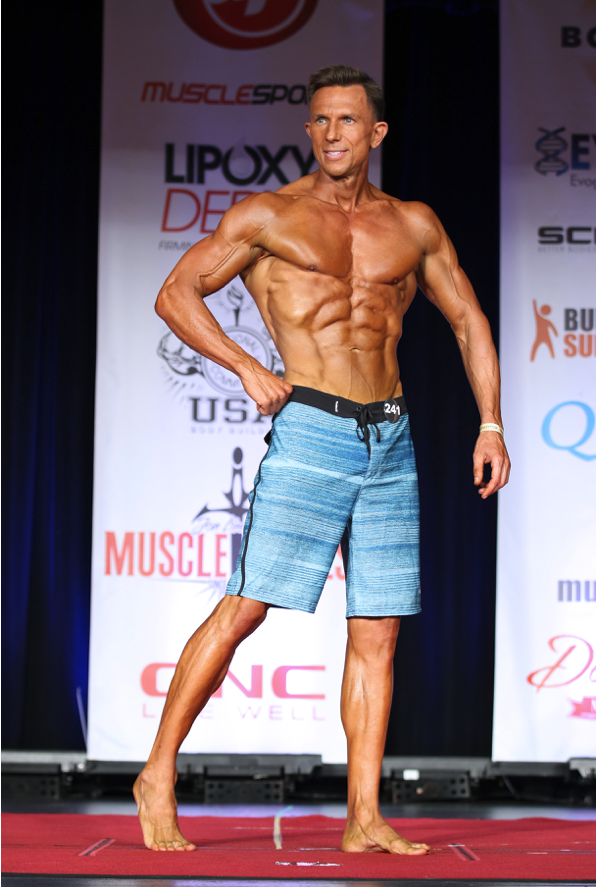
On the natural Master's Men's Physique stage.
Dr. Andreas Boettcher, B.S., D.C., C.F.M.P.
Founder, It's Only Halftime
Ironman Triathlete / Master's Men's Physique Competitor / Medication-Free at 56 / 33 Years of Clinical Practice
Thirty-three years in practice and the same pattern keeps walking through my door. A patient training hard, eating what they believe is a clean diet, and quietly under-protein at every meal before lunch. They buy a tub of protein because someone told them to, and what they bring me is maltodextrin, sucralose, artificial color, and a nitrogen number propped up with cheap amino acids.
When we built this one, the argument in the room was about the protein number. We could have taken it higher. Doing that meant processing the whey hard enough to throw away the immunoglobulins, the glycomacropeptide, the alpha-lactalbumin — the fractions that make whey worth eating instead of merely worth counting. Look at the two protein sources on our own panel: 15 percent glycomacropeptide in the concentrate, 2 percent in the isolate. Same milk, different processing. We were not willing to trade that away for a bigger digit on the front of the tub.
I am 56. I race Ironman, I compete drug-free in Master's Men's Physique, and I take no prescription medication. That is not a credential I am waving at you, it is the reason we built this formula at all. I was going to be drinking something every single day for the rest of my life, and I was not going to drink a compromise. So this is what I reach for, it is what I hand to patients who are done guessing, and every fraction and every test result on this page is printed where you can hold me to it.
Stay strong.
Dr. Andreas Boettcher, B.S., D.C., C.F.M.P.
Protein is the foundation. These are the three I most often run alongside it, and each does a job protein cannot do on its own.
Protein handles what happens after training. This handles the quality of the training itself — clean energy, focus, and time to fatigue without the crash and jitters that come with a stimulant-first formula.
View productYou sweat out minerals you then need for muscle contraction, recovery, and sleep. A serving of this protein assayed at 19 mg of magnesium and 174 mg of potassium, which is a contribution, not a solution. Chelated forms, because form determines whether a mineral crosses the gut wall or simply passes through.
View productThe immunoglobulin and glycomacropeptide fractions in this protein do their work at the gut lining. Gut RestoreX works on the same surface from the other direction, supporting the microbiome and barrier everything else depends on.
View productYes, and they are printed above rather than described. On the certificate of analysis for control number 2025-26271, arsenic, cadmium, lead, and mercury each returned below 0.025 parts per million by ICP-MS, which is at or under the reporting threshold of the method. Testing was performed on the finished product, not only on the incoming raw material.
Two honest notes. Those four elements are reported rather than held to a numeric specification on this report, so the value is in the result, not in a pass mark. And a certificate of analysis covers the lot it was run on. If you want the report for the tub currently in your hand, ask us and we will get it for you.
There is, and the full summary is on this page. It covers identity, every active on the panel, four heavy metals, and a five-test microbiological screen, certified in compliance with 21 CFR Part 111.75.
Here is the distinction I want you to have. This is finished-product testing performed for the manufacturer under federal supplement regulation. It is not an independent certification program such as NSF Certified for Sport or Informed Sport, which are different animals with their own logos and their own fees. Plenty of brands blur that line. I would rather show you the actual report and tell you exactly what it is.
Two answers. First, look at the scoop, not just the grams. The certificate of analysis assays 21 grams of whey protein blend inside a 24 gram scoop, which means roughly seven eighths of what you are paying for is whey. A 25 gram protein claim sitting inside a 35 gram scoop is a very different ratio, and the difference is usually maltodextrin. You are not comparing protein to protein, you are comparing protein to protein plus filler.
Second, pushing the percentage higher means harsher processing, and harsher processing is what destroys the immunoglobulin, glycomacropeptide, and alpha-lactalbumin fractions. If you need 35 to 40 grams in one sitting, take two scoops or take one with food. Hitting a protein target is arithmetic, and arithmetic is easy. Restoring a protein fraction destroyed in processing is not possible at any dose.
The RDA of 0.8 grams per kilogram of body weight is a floor built to prevent deficiency, not a target for keeping lean mass. Published guidelines for older adults commonly land at 1.0 to 1.2 grams per kilogram per day or higher, and people training seriously generally need more than that. Distribution matters as much as the total, because muscle responds to the protein dose in a given meal rather than to a daily sum.
Practically, that means anchoring breakfast. Most people I see are eating almost nothing at the start of the day and then loading protein into dinner, which is the least useful arrangement available. Your specific number depends on your body weight, training load, and kidney function, so set it with your physician rather than with a label.
The 18 percent usable figure you have been shown comes from a proprietary net nitrogen utilization model created by the developer of a free-form amino acid product. It is not the method used by the FAO, the World Health Organization, or United States labeling regulations. Under both standard methods whey sits at the top: 1.0 on PDCAAS, the maximum the scale allows, and 1.09 on DIAAS for whey protein concentrate as a raw material class.
Free-form essential amino acids are a legitimate tool and I use them in specific clinical situations. But they contain no immunoglobulin G, no glycomacropeptide, no alpha-lactalbumin, and by definition no cysteine or glutamic acid, because those are not classified as essential. Cysteine is the rate-limiting amino acid for your own glutathione production, and this label discloses glutamic acid at roughly 19 percent of protein content, about 3.5 grams a serving, feeding the glutamine pool your intestinal lining runs on. Notably, the research showing the strongest anabolic response from free amino acids generally adds them to whey rather than replacing it.
It raises insulin, yes. That response comes from leucine acting on the pancreatic beta cell and from the incretin hormones GIP and GLP-1, and it is the same signal that moves amino acids into muscle tissue. It arrives with almost no glycemic load: 2 grams of total carbohydrate, all naturally occurring milk sugar, nothing added.
The part usually left out of that argument is that leucine is one of the most insulinotropic amino acids in existence, so a leucine-forward amino acid product triggers the same response. And whey's insulin and incretin effect is exactly why it has been studied so extensively as a pre-meal protein in glycemic research. If you are managing a diagnosed metabolic condition, work with your physician on where protein fits in your plan.
It means the dairy this whey came from is sourced from pasture-raised herds, and it is stated on the front of the label alongside non-GMO and rBGH free. Grass-fed dairy generally carries a more favorable fatty acid profile than conventional, though at 1 gram of total fat per serving that is a smaller factor here than it would be in butter or cream.
What I will not do is stretch it. Grass fed is a sourcing and husbandry claim backed by supplier documentation. It is not something a certificate of analysis measures, and you should be skeptical of any brand that implies otherwise.
If you have a milk allergy, no. This is a milk protein, beta-lactoglobulin is the fraction most often implicated in cow's milk protein allergy, and there is no way around that.
Lactose intolerance is a different question and the panel answers it better than I can. Total carbohydrate is 2 grams per serving and total sugars are 2 grams, both confirmed on the certificate of analysis, which means the lactose load per scoop is small — well under the amount most people with mild to moderate intolerance handle without trouble. If you are severely intolerant, start with half a scoop and take it with food.
Because a high-protein powder with no maltodextrin in it will cake and bridge in the container, especially in a humid kitchen, and a scoop you cannot get out of the tub is not much use to you. Silica is an anti-caking and flow agent, used in a small amount, and it is disclosed on the label rather than buried.
I would rather tell you it is in there and why than pretend a powder needs no processing aids at all. The same goes for the soy lecithin at under one percent, which is there so this mixes with a spoon.
A protein powder is food, but timing matters with a few drug classes, mostly because of the calcium and dairy protein rather than anything unusual in this formula. A serving carries 130 mg of calcium.
Thyroid hormone replacement, including levothyroxine, is best taken on an empty stomach and separated from calcium-containing foods and dairy protein, generally by four hours. Tetracycline and fluoroquinolone antibiotics bind calcium, so separate them from a dairy protein shake by at least two hours. Oral bisphosphonates such as alendronate require an empty stomach with plain water. If you have chronic kidney disease or reduced kidney function, total daily protein is something your physician sets, not a supplement label.
None of this makes the product unsafe. It means take it at the right hour. When in doubt, ask the physician who wrote your prescription.
Protein percentage by weight, and nothing else inherently. Concentrate typically runs 70 to 80 percent protein with more of the surrounding milk components still present. Isolate runs above 90 percent because more of everything else has been removed, including fractions worth keeping.
This label lets you see the trade directly. The concentrate is disclosed at roughly 15 percent glycomacropeptide and 3 percent immunoglobulin G; the isolate at 2 percent and 2 percent, with beta-lactoglobulin rising from 36 to 69 percent. Neither word on the front of a tub tells you about processing temperature, filtration method, or fraction integrity, and those are the variables that decide whether you are drinking intact whey protein or a high-percentage powder with the interesting parts stripped out.
The two windows where it earns the most: within an hour or so after training, and at breakfast if your breakfast is otherwise carbohydrate with no protein anchor. Total daily protein matters more than timing, but distribution across the day is what most people are actually getting wrong.
You can bake with it, and the protein and amino acids survive heat perfectly well since your stomach denatures protein anyway. The fragile bioactive fractions are a different story. Immunoglobulin G in particular is heat-sensitive, and gentle processing to protect it is the specific reason we built the formula this way, so baking it into muffins undoes the thing you paid for. Cold or room-temperature liquid keeps the fractions intact.
Every protein powder on the shelf made a choice about what to sacrifice. Most sacrificed the fractions, the sweetener quality, the sourcing, and the honesty of the panel to win on grams and price. We sacrificed the grams. That is the whole trade, stated plainly, and it is the one I would make again in every formulation meeting.
Nineteen grams of complete protein in a 24 gram scoop, with 21 of those grams assayed as whey. Grass-fed dairy. 4.75 grams of branched-chain amino acids. Immunoglobulin G, glycomacropeptide, alpha-lactalbumin, and beta-lactoglobulin disclosed by percentage instead of hidden inside one number. Heavy metals under 0.025 parts per million, printed on the page rather than promised in an adjective.
Muscle is the organ of longevity. Feed it like you intend to keep it.
Tastes great! Great energy boost!
Great supplement to support my body. No GI side effects
I feel the boost it gives me. No weird stimulant effect, just more energy.
Easy on the gut with no weird taste or GI upset.
No weird or fishy taste or GI upset. I take several a day and feel great compared to other omega 3 supplements I have tried.
I take it daily and am glad to have a supplement to help with my cholesterol. No GI upset.
Great way to get needed minerals. No weird taste and no GI upset.
No weird taste and no gastric upset. Best MVI I have used.
Tastes great and it mixes up really well even with hot coffee.
I’ve tried many different omega 3/fish oil supplements and IOH’s has me at my best.
Based on Dr A’s coaching and advice, IOH creatine is a supplement must!
I've been consuming chocolate whey powder for a long time. I don't make particularly tasty protein drinks. However, I do with this!
If you are looking for high purity products with actual clinical doses and a product line that doesn't need a colorful, cartoon-like label to grab your attention, then IOH products are what you should be buying.
I tend to workout early AM, and used to pound a diet soda as my pre workout. I switched to this and have found it gives a much stronger and sustained energy boost without the jitters other caffeinated options have given me before.
I've tried many different pre-workout drinks over my years of lifting and for the most part have not been happy with them, loaded with toxic ingredients, jitters, the crash that comes after, etc.
I was introduced to IOH pre-workout from a friend and decided to give it a try. Prior to ordering an analyzed the ingredients and was impressed with the makeup of the product. The fact that there are no binders, fillers, artificial sweeteners and other common ingredients that are a far cry from healthy was encouraging.
After taking the supplement, I can confidently say it's a winner. Great clean energy, that is sustainable with no crash, no jitters or side effects from harsh stimulants. The energy and the increased time to fatigue, allowing me to push more reps and the pump you get was excellent.
I've added this to my routine and would encourage anyone looking for that clean energy performance added to their workouts, to give it a try.
Great job IOH team!


