Daily Multi - Daily Micronutrient, Mineral & Methylation Support


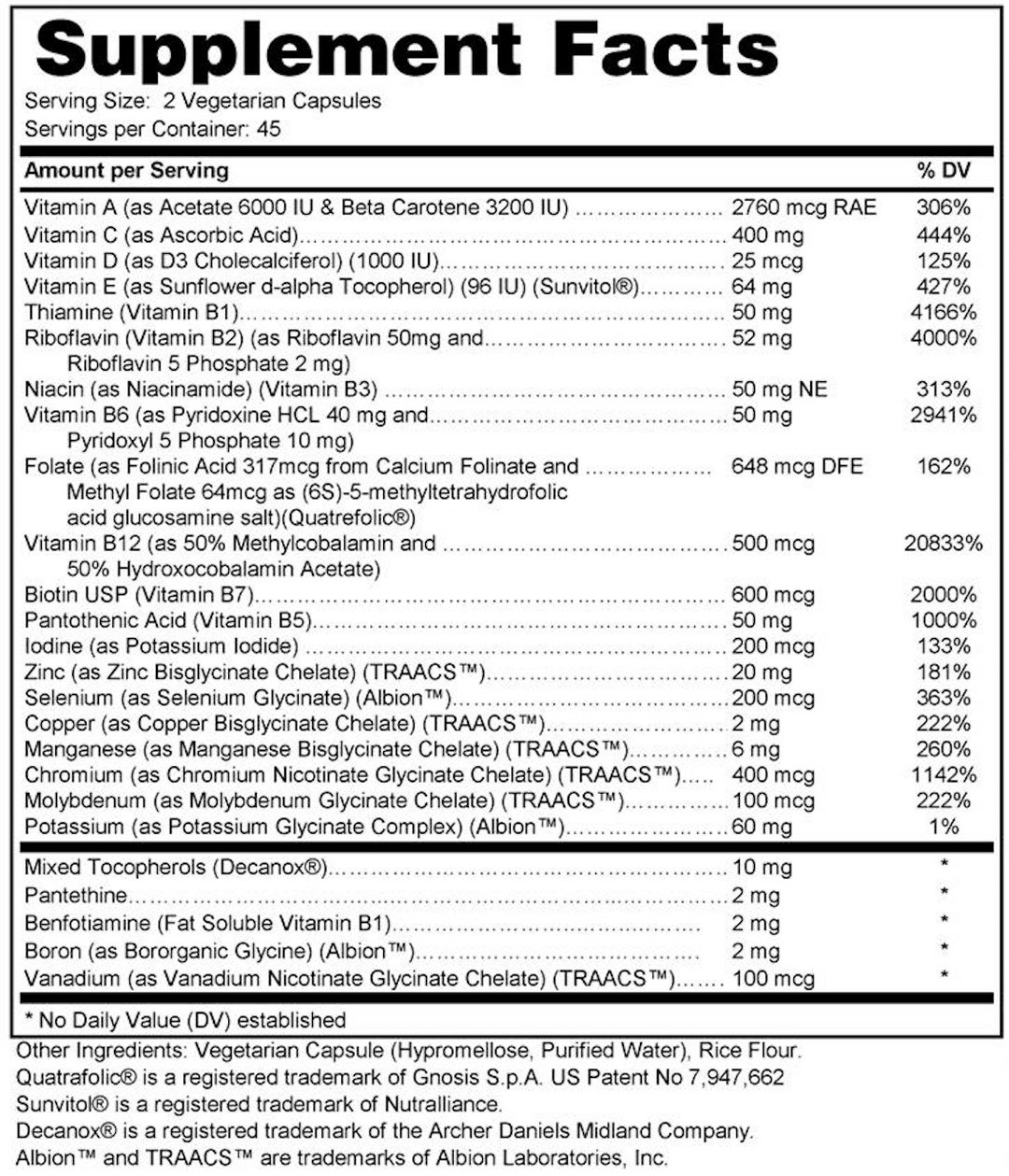


Every vitamin and mineral in this formula is listed individually on the panel with its own amount and its own chemical form. Where a raw material is a branded, patented input, we name the brand and the owner. There is no proprietary blend anywhere on this label, which means you can check our arithmetic instead of taking our word for it.
Two ingredients are the entire other-ingredients line: the vegetarian capsule itself and rice flour. No magnesium stearate, no titanium dioxide, no colorants, no shellac coating. That is unusual in a 25-nutrient capsule and it is deliberate.
A two-capsule daily multivitamin built around the methylation cycle. Activated and mixed-form B vitamins, Albion™ and TRAACS™ amino acid chelated trace minerals, natural-source vitamin E with mixed tocopherols, and a dual-form folate.
Supports the enzyme steps your body uses to recycle homocysteine back into methionine, and supports normal energy metabolism, antioxidant status and trace mineral sufficiency across a full day.
Adults who want a real micronutrient base rather than a gummy. Particularly relevant if you carry an MTHFR variant, if you are over 40, or if you have been taking a big-box multi built on folic acid and cyanocobalamin.
Two vegetarian capsules daily with food. Every amount on the panel is stated per two capsules. Ninety capsules is a 45-day bottle. Take it in the morning; B vitamins are stimulating for some people.
Two labels can both say folate, B12, magnesium and zinc and be entirely different products. What separates them is which molecule the manufacturer actually bought — and that decision is made on a spreadsheet, months before anyone writes the marketing copy. Cheap forms cost pennies. Activated forms and amino acid chelates cost multiples of that. The panel is where the decision shows.
These are the areas the nutrients in this formula are understood to support. Where you start from determines what you notice, and everybody starts somewhere different.
Folate, B12, B6 and riboflavin are the four nutrients that sit directly on the enzymes that recycle homocysteine into methionine, or route it down the transsulfuration arm. All four are here in activated or mixed forms.
Thiamine, riboflavin, niacin, B5 and B6 are cofactors in the reactions that turn what you eat into ATP. This formula carries them at nutritional amounts well above the Daily Value, not at trace levels.
Vitamin C at 400 mg, natural-source vitamin E at 64 mg with mixed tocopherols alongside it, beta carotene, and selenium — the mineral the glutathione peroxidase enzyme family is structurally built around.
Zinc, copper, manganese, selenium, chromium, molybdenum, iodine and boron, all as amino acid chelates, with zinc and copper held at a 10-to-1 ratio so that supplementing one does not quietly deplete the other.
Methylation is not an abstraction. It is a physical loop: methionine becomes SAMe, SAMe hands its methyl group to something that needs one, what is left becomes homocysteine, and homocysteine has to be either recycled back to methionine or converted into cysteine. Four enzymes run that loop. Each one requires a specific vitamin as a cofactor. Here is where this formula sits on each of them.
This is the enzyme everyone has heard of and almost nobody describes accurately. MTHFR does one job: it converts one folate form into another, producing 5-MTHF, the only folate species that can hand a methyl group to homocysteine. The C677T variant produces a version of the enzyme that is thermolabile and holds its riboflavin-derived FAD cofactor less tightly, which is why riboflavin status has been studied as a modifier of how much that variant actually matters in a given person.
That relationship is the reason there is 52 mg of riboflavin on this panel rather than a token 1.3 mg. It is also the single most overlooked line on any methylation product.
This is the reaction at the center of the entire methylation conversation. Homocysteine is not a villain and it is not waste. It is an intermediate that your body would very much like to turn back into methionine, and this enzyme is how that happens. It needs two things at once: a methyl group carried by 5-MTHF, and B12 in its methylcobalamin form sitting in the enzyme's active site to accept and pass it along.
Take away either one and the reaction slows. That is why folate and B12 belong on the same label, in the same serving, in forms that do not require a conversion step first. This formula carries 500 mcg of B12, half as methylcobalamin and half as hydroxocobalamin acetate, a methyl-neutral reservoir form that the body can draw on as needed.
Methionine gets activated into S-adenosylmethionine, which is the universal methyl donor for something on the order of two hundred reactions: silencing and activating genes, building creatine, building phosphatidylcholine for cell membranes, building myelin, and metabolizing catecholamines. Every one of those methyl groups came off the loop described above. Spend the methyl group, and what is left becomes homocysteine again.
One honest note on this station: ATP handling requires magnesium, and there is no magnesium in this formula. That is a deliberate choice we explain in the stack section below, not an oversight.
Recycling homocysteine back to methionine is only one of its two exits. The other is the transsulfuration arm, where cystathionine beta-synthase converts it to cystathionine, and from there to cysteine, which is the rate-limiting raw material for building glutathione. Both of those enzymes run on vitamin B6 in its activated pyridoxal 5-phosphate form.
This is the exit most methylation products ignore entirely, and it is the reason there is 10 mg of P5P on this panel alongside the pyridoxine HCl rather than pyridoxine alone. A loop with only one exit is not a loop, it is a bottleneck.
The mechanisms described here reflect published biochemistry on how these nutrients function in the body. They are not a claim that this product diagnoses, treats, prevents or cures any condition, including any genetic variant. MTHFR genotype is determined by a laboratory test and interpreted by your physician, not by a product page.
All twenty-five nutrients appear on the Supplement Facts panel below with their exact amounts. These are the eight that carry the argument — either because the form was an expensive decision, or because the amount deserves a comment. Every figure is per two-capsule serving.
Most multivitamins carry folic acid, which is not a form that occurs in food. It is the fully oxidized synthetic molecule, and before a cell can use it, it has to be reduced twice by dihydrofolate reductase, an enzyme with limited capacity in human liver. Unconverted folic acid circulating in the blood is a well-documented consequence of that bottleneck.
We used neither. This panel carries calcium folinate, a reduced folate that enters the folate pool downstream of that bottleneck and supports DNA synthesis and repair, plus Quatrefolic®, the glucosamine salt of (6S)-5-methyltetrahydrofolate, which is the exact molecule methionine synthase requires. The 648 mcg figure is dietary folate equivalents, which is the FDA's required conversion. The actual weight of folate in the capsule is 381 mcg.
Of the 381 mcg of folate in this serving, 317 mcg is folinic acid and 64 mcg is methylfolate. Folinic acid is a genuinely good raw material and it does real work in the folate pool. But it is not already methylated. Some portion of it still has to travel through the MTHFR enzyme to become 5-MTHF, which is precisely the step a C677T variant slows down.
So the accurate way to describe this line is that it is a dual-form folate with a methylated component, not a fully methylated folate. If you have a lab-confirmed homozygous variant and a homocysteine number your physician is actively watching, this multivitamin is a good base and it is probably not your whole folate answer. That is a conversation to have with the person reading your labs. We would rather tell you that here than let you find it out later.
Cyanocobalamin is the industry default because it is the most stable and the cheapest. It also arrives with a cyanide group attached, which your body has to remove and excrete before the molecule is useful. The amount is small and not dangerous, but there is no reason to build a premium formula around a molecule that requires a disassembly step.
The split here is deliberate. Methylcobalamin is the coenzyme form methionine synthase actually uses. Hydroxocobalamin is a methyl-neutral storage form with a longer plasma residence, which gives the body a reservoir to draw on rather than a single spike. Running both is a formulation choice, not a marketing one.
The quietest line on the panel and arguably the most interesting one. Riboflavin becomes FAD, and FAD is the cofactor bolted into the MTHFR enzyme. The thermolabile enzyme produced by the C677T variant is understood to lose its FAD more readily than the standard version, and riboflavin status has been studied specifically as a modifier of how much that variant affects homocysteine in a given individual.
Almost no multivitamin on a shelf connects those two facts. Riboflavin is treated as the cheap yellow B vitamin that turns your urine bright, and then folate gets all the attention. We put 52 mg on this panel because if you are going to build a formula around MTHFR, the enzyme's own cofactor is not an afterthought.
B6 is the cofactor for the transsulfuration arm — the exit that routes homocysteine toward cysteine and glutathione rather than back to methionine. It is also required for the synthesis of serotonin, dopamine and GABA from their amino acid precursors, and for heme synthesis.
One correction to something you will read on other pages, including our own older copy: P5P is the activated coenzyme form, not the methylated form. B6 does not have a methylated form. It is a distinction worth getting right on a page that is asking you to care about chemical forms. Including 10 mg as P5P means part of the dose arrives without needing the liver to phosphorylate it first.
A mineral is not absorbed as a mineral. It is absorbed as whatever compound it is attached to, and that compound determines how much of it survives stomach acid, competes with the other minerals in the same capsule, and actually crosses the intestinal wall. Oxides and sulfates are cheap and they are what the discount aisle runs on. Amino acid chelates bond the mineral to glycine or a similar carrier, which changes how it is handled.
Every trace mineral in this formula is an Albion™ or TRAACS™ chelate. Zinc sits at 20 mg with copper at 2 mg, a 10-to-1 ratio held deliberately, because zinc supplementation without copper alongside it is a known way to run copper down over months. Selenium is glycinate at 200 mcg, which is a real nutritional amount rather than a gesture — read the stacking question in the FAQ if you also take a greens powder or eat Brazil nuts.
Synthetic vitamin E is dl-alpha tocopherol, a racemic mixture of eight stereoisomers, only one of which is the form found in food and preferentially bound by the liver's alpha-tocopherol transfer protein. This is the natural d-alpha form, sunflower-derived rather than soy-derived.
The mixed tocopherols matter separately. High-dose alpha tocopherol alone can displace gamma tocopherol from tissue, and gamma has its own distinct antioxidant behavior. Ten milligrams of mixed tocopherols alongside is a modest amount, and we are calling it modest rather than dressing it up. It is there as a companion to the alpha, not as a headline.
Most labels give you one vitamin A number and leave you unable to tell how much of it is preformed retinol versus carotenoid. This one prints both. That transparency exists because the two behave completely differently: preformed retinol is stored and has a defined tolerable upper intake level, while beta carotene is converted on demand and does not carry the same ceiling.
Being specific about it: 6,000 IU of retinyl acetate is 1,800 mcg RAE of preformed vitamin A. The tolerable upper intake level for preformed vitamin A in adults is 3,000 mcg per day, so this serving is roughly sixty percent of that ceiling on its own. That is a perfectly reasonable amount in a daily multivitamin and it is also a number you should know if you take cod liver oil, a separate vitamin A product, or if you are pregnant or planning to be. The pregnancy question is answered specifically below.
Omissions are formulation decisions too, and the honest thing is to explain them rather than let you assume they were accidents.
No vitamin K. This formula contains no vitamin K in any form. That is a factual statement about the panel, not a recommendation about anyone's medication. If you take an anticoagulant, your prescriber manages your vitamin K intake and your INR, and any supplement decision belongs in that conversation, not on this page.
No iron. Iron competes with zinc and copper for the same absorption transporters, and most adult men and postmenopausal women do not need supplemental iron. Adding it to a general multivitamin means giving it to a large number of people who will not benefit. If you are iron deficient, that is a diagnosis made from labs, and it is treated with an iron product at a therapeutic amount, not with a multivitamin.
No magnesium or calcium. These are bulk minerals. A useful magnesium dose is several hundred milligrams, and a useful calcium dose is larger still. Neither fits into two capsules alongside twenty-five other nutrients, and any multivitamin claiming to cover them is carrying a token amount. We would rather leave them out and hand you a powder that carries real doses, which is what the stack section below is for.
Below the potassium line, the panel lists five nutrients with no established Daily Value: mixed tocopherols 10 mg, pantethine 2 mg, benfotiamine 2 mg, boron 2 mg, and vanadium 100 mcg. They are worth a straight accounting, because three of the five are at amounts far below what the research on them uses.
| Nutrient | In this serving | Honest read |
|---|---|---|
| Boron | 2 mg | A legitimate nutritional amount. Typical dietary intake runs roughly 1 to 3 mg per day, so this is a real contribution to bone and hormone-related support. |
| Mixed tocopherols | 10 mg | Modest but purposeful. It is there to keep company with the 64 mg of alpha tocopherol, not to function as a standalone gamma tocopherol dose. |
| Pantethine | 2 mg | Well below the amounts used in human research on pantethine, which run in the hundreds of milligrams. Treat this as a coenzyme-A-pathway companion to the 50 mg of pantothenic acid, not as a pantethine dose. |
| Benfotiamine | 2 mg | Same story. Benfotiamine research uses amounts many times larger. Its value here is as a fat-soluble thiamine derivative alongside the 50 mg of thiamine, which is where the actual B1 in this formula lives. |
| Vanadium | 100 mcg | A trace nutritional amount, and deliberately so. The metabolic research on vanadium used doses thousands of times higher, at levels with real toxicity concerns. A trace amount is the responsible formulation choice, and we are not going to attach that research to this number. |
We could have left this section off the page and nobody would have noticed. Publishing it is the point. If a company will tell you which of its own ingredients are supporting cast, you can generally trust it when it tells you which ones are not.
Read the panel
| Serving Size: 2 Vegetarian Capsules | ||
| Servings Per Container: 45 | ||
| Amount Per Serving | Amount | % DV |
|---|---|---|
| Vitamin A (as Acetate 6000 IU & Beta Carotene 3200 IU) | 2760 mcg RAE | 306% |
| Vitamin C (as Ascorbic Acid) | 400 mg | 444% |
| Vitamin D (as D3 Cholecalciferol) (1000 IU) | 25 mcg | 125% |
| Vitamin E (as Sunflower d-alpha Tocopherol) (96 IU) (Sunvitol®) | 64 mg | 427% |
| Thiamine (Vitamin B1) | 50 mg | 4166% |
| Riboflavin (Vitamin B2) (as Riboflavin 50 mg and Riboflavin 5 Phosphate 2 mg) | 52 mg | 4000% |
| Niacin (as Niacinamide) (Vitamin B3) | 50 mg NE | 313% |
| Vitamin B6 (as Pyridoxine HCL 40 mg and Pyridoxyl 5 Phosphate 10 mg) | 50 mg | 2941% |
| Folate (as Folinic Acid 317 mcg from Calcium Folinate and Methyl Folate 64 mcg as (6S)-5-methyltetrahydrofolic acid glucosamine salt) (Quatrefolic®) | 648 mcg DFE | 162% |
| Vitamin B12 (as 50% Methylcobalamin and 50% Hydroxocobalamin Acetate) | 500 mcg | 20833% |
| Biotin USP (Vitamin B7) | 600 mcg | 2000% |
| Pantothenic Acid (Vitamin B5) | 50 mg | 1000% |
| Iodine (as Potassium Iodide) | 200 mcg | 133% |
| Zinc (as Zinc Bisglycinate Chelate) (TRAACS™) | 20 mg | 181% |
| Selenium (as Selenium Glycinate) (Albion™) | 200 mcg | 363% |
| Copper (as Copper Bisglycinate Chelate) (TRAACS™) | 2 mg | 222% |
| Manganese (as Manganese Bisglycinate Chelate) (TRAACS™) | 6 mg | 260% |
| Chromium (as Chromium Nicotinate Glycinate Chelate) (TRAACS™) | 400 mcg | 1142% |
| Molybdenum (as Molybdenum Glycinate Chelate) (TRAACS™) | 100 mcg | 222% |
| Potassium (as Potassium Glycinate Complex) (Albion™) | 60 mg | 1% |
| Mixed Tocopherols (Decanox®) | 10 mg | * |
| Pantethine | 2 mg | * |
| Benfotiamine (Fat Soluble Vitamin B1) | 2 mg | * |
| Boron (as Bororganic Glycine) (Albion™) | 2 mg | * |
| Vanadium (as Vanadium Nicotinate Glycinate Chelate) (TRAACS™) | 100 mcg | * |
* Daily Value (DV) not established.
Other Ingredients: Vegetarian Capsule (Hypromellose, Purified Water), Rice Flour.
90 vegetarian capsules per bottle. 45 servings.
The full printed label is also shown in the product images at the top of this page
A multivitamin is a nutritional status product. It corrects intake, and intake changes status slowly, on the timeline of red blood cell turnover and tissue stores rather than on the timeline of a stimulant. Anyone promising you a felt difference by Thursday is describing a different category of product.
Two capsules with breakfast, same time daily. Write down three things before you start: your energy at 3pm, how you sleep, and how you recover from a hard day. You will not trust your memory in ten weeks. Expect bright yellow urine from the riboflavin. That is riboflavin, not a sign of anything.
This is where people tend to notice something, and it is rarely dramatic. Usually it shows up in what stopped happening: the mid-afternoon flatline that was routine, the recovery day that used to cost two. One bottle is 45 days, so this window is roughly your first bottle.
Ninety days is a fair trial and it is two bottles. Compare against what you wrote, not what you remember. If your physician tracks homocysteine, B12, ferritin or a vitamin D level, this is a reasonable interval to look again — and a lab number is a far better judge of a multivitamin than a feeling is.
Use these on us first, then take them to the next bottle you pick up anywhere. Most of them can be answered in thirty seconds by turning the bottle around, which is exactly why the answers are worth knowing.
| The question | IOH Daily Multi | Typical off-the-shelf multivitamin |
|---|---|---|
| Which folate form, and how much of each? | Calcium folinate 317 mcg plus Quatrefolic® 5-MTHF 64 mcg, both amounts printed separately | Folic acid, the synthetic oxidized form, listed as a single number |
| Which B12 form? | 50% methylcobalamin, 50% hydroxocobalamin acetate, no cyanide moiety | Cyanocobalamin, the cheapest and most stable form |
| Is any of the B6 activated? | 10 mg as pyridoxal 5-phosphate alongside 40 mg pyridoxine HCl, both printed | Pyridoxine HCl only |
| What form are the trace minerals? | Albion™ and TRAACS™ amino acid chelates across all eight minerals | Oxides, sulfates and carbonates chosen on cost per elemental milligram |
| Natural or synthetic vitamin E? | Sunvitol® sunflower-derived d-alpha tocopherol plus Decanox® mixed tocopherols | dl-alpha tocopherol, the synthetic eight-isomer mixture |
| Can you tell how much vitamin A is preformed retinol? | Yes — 6,000 IU retinyl acetate and 3,200 IU beta carotene printed separately | One combined vitamin A figure with no split disclosed |
| Is the zinc-to-copper ratio managed? | 20 mg zinc to 2 mg copper, a deliberate 10-to-1 | Zinc included, copper often omitted entirely or present in trace |
| What is in the capsule besides the nutrients? | Hypromellose capsule and rice flour. That is the complete list | Magnesium stearate, silica, titanium dioxide, waxes, colorants |
Comparisons describe general patterns in the retail multivitamin category and are not directed at any specific brand or product. Branded ingredient names are the property of their respective owners; see the footer.


Dr. Andreas Boettcher, B.S., D.C., C.F.M.P.
Founder, It's Only Halftime
Ironman Triathlete/Master's Men's Physique Competitor/Medication-Free at 56/33 Years of Clinical Practice
In thirty-three years of practice I have watched people spend real money on exotic single-ingredient products while the foundation underneath them was built out of the cheapest possible raw materials, bought in a supermarket aisle, and taken without a second thought.
I understand why. A multivitamin is boring. It does not have a mechanism you can explain at dinner. It does not do anything you can feel on a Tuesday afternoon. And because of that, it is the one product category where consumers accept forms they would never accept anywhere else. Folic acid instead of folate. Cyanocobalamin instead of methylcobalamin. Zinc oxide instead of a chelate. If a company sold you a protein powder made that carelessly you would notice immediately.
So we built this one around the loop that actually runs the show. Methylation is not a wellness word. It is a set of four enzymes handing methyl groups back and forth, and homocysteine sits right in the middle of it as the intermediate that either gets recycled back into methionine or gets routed off toward glutathione. Every one of those four enzymes needs a specific vitamin, in a specific form, and this formula puts all four of them on one panel: folate in two forms, B12 as methylcobalamin and hydroxocobalamin, B6 with activated P5P, and riboflavin at 52 mg because riboflavin is the MTHFR enzyme's own cofactor and virtually nobody in this industry says so out loud.
I want to be careful about one thing, because the MTHFR conversation online has gotten loud and imprecise. Carrying a variant is not a diagnosis. It is not a life sentence, it does not automatically mean you are symptomatic, and it does not mean every problem you have traces back to it. What it means is that a specific enzyme in your folate pathway may run less efficiently, and that the forms of the nutrients you feed it are worth thinking about. That is a modest, true claim, and I would rather make a modest true claim than an exciting one I have to defend later.
This is what I take. Not a version we made for the catalog while I take something else. Two capsules with breakfast, every day, and it is the last thing I would cut from my own shelf.
Daily Multi is the micronutrient base. These three cover ground it deliberately does not, and each pairing has a specific reason behind it rather than a bundle discount.
This is the intended companion, and it is the reason Daily Multi contains no magnesium or calcium. Those are bulk minerals: a useful magnesium dose is measured in hundreds of milligrams, which is physically impossible to fit into two capsules alongside twenty-five other nutrients. Rather than put a token 25 mg on the panel and let it look impressive, we left them out of the capsule and built a powder that carries real amounts.
Why the pair worksMagnesium is required for the ATP handling at Station 03 of the methylation cycle described above, and it is the most commonly under-consumed mineral in the American diet. The capsule covers the trace minerals and the activated vitamins. The powder covers the bulk minerals. Together they are a complete mineral base, which neither one is alone.
Do the arithmetic before you start both. Both products contain some of the same trace minerals. Add the two panels together and check your combined daily totals for zinc, selenium and boron in particular, and adjust the scoop size if the total is climbing. This is exactly the kind of stacking math nobody does and everybody should.
View 5X Chelated Minerals →This pairing is not the obvious one and it is the one I find most interesting. Creatine synthesis is one of the single largest consumers of methyl groups in the human body. Your liver builds creatine using SAMe as the methyl donor — the same SAMe pool described at Station 03 above, generated by the same loop this multivitamin is built around.
Why the pair worksWhen you supply creatine from the outside, the body does not have to spend as much of its own methyl budget building it. That frees methyl groups for the other two hundred reactions competing for them. It is a genuine biochemical relationship, not a marketing bridge, and it is the reason creatine belongs in a conversation about methylation and not only in a conversation about the gym.
View Pure Creatine →A multivitamin covers vitamins and minerals. It does not cover essential fatty acids, and it cannot — meaningful EPA and DHA intake is measured in grams, not milligrams. That is a different delivery format entirely, and no capsule multivitamin on any shelf solves it.
Why the pair worksThese two together are the closest thing to genuinely complete daily nutritional coverage in the line: water-soluble vitamins and trace minerals from one, long-chain fatty acids for cell membranes from the other. There is also a practical reason to run them at the same meal — the fat in a fish oil softgel improves absorption of the fat-soluble vitamins A, D and E in the multi.
View Omega 3 TS →The way I'd sequence it: start with Daily Multi alone for the first bottle so you know what a corrected micronutrient base does on its own. Add Omega 3 TS second, because it has the widest reach of anything in the line. Add 5X Chelated Minerals third, in the evening, which is when most people prefer magnesium anyway. Adding three things at once teaches you nothing about which one earned its place.
One product to think carefully about: we also make Methylated B, a dedicated B-complex. Running it alongside Daily Multi means taking two products with substantial overlap in the same nutrients, and that is a conversation to have with your physician rather than a default upsell. For most people, one or the other is the right answer, not both.
A twenty-five nutrient formula at these amounts is an active product, and active products interact with things. Vitamin B6 at 50 mg can interfere with levodopa. Folate interacts with methotrexate and with several anticonvulsants. Iodine at 200 mcg matters if you have a thyroid condition. Biotin at 600 mcg can distort common laboratory blood tests. Preformed vitamin A at 1,800 mcg RAE is a real consideration in pregnancy. None of that makes this formula unsafe. It makes it worth reading before you start. If you take prescription medication, are pregnant or nursing, or have a thyroid or kidney condition, talk to your prescribing physician or pharmacist first.
It is a reasonable base, and here is the precise version of why. This formula avoids folic acid entirely, carries a methylated folate component that does not require the MTHFR enzyme, includes methylcobalamin for the enzyme immediately downstream, includes activated P5P for the transsulfuration exit, and carries 52 mg of riboflavin, which is the MTHFR enzyme's own FAD cofactor. Those four decisions are why this product exists.
Now the honest limitation. Of the 381 mcg of folate in a serving, only 64 mcg is methylfolate. The remaining 317 mcg is folinic acid, which is a good reduced folate but still travels through MTHFR to become 5-MTHF. If you have a lab-confirmed homozygous C677T and a homocysteine level your physician is watching, this multivitamin is a solid foundation and it may not be your complete folate strategy. That is a conversation for the person reading your labs.
One more thing worth saying plainly, because the internet has gotten strange about this: carrying an MTHFR variant is common, it is not a disease, and this product does not treat it. Genotype is determined by a laboratory test and interpreted by a physician.
More common than most people expect and less catastrophic than the loudest corners of the internet suggest. Roughly a third of people carry one copy of the C677T variant and somewhere in the range of ten to fifteen percent carry two, with substantial variation by ancestry — prevalence is notably higher in some Hispanic and Mediterranean populations and lower in populations of African descent. A second common variant, A1298C, adds to the picture.
What matters is the distinction between carrying a variant and having a clinical problem. Carrying one copy typically has a modest effect on enzyme activity. Carrying two has a larger one, and even then the practical significance depends heavily on your folate intake, your riboflavin status and your B12 status — which is the entire point of a formula like this one. We have deliberately not used the higher prevalence figures that circulate in supplement marketing, because they tend to blend the two variants and both zygosities together to produce a bigger number.
Yes, and this is the question I most wish more people asked. Biotin at 600 mcg is well above the Daily Value, and high biotin intake is a well-documented interference in immunoassay-based laboratory tests — the technology behind many thyroid panels, cardiac troponin tests, and several hormone assays. It can push results falsely high or falsely low depending on the assay design, which in the case of a troponin test is not a trivial thing.
The practical answer: stop taking this product at least 48 to 72 hours before any scheduled bloodwork, and tell the lab and the ordering physician that you have been taking biotin. This is standard guidance and it applies to every biotin-containing supplement, not just ours. If you end up in an emergency room, tell them about the biotin. Any multivitamin with hair, skin and nail messaging is likely carrying more of it than this one.
Bring the label to your prescriber or pharmacist and ask about these by name.
Levodopa without carbidopa. Vitamin B6 at 50 mg can increase the peripheral breakdown of levodopa and reduce how much reaches the brain. This is a well-established interaction and it is important.
Methotrexate. Methotrexate works by antagonizing folate. Supplemental folate can affect that, in both helpful and unhelpful directions depending on why it was prescribed and at what dose. This decision belongs entirely to your prescriber.
Anticonvulsants, particularly phenytoin, phenobarbital and primidone. Folate and these drugs affect each other's levels in both directions.
Thyroid medication. This formula contains 200 mcg of iodine, and iodine intake can affect thyroid function, particularly in Hashimoto's or Graves' disease. Selenium at 200 mcg is also directly involved in thyroid hormone metabolism.
Anticoagulants and antiplatelet drugs. This formula contains no vitamin K, and vitamin E at 64 mg is worth mentioning to your prescriber. Any supplement decision while you are on an anticoagulant is theirs to make.
Certain antibiotics, including tetracyclines and fluoroquinolones. Zinc and other minerals can bind them in the gut and reduce absorption. Separate the doses by two to four hours.
Blood sugar medication. Chromium is included at 400 mcg and is involved in glucose metabolism, so it is worth a mention if your medication is being actively titrated.
Do not use this as a prenatal, and talk to your OB before taking it at all in pregnancy. It was not formulated as a prenatal and it should not be substituted for one.
The specific reason is the preformed vitamin A. This serving carries 6,000 IU of retinyl acetate, which is 1,800 mcg RAE of preformed vitamin A. High intakes of preformed vitamin A during pregnancy are associated with teratogenic risk, and while this amount sits below the 3,000 mcg tolerable upper intake level on its own, it uses up a substantial portion of that allowance before you count food or any other supplement. Prenatal formulas are built to manage exactly that, and this one is not. There is also no iron here, which most prenatal protocols require.
If you are nursing or trying to conceive, that is still an OB conversation rather than a product page decision.
This is the arithmetic almost nobody does. Selenium here is 200 mcg, which is 363% of the Daily Value. The tolerable upper intake level for adults is 400 mcg per day from all sources. Greens powders and antioxidant blends frequently carry selenium, and Brazil nuts carry a startling amount — a single nut can run 70 to 90 mcg depending on where it was grown. It is genuinely possible to stack past the ceiling across three products without noticing.
Zinc is 20 mg here against an upper intake level of 40 mg for adults, so a separate 30 or 50 mg zinc lozenge on top of this puts you over. Long-term excess zinc depletes copper. Add up every source you take, including food, and if a total is climbing toward its ceiling, talk to your physician about which product to drop. We would rather tell you this plainly than let a good ingredient become a problem through inattention.
Because the amounts on this panel do not fit in one capsule, and we would rather show you real amounts than shrink the formula to fit a more convenient serving size. Twenty-five nutrients at these levels, in chelated and activated forms that are physically bulkier than their cheap counterparts, take up two size-zero vegetarian capsules.
Every figure on the panel is stated per two capsules. Taking one gives you half of everything, which is a legitimate choice if you want to ease in, but it means the panel no longer describes what you are getting. Ninety capsules at two per day is a 45-day bottle.
It is designed as a daily formula and most people take it continuously. Two caveats. First, the selenium, zinc and preformed vitamin A arithmetic above does not go away with time — redo the addition any time you add another supplement to your shelf. Second, if you are taking it long term alongside prescription medication, a periodic review with your physician and a look at the relevant labs is the honest way to know whether it is still earning its place.
The B vitamins in this formula are water soluble and are not stored in any meaningful way, which is why a daily rhythm matters more here than an occasional large dose does.
Take it with food. Two capsules on an empty stomach is the most common reason people report nausea with any multivitamin, and the fat-soluble vitamins A, D and E absorb better with a meal that contains some fat anyway. Morning is generally better than evening — B vitamins at these amounts are mildly stimulating for some people and can interfere with sleep if taken late.
Bright yellow urine within a few hours is riboflavin doing what riboflavin does at 52 mg. It is harmless and it is the most reliable evidence in supplementation that you actually swallowed something.
No, and I would be suspicious of anyone who told you otherwise. Food delivers fiber, protein, phytochemicals, and a matrix of compounds that no capsule reproduces. What a multivitamin does is cover the gap between a genuinely good diet and the specific micronutrient amounts that are hard to hit consistently — particularly if you train hard, travel, are over forty, or have a variant that makes the form of a nutrient matter more than the amount.
It is insurance on the foundation, not a substitute for the foundation. That framing is less exciting than the alternative and it happens to be true.
That is not a criticism. It is how the entire category is designed to work. The bottle says folate and B12 and zinc, the numbers look enormous, and the assumption is that a nutrient is a nutrient. So the decision gets made on price and habit, and the same supermarket bottle sits on the shelf for a decade while you spend real money on things with better stories.
But your body does not absorb a word on a label. It absorbs a molecule. Folic acid and 5-MTHF are not the same molecule. Cyanocobalamin and methylcobalamin are not the same molecule. Zinc oxide and zinc bisglycinate are not the same molecule. Those differences do not show up as a feeling on any particular afternoon — they show up over years, in the enzymes that recycle homocysteine, in the reactions that build your neurotransmitters and your cell membranes, in the quiet background chemistry that decides how you age.
This is the bottle for people who decided that mattered. Twenty-five nutrients, every amount printed, four branded raw materials named with their owners, no proprietary blend, no filler beyond the capsule and rice flour, and a panel we published in full on this page so you could check it before you bought it.
Two capsules. With breakfast. Every day. It is the least glamorous decision on your shelf and it is the one holding everything else up.
Feed the loop · Fix the forms · It's Only Halftime
Tastes great! Great energy boost!
Great supplement to support my body. No GI side effects
I feel the boost it gives me. No weird stimulant effect, just more energy.
Easy on the gut with no weird taste or GI upset.
No weird or fishy taste or GI upset. I take several a day and feel great compared to other omega 3 supplements I have tried.
I take it daily and am glad to have a supplement to help with my cholesterol. No GI upset.
Great way to get needed minerals. No weird taste and no GI upset.
No weird taste and no gastric upset. Best MVI I have used.
Tastes great and it mixes up really well even with hot coffee.
I’ve tried many different omega 3/fish oil supplements and IOH’s has me at my best.
Based on Dr A’s coaching and advice, IOH creatine is a supplement must!
I've been consuming chocolate whey powder for a long time. I don't make particularly tasty protein drinks. However, I do with this!
If you are looking for high purity products with actual clinical doses and a product line that doesn't need a colorful, cartoon-like label to grab your attention, then IOH products are what you should be buying.
I tend to workout early AM, and used to pound a diet soda as my pre workout. I switched to this and have found it gives a much stronger and sustained energy boost without the jitters other caffeinated options have given me before.
I've tried many different pre-workout drinks over my years of lifting and for the most part have not been happy with them, loaded with toxic ingredients, jitters, the crash that comes after, etc.
I was introduced to IOH pre-workout from a friend and decided to give it a try. Prior to ordering an analyzed the ingredients and was impressed with the makeup of the product. The fact that there are no binders, fillers, artificial sweeteners and other common ingredients that are a far cry from healthy was encouraging.
After taking the supplement, I can confidently say it's a winner. Great clean energy, that is sustainable with no crash, no jitters or side effects from harsh stimulants. The energy and the increased time to fatigue, allowing me to push more reps and the pump you get was excellent.
I've added this to my routine and would encourage anyone looking for that clean energy performance added to their workouts, to give it a try.
Great job IOH team!


