E Essentials Plus - Cardiovascular, Cholesterol and Collagen Support


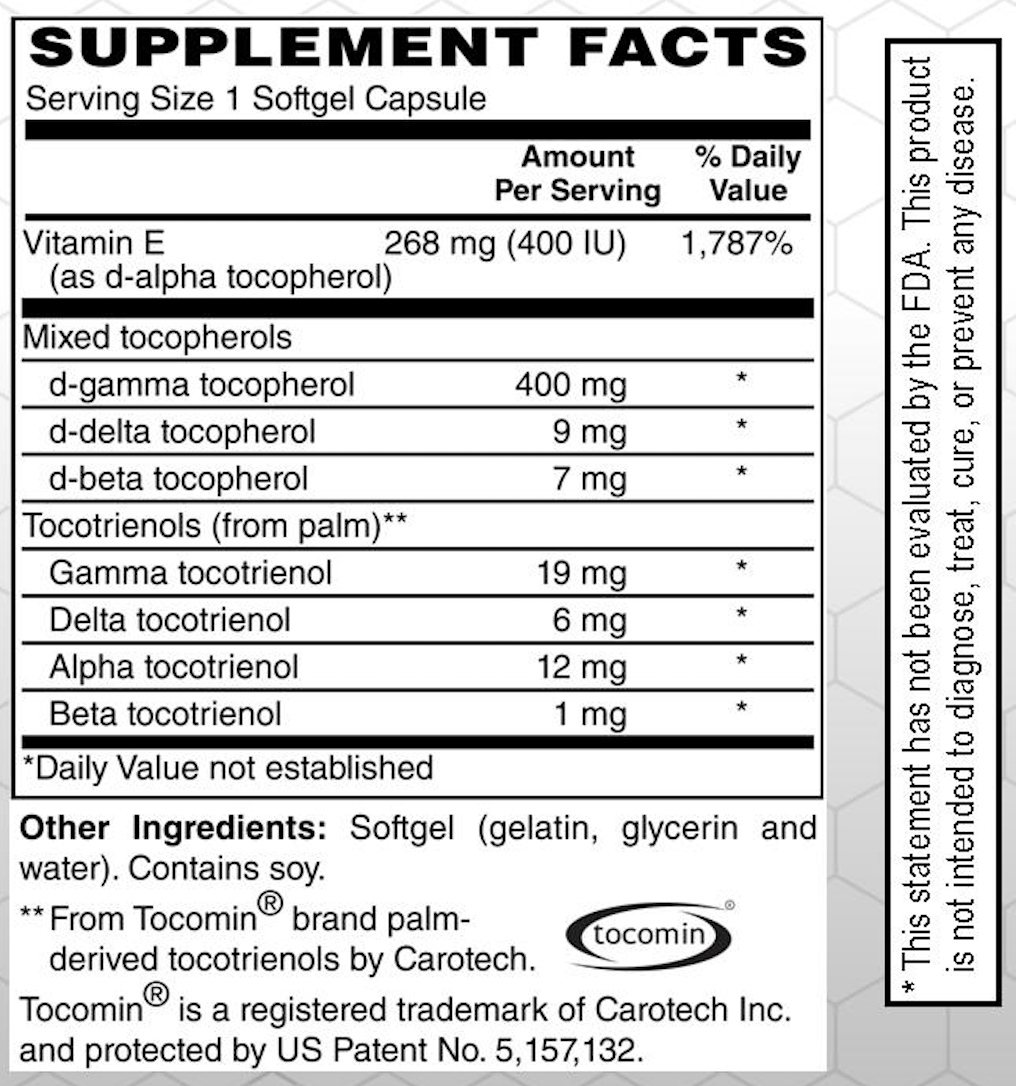


E Essentials Plus delivers all eight naturally occurring forms of vitamin E in a single softgel — led by 400 mg of gamma tocopherol and rounded out with a full-spectrum palm tocotrienol complex from Tocomin®. It is built around the forms that a standard alpha-tocopherol supplement leaves out.
Walk into any pharmacy, pick up the vitamin E, and read the panel. Almost every one of them says the same thing: Vitamin E (as d-alpha tocopheryl acetate). That is one of eight. The label says vitamin E. The bottle contains a fraction of it.
Nature does not package vitamin E that way. Nuts, seeds, olives, palm fruit, and rice bran deliver a mixture — four tocopherols and four tocotrienols, each with a different chromanol ring and a different chemistry. Gamma tocopherol, not alpha, is the most abundant form in the American diet. Tocotrienols are the scarcest and the least represented in supplements, because they are expensive and hard to source.
There is a second wrinkle that matters more than most people realize. High-dose alpha tocopherol does not sit quietly alongside the other forms. It competes with them for the same transfer protein, and human supplementation studies have shown that loading up on alpha alone can depress circulating gamma tocopherol. So the standard high-dose alpha capsule is not just incomplete. It can actively narrow your vitamin E profile while telling you it is broadening it.
We formulated E Essentials Plus to invert that. Gamma tocopherol is the largest single ingredient in the softgel — 400 mg, more than the 268 mg of alpha. Then we added the beta and delta tocopherols, and a full palm tocotrienol complex on top. Eight forms, every one disclosed at its exact milligram amount, no blend, nothing hidden behind a proprietary label.
Vitamin E's established biological role is protecting the fatty portions of the body — cell membranes, mitochondrial membranes, and circulating lipoproteins — from peroxidation. That is not a fringe claim. It is the reason vitamin E was designated essential in the first place.
Gamma and delta tocopherol carry an open position on the chromanol ring that alpha tocopherol does not have. That open site is what allows them to trap electrophilic nitrogen species. It is the single most distinctive thing about this formula, and we built the next section around it.
Cholesterol carried in lipoprotein particles is a lipid, and lipids oxidize. Fat-soluble antioxidants distribute into those particles. Supporting the oxidative stability of what is already circulating is a different proposition than changing how much of it there is, and we are careful about the distinction.
If you have been taking a conventional 400 IU alpha capsule for years, the forms most likely to be under-represented in your tissues are gamma and delta. This formula supplies 400 mg of gamma tocopherol directly, alongside the alpha, rather than asking the alpha to stand in for all eight.
Every form of vitamin E shares the same chromanol head. What separates them is which positions on that ring are capped with a methyl group — and which are left open. An open position is a place where chemistry can happen.
Here is why that matters in a body rather than on a whiteboard. Alpha tocopherol is a superb chain-breaking antioxidant against oxygen radicals. But its ring is fully capped, so when it meets an electrophilic nitrogen species — peroxynitrite, nitrogen dioxide — it has nowhere to put it. Gamma tocopherol does. The open C-5 carbon accepts the nitro group directly and forms 5-nitro-gamma-tocopherol, a stable end product that researchers now measure in plasma as a marker that the reaction happened.
Gamma tocotrienol carries the same open C-5. Delta tocopherol and delta tocotrienol carry two. Which means that when we designed this formula, the question was not simply “how much vitamin E” but “how much of it has an open site.”
Run the arithmetic and 434 of the 722 milligrams in this softgel — just over 60 percent — are gamma or delta forms carrying at least one open ring position. In a conventional high-dose alpha capsule that number is effectively zero. That is the formula's whole argument in one figure.
You will see “tocotrienols are 40 to 60 times more potent than vitamin E” on a lot of packaging, including our own earlier copy. Here is the actual source. In 1991, Serbinova and colleagues compared d-alpha tocotrienol against d-alpha tocopherol in isolated rat liver microsomal membranes and reported 40 to 60 times greater antioxidant activity against iron-driven lipid peroxidation. That is a real, well-cited finding, and it is worth knowing.
It is also three things people leave out. It was in vitro, in rodent tissue preparations, not in a person. It measured alpha tocotrienol specifically, not delta or gamma. And the same body of work notes that alpha tocotrienol carries only about 30 percent of alpha tocopherol's classical vitamin E biological activity. Membrane antioxidant potency and vitamin E activity are two different scoreboards, and the tocotrienols do not win both.
We think the honest version is more persuasive than the marketing version. Tocotrienols behave differently in a membrane than tocopherols do. That is genuinely interesting. It does not need to be inflated into a 60-fold promise about your body.
Every amount below is the exact figure from the printed panel. Nothing is grouped, rounded, or hidden inside a proprietary complex.
The reference form. Alpha tocopherol is what the Daily Value is written against, what the alpha-tocopherol transfer protein in the liver preferentially loads into circulating lipoproteins, and the form with the highest classical vitamin E activity. It is the body's front-line chain-breaking antioxidant in the lipid phase, interrupting the propagation step of lipid peroxidation in cell membranes.
Note the form we used. This is natural d-alpha tocopherol in free, unesterified form — not dl-alpha (synthetic, a mixture of eight stereoisomers, roughly half of which the body handles poorly) and not an acetate or succinate ester that has to be cleaved before it does anything.
The largest single ingredient in the softgel, and the reason this product exists. Gamma tocopherol is the most abundant form of vitamin E in the North American food supply and the second most abundant in human blood and tissue — and it is almost entirely missing from the supplement aisle.
Its distinguishing feature is chemical, not marketing. The unsubstituted C-5 carbon on its chromanol ring gives it the ability to trap electrophilic reactive nitrogen species by forming 5-nitro-gamma-tocopherol, a stable adduct. Alpha tocopherol, with that position methylated, cannot do the same thing. Laboratory work has also examined gamma tocopherol's influence on eicosanoid-forming enzymes including 5-lipoxygenase and COX-2, which is the mechanistic basis for its association with a healthy inflammatory response.
At 400 mg, gamma is dosed larger than the alpha in this formula. That is deliberate. It is also, as far as we can find, unusual in the category.
The two least common tocopherols, included so the panel reads four for four rather than two for four. Delta tocopherol carries two open ring positions, C-5 and C-7, making it the most nucleophilic chromanol in the tocopherol family. Beta is present in food in small amounts and is included here at a matching food-relevant level.
We will be straight with you: 9 mg and 7 mg are completeness amounts, not clinical doses. They are here because a formula claiming full spectrum should actually contain the full spectrum, not because we think 9 mg of delta tocopherol is doing heavy lifting on its own.
All four tocotrienols, sourced from Tocomin® palm-derived tocotrienols by Carotech Inc.: gamma tocotrienol 19 mg, alpha tocotrienol 12 mg, delta tocotrienol 6 mg, beta tocotrienol 1 mg.
Tocotrienols differ from tocopherols in the tail, not the head. Where a tocopherol has a saturated phytyl chain, a tocotrienol has three double bonds in its isoprenoid tail. That unsaturation makes the molecule shorter, more mobile, and less rigidly anchored inside a lipid bilayer — which is the structural explanation researchers give for why tocotrienols move through membranes differently and distribute readily into fatty tissue. Within the group, gamma tocotrienol has repeatedly come out as the most active isomer in membrane oxidation work, which is why it is the largest of the four here.
Tocotrienols are scarce. Palm fruit and rice bran are among the few concentrated sources on earth, and extracting them is expensive. Most vitamin E products skip them entirely for exactly that reason.
This softgel contains 38 mg of tocotrienols. Published human trials of palm tocotrienol-rich fraction have generally run between 50 and 400 mg per day, and the well-known cardiovascular, liver, and neurological studies sat at the upper end — 200 mg twice daily in several of them. Our 38 mg is below that range. We are telling you that on the product page rather than letting you find it in a footnote.
Two more distinctions that matter and that we will not blur. First, the notable clinical work on palm tocotrienols used Tocomin® SupraBio, a bioenhanced self-emulsifying preparation. This formula uses Tocomin®, the same manufacturer's tocotrienol complex, but not the SupraBio delivery system — so we do not attribute those trial outcomes to this product. Second, the research showing tocotrienols influencing cholesterol synthesis through HMG-CoA reductase found that effect was attenuated when alpha tocopherol made up a large share of the preparation; the profiles associated with that effect sat at roughly 15 to 20 percent alpha tocopherol. This formula is about 37 percent alpha tocopherol. So this page does not make a cholesterol-synthesis argument, and you should be skeptical of any full-spectrum vitamin E product that does.
What the tocotrienols are here for is completeness and membrane-phase antioxidant coverage. That is a real reason. It is just not the same reason as a 400 mg tocotrienol monotherapy, and we are not going to pretend otherwise.
| Amount Per Serving |
% Daily Value |
|
|---|---|---|
| Vitamin E (as d-alpha tocopherol) | 268 mg (400 IU) | 1,787% |
| Mixed tocopherols | ||
| d-gamma tocopherol | 400 mg | * |
| d-delta tocopherol | 9 mg | * |
| d-beta tocopherol | 7 mg | * |
| Tocotrienols (from palm)** | ||
| Gamma tocotrienol | 19 mg | * |
| Delta tocotrienol | 6 mg | * |
| Alpha tocotrienol | 12 mg | * |
| Beta tocotrienol | 1 mg | * |
Panel transcribed from the printed label, also shown in the product images. 268 mg of d-alpha tocopherol is 1,787% of the Daily Value and roughly 27% of the 1,000 mg per day tolerable upper intake level for supplemental alpha tocopherol in adults.
A once-daily softgel supplying all eight naturally occurring forms of vitamin E — four tocopherols and four tocotrienols — totaling 722 mg per serving, led by 400 mg of gamma tocopherol.
Supplies the fat-soluble antioxidant forms that protect membrane and lipoprotein lipids from oxidation, with emphasis on the gamma and delta forms that carry open ring positions.
Adults who want vitamin E the way food delivers it rather than as isolated alpha; anyone who has been on a conventional 400 IU alpha capsule for years; people building a fat-soluble vitamin protocol with lab work behind it.
One softgel daily with a meal that contains fat. Vitamin E is fat-soluble and absorption depends on it. Do not take on an empty stomach.
Nobody feels a fat-soluble antioxidant working. Anyone who tells you otherwise is selling you a sensation, not a nutrient. Here is the real arc.
Vitamin E is stored in adipose tissue, liver, and cell membranes, and those compartments fill slowly. Gamma tocopherol in particular has a shorter circulating half-life than alpha and is more heavily metabolized, so consistent daily intake matters more than dose size. Expect to feel nothing. That is the correct experience of this category.
This is the window where a serum vitamin E panel that separates alpha from gamma would start telling a different story than it did at baseline. Most standard labs report only alpha tocopherol. If you want to see what this product is actually doing, you need a panel that fractionates. Ask for it specifically.
Tissue stores approach a new plateau. From here it is a maintenance nutrient, not a project. The right way to judge it is with lab work and with your practitioner's read on your overall fat-soluble vitamin picture — not by how you feel on a given Tuesday.
This is the checklist I use in practice when a patient hands me a bottle. It works on any brand, including ours.
| The line item | The typical off-the-shelf vitamin E | E Essentials Plus |
|---|---|---|
| Number of forms | One, occasionally two | All eight, individually itemized |
| Isomer | Frequently dl-alpha, a synthetic mixture of eight stereoisomers | Natural d- isomers throughout |
| Chemical form | Usually an acetate or succinate ester | Free, unesterified tocopherols and tocotrienols |
| Gamma tocopherol | Absent, or inside an undisclosed “mixed tocopherols” blend | 400 mg, stated, and larger than the alpha dose |
| Tocotrienols | None — all four forms omitted | 38 mg from Tocomin®, all four isomers listed separately |
| Dose transparency | Blend totals only; you cannot reconstruct the ratio | Every milligram disclosed, plus a published straight-talk note on where this dose sits below the research |

E Essentials Plus is manufactured in the United States in an FDA-registered facility operating under current Good Manufacturing Practice guidelines. Testing is performed at multiple stages of production. The tocotrienol fraction is a standardized, branded raw material — Tocomin® palm tocotrienol complex from Carotech Inc., protected under US Patent No. 5,157,132 — which means the isomer ratio in this softgel is a specified input rather than whatever a commodity extract happened to yield that month.
Every active is a named, itemized compound. There are no proprietary blends on this panel and no filler actives added for label appeal. Please note the allergen line: the softgel shell is gelatin, glycerin, and water, and the product contains soy. It is not vegetarian or vegan. If you have a soy allergy, this is not the right vitamin E for you and we would rather tell you here than have you find out at home.

Dr. Andreas Boettcher, Ironman finish, with his son. This photograph is a personal image and is not a product claim. No supplement produced this result.
I spent years assuming I had vitamin E covered because I took vitamin E. Then I actually read the panel on the bottle I had been buying and realized I had been taking one molecule out of eight for a decade. If you train hard, if you eat a lot of polyunsaturated fat, if you are over fifty and thinking about the long game — this is the one I reach for now, and I take it with dinner every night.

Dr. Andreas Boettcher, B.S., D.C., C.F.M.P.
Founder, It's Only Halftime
Fat-soluble nutrients travel the same routes and share the same absorption pathway. Here is how we pair this one.
The other two fat-soluble vitamins in the daily protocol. Same absorption pathway, same requirement for dietary fat, same once-a-day-with-dinner habit. Taken together they complete the fat-soluble side of the shelf. One important note that we cover in the FAQ below: high-dose vitamin E and vitamin K have a documented physiological interaction, which is a reason to discuss this pairing with your practitioner, not a reason to avoid it.
View D3 & K2This is the most logical pairing in the entire IOH line. EPA and DHA are long-chain polyunsaturated fats, which means they are the single most oxidation-prone lipids you can put in your body. Vitamin E is the fat-soluble antioxidant that travels with them. Anyone taking a serious daily omega-3 dose has a real reason to make sure their vitamin E status is complete rather than partial.
View Omega 3 TSGamma tocopherol's contribution to a healthy inflammatory response runs through the eicosanoid enzymes. InflaMend comes at the same territory from the botanical side. Different mechanisms, same objective, and they layer cleanly — which is exactly what you want in a stack rather than two products doing the identical job twice.
View InflaMendIf you take one thing from this page, take this: go read the ingredient line on the vitamin E you already own. Whatever you decide to do next, at least decide it with the whole panel in front of you.
Stay Strong,
Dr. Andreas
Dr. Andreas Boettcher, B.S., D.C., C.F.M.P.
Founder, It's Only Halftime
The Daily Value for vitamin E is set at 15 mg of alpha tocopherol, which reflects the minimum needed to prevent deficiency, not an optimal or maximal intake. A 400 IU softgel delivers 268 mg, so the arithmetic produces a large percentage. For context, the tolerable upper intake level for supplemental alpha tocopherol in adults is 1,000 mg per day, and 268 mg is roughly 27 percent of that. Percent Daily Value on fat-soluble vitamins is a compliance number, not a safety signal in either direction. Talk to your physician about your specific situation.
Ask your prescribing physician before you start, and be specific with them about the dose. This is the most important interaction on this page.
Vitamin E at supplemental doses can inhibit platelet aggregation and can antagonize vitamin K-dependent clotting factors. The drug classes that matter here are vitamin K antagonists such as warfarin, the direct oral anticoagulants, heparins, and antiplatelet agents including clopidogrel and daily aspirin. In one 12-week trial, 1,000 IU per day of vitamin E in adults with normal coagulation status increased undercarboxylated prothrombin, a marker of poorer vitamin K status. This product delivers 400 IU, which is below that study dose, but the mechanism is real and it is dose-related. If you are on any of these medications, this is a conversation with your prescriber, not a decision to make from a product page.
The same applies if you have a scheduled surgery or procedure. Many surgeons ask patients to stop vitamin E in advance. Follow their instruction over ours.
Both, and we would rather say so than quietly leave one of them out. The interaction described in the research is between supplemental vitamin E and vitamin K-dependent carboxylation. Supplying vitamin K2 alongside is a reasonable way to keep both in the picture, and 300 mcg of K2 is a substantial dose. But if you are on an anticoagulant, adding a vitamin K product changes the calculus further, not less, and that combination absolutely requires your prescriber's input. For someone not on anticoagulant therapy, taking the two together with the evening meal is the pairing we use. This is the kind of question that lab work and a practitioner answer better than a website does.
Bile acid sequestrants such as cholestyramine and colestipol, the lipase inhibitor orlistat, and mineral oil all reduce absorption of fat-soluble vitamins including vitamin E, so timing needs to be separated. There is also literature on high-dose vitamin E interacting with cyclosporine and with certain chemotherapy and radiation protocols, and on statin-niacin combination therapy. If you are on any of these, bring the bottle to your physician or pharmacist. Consult a physician before use, particularly if you are pregnant, nursing, have a medical condition, or take prescription medication.
Because alpha tocopherol is not optional. It is the form the alpha-tocopherol transfer protein loads into circulation, the form with the highest classical vitamin E activity, and the form the Daily Value is written against. A vitamin E product with no alpha would be a novelty, not a nutrient. The design question is the ratio, not whether to include it. We put gamma above alpha at 400 mg to 268 mg specifically so that this formula widens the profile rather than narrowing it. If you want a tocopherol-free tocotrienol isolate, that is a legitimate and quite different product category, and this is not it.
Not without your physician's direction. One softgel is the labeled serving. Doubling it puts you above 500 mg of supplemental alpha tocopherol daily and moves you meaningfully closer to the 1,000 mg upper intake level, and it compounds every interaction discussed above. Fat-soluble vitamins accumulate. More is not the strategy here.
No, it is not vegetarian. The softgel shell is gelatin, glycerin, and water. The product also contains soy. Please read the Other Ingredients line on the panel above before ordering if you have a soy allergy or follow a plant-based diet.
Yes, and specifically with a meal that contains some fat. Vitamin E absorption depends on bile secretion and micelle formation, both of which are driven by dietary fat. Taking it with black coffee or on an empty stomach means you paid for milligrams that may not fully make it in. We take it with dinner.
Partially, and this is worth knowing before you order labs. Most standard serum vitamin E panels report alpha tocopherol only. To actually see what a gamma-led formula is doing, you need a fractionated panel that reports alpha and gamma tocopherol separately. Some reference labs offer tocotrienol fractions as well, though they are less commonly available. Ask your practitioner for the fractionated version specifically, or you will get a number that tells you almost nothing about this product.
We are not going to tell you that it does. There is real research on tocotrienols influencing cholesterol synthesis, but that work also found the effect was attenuated when alpha tocopherol made up a large proportion of the preparation, and the formulations associated with the effect sat around 15 to 20 percent alpha tocopherol. This formula is approximately 37 percent alpha tocopherol and delivers 38 mg of tocotrienols, below the doses used in that literature. What full-spectrum vitamin E is genuinely positioned to support is the oxidative stability of the lipids already circulating — a different proposition from changing how much of them there is. If lipid management is your primary goal, talk to us about which product in the line actually targets it.
You have almost certainly been buying vitamin E for years. Go pull the bottle off the shelf right now and read the ingredient line. If it says alpha tocopheryl acetate and nothing else, you have been supplementing one molecule out of eight and calling it complete.
E Essentials Plus is what the label should have said the whole time. Eight forms. 722 milligrams. Every number printed, including the ones that do not flatter us. Gamma tocopherol dosed above the alpha, because that is what the chemistry argues for and not what the marketing department wanted. Sixty days in a bottle, one softgel with dinner, and no theatrics about how it will make you feel — because a fat-soluble antioxidant working correctly feels like nothing at all.
Complete is not a marketing word here. It is an arithmetic one, and you can check it against the panel yourself.
Trademark attribution: Tocomin® is a registered trademark of Carotech Inc. and is protected under US Patent No. 5,157,132. All other trademarks are the property of their respective owners. IOH Nutrition LLC is not affiliated with, endorsed by, or sponsored by Carotech Inc.
Manufacturing: Manufactured in the United States in an FDA-registered facility under current Good Manufacturing Practice guidelines. Testing is performed at various stages of production. We use high-quality raw materials.
Allergen and dietary information: Contains soy. Softgel shell contains gelatin. Not vegetarian or vegan.
Use and cautions: Take one softgel daily with a meal containing fat, or as directed by your healthcare professional. Consult a physician before use if you are pregnant, nursing, have a medical condition, are scheduled for surgery, or take prescription medication — particularly anticoagulant or antiplatelet therapy. Keep out of reach of children. Store in a cool, dry place. Do not use if the safety seal is broken.
These statements have not been evaluated by the Food and Drug Administration. This product is not intended to diagnose, treat, cure, or prevent any disease.
Tastes great! Great energy boost!
Great supplement to support my body. No GI side effects
I feel the boost it gives me. No weird stimulant effect, just more energy.
Easy on the gut with no weird taste or GI upset.
No weird or fishy taste or GI upset. I take several a day and feel great compared to other omega 3 supplements I have tried.
I take it daily and am glad to have a supplement to help with my cholesterol. No GI upset.
Great way to get needed minerals. No weird taste and no GI upset.
No weird taste and no gastric upset. Best MVI I have used.
Tastes great and it mixes up really well even with hot coffee.
I’ve tried many different omega 3/fish oil supplements and IOH’s has me at my best.
Based on Dr A’s coaching and advice, IOH creatine is a supplement must!
I've been consuming chocolate whey powder for a long time. I don't make particularly tasty protein drinks. However, I do with this!
If you are looking for high purity products with actual clinical doses and a product line that doesn't need a colorful, cartoon-like label to grab your attention, then IOH products are what you should be buying.
I tend to workout early AM, and used to pound a diet soda as my pre workout. I switched to this and have found it gives a much stronger and sustained energy boost without the jitters other caffeinated options have given me before.
I've tried many different pre-workout drinks over my years of lifting and for the most part have not been happy with them, loaded with toxic ingredients, jitters, the crash that comes after, etc.
I was introduced to IOH pre-workout from a friend and decided to give it a try. Prior to ordering an analyzed the ingredients and was impressed with the makeup of the product. The fact that there are no binders, fillers, artificial sweeteners and other common ingredients that are a far cry from healthy was encouraging.
After taking the supplement, I can confidently say it's a winner. Great clean energy, that is sustainable with no crash, no jitters or side effects from harsh stimulants. The energy and the increased time to fatigue, allowing me to push more reps and the pump you get was excellent.
I've added this to my routine and would encourage anyone looking for that clean energy performance added to their workouts, to give it a try.
Great job IOH team!


