Omega 3 TS - Heart, Brain & Inflammatory Support




Omega 3 TS / Triple Strength Marine Oil / SKU A228IOH
Omega-6 and omega-3 fatty acids compete for the same enzymes and the same seat in every cell membrane you own. The balance between them is one of the most modifiable inputs into your body's own inflammatory signaling, and in a seed oil saturated food supply it has drifted somewhere our species has never been. It is also almost never on a standard blood panel, which means most people have no idea where they stand.
Omega 3 TS exists to move that number. It is a concentrated marine oil: two softgels deliver 1,800 mg of EPA and DHA out of 2,400 mg of total fat, which is 75 percent of every softgel doing the work you bought it for. One serving a day, at a dose that is actually large enough to shift a ratio rather than decorate a label.
The ratio
Omega-6 and omega-3 are both essential. Neither one is the villain. The problem is proportion, and the modern food supply has broken the proportion so thoroughly that most people are operating on a fatty acid profile no human ate before roughly 1950.
Ancestral pattern
1:1 – 4:1
The range published estimates give for a traditional human diet, before industrial seed oils and grain-fed animal products existed at scale.
What I see in practice
20:1 – 30:1
Published estimates for the modern Western diet commonly run 10:1 to 20:1. In my own patient panels, run in my own practice, I routinely see 20:1 and higher. That is my clinical observation, not a national statistic.
Where I want my patients
3:1
There is no official government target for this ratio. Three to one is the number I work toward with my own patients, based on thirty-three years of clinical practice and the literature I trust.
Omega-6 and omega-3 fatty acids are processed by the same desaturase and elongase enzymes, and they occupy the same phospholipid positions in your cell membranes. Whichever one you eat more of wins that competition. Those membrane fatty acids are the raw material your body draws on to build the signaling molecules that both initiate and resolve an inflammatory response.
Inflammation is supposed to switch on. It is also supposed to switch off, and the resolution side of that system is built substantially out of EPA and DHA. When the membrane is stocked twenty-to-one in favor of omega-6, you have plenty of raw material for the switch-on and very little for the switch-off. This is a substrate availability problem, and substrate availability is something you control at the end of a fork.
This is why I call it a lever. Almost nothing else in nutrition gives you a measurable, structural change in cell membrane composition from a single daily decision. It is not fast and it is not dramatic. It is just one of the few things in this space where the mechanism, the measurement and the intervention all line up.
Good instinct, and I would rather you eat the fish than take anything I sell. Run the arithmetic first, because it is not what most people picture.
EPA and DHA content varies meaningfully by species, by season and by whether the fish is wild or farmed. The figure above uses wild sockeye, which sits toward the middle of the range. Per-serving cost is this bottle's price divided by its thirty servings.
Farmed salmon is often the fattier fish and can carry as much EPA and DHA per ounce as wild, sometimes more. The catch is what else comes with it. Farmed salmon is raised on feed that has shifted heavily toward grain and vegetable oil, and that feed change shows up in the fillet as a substantially higher omega-6 content than wild salmon carries. If your reason for eating salmon is to fix a ratio, the farmed fish is working against you on the exact axis you care about, even while the EPA and DHA number looks fine.
On mercury, I want to be accurate rather than alarming, because this gets repeated wrong constantly. Salmon, wild or farmed, is a low-mercury fish and sits on the FDA and EPA "Best Choices" list. Mercury is a genuine reason to be careful about scaling certain fish to a daily habit, but those fish are the large, long-lived predators: swordfish, shark, king mackerel, tilefish, marlin, bigeye tuna. The concern with farmed salmon specifically is the feed-driven fatty acid profile and contaminant load, not mercury. Omega 3 TS is built on anchovy, sardine, mackerel and tuna, which is to say small, short-lived, fast-reproducing species, purified and concentrated.
A standard lipid panel gives you total cholesterol, LDL, HDL and triglycerides. It tells you nothing whatsoever about the fatty acid composition of your cell membranes. Your omega-6 to omega-3 ratio and your omega-3 index are separate tests, they are not part of routine bloodwork, and almost nobody is ordering them.
I order them. I have run fatty acid analysis in my practice for years, before someone starts and again after several months of consistent intake, because I would rather look at a number than listen to anyone's opinion, including my own. This biomarker responds to intake. That is well established in the research and it is what I watch happen on paper. It is one of the few things in nutrition where you can draw a line from a daily decision to a measurable change in your own tissue.
If you take one thing from this page, make it this: get the test. Whether you buy this bottle or a different one, or you decide to eat two and a half pounds of wild salmon a week instead, you should know your number before you start and know it again in four months. Guessing is not a strategy, and this is a nutrient where the guessing has gone on long enough.
The difference
The number most brands print in big type is total fish oil, not omega-3. It is the weight of the whole capsule contents. The number that actually matters is on the back, in small type, and it is usually a fraction of what you thought you were buying.
The industry standard
The IOH standard
Why we formulated this one
Your body can make some fats. It cannot make these efficiently. EPA and DHA come from the diet, they build into the membrane of every cell you own, and the modern food supply is not delivering them. That is the whole argument, and it does not require exaggeration.
EPA and DHA are the most studied nutritional compounds in cardiovascular science. They support healthy triglyceride levels already within the normal range and support normal heart function as part of an omega-3 sufficient diet.
DHA is a primary structural fatty acid in the brain and in the retina. It is not a stimulant and it does not act like one. It is building material for the tissue that does the thinking.
EPA and DHA feed the resolving side of your body's own inflammatory signaling. Inflammation is supposed to switch on. It is also supposed to switch off, and that off-switch is built partly from these fats.
Supports joint comfort and normal recovery from training. I have raced Ironman on this and I will tell you plainly what it is: a foundation, not a rescue. It works on the base you build over months.
Signature / The concentration math
Set both bottles on the counter and give them the same job: deliver 1,800 mg of EPA and DHA. Then count what you have to swallow to get there.
Typical 1,000 mg fish oil softgel
Omega 3 TS
Every figure in the Omega 3 TS column is taken directly off the Supplement Facts panel below and nowhere else. Total fat 2.4 g. Total omega-3 1,992 mg. EPA 1,200 mg. DHA 600 mg. Divide and you get 83 percent omega-3 by weight of the fat in the serving, and 75 percent EPA and DHA specifically. The comparison column uses the standard composition of unconcentrated fish oil, which is where the familiar 180 mg EPA and 120 mg DHA per 1,000 mg softgel comes from. We are not naming a competitor because we do not need to. Turn over whatever is in your cabinet and do the arithmetic yourself.
Inside the formula
Four numbers on this label and every one of them is stated. There is nothing here you have to take on faith.
Twenty-carbon omega-3 / signaling and resolution
EPA is the fatty acid your body draws on to build the specialized signaling molecules that govern the resolution phase of inflammation, the part where the response is supposed to wind down and tissue repair takes over. It also occupies membrane space that would otherwise be filled by arachidonic acid from the omega-6 side. This is why the ratio conversation matters and why simply adding a token amount does not move the needle.
At 1,200 mg per serving, EPA is the dominant fatty acid in this formula by a two-to-one margin over DHA. That was a deliberate choice in a formula built for cardiovascular support, healthy inflammatory response and recovery in active adults.
Straight talk
Clinical research on EPA spans a wide range of daily intakes, and different studies used different doses, different forms and different populations. We are not going to attach someone else's percentage to this bottle. What we will tell you is the amount in the serving, which is 1,200 mg, and let you compare it to whatever you are reading.
Twenty-two-carbon omega-3 / structural
DHA is the longest and most flexible of the common omega-3 fatty acids, and it is concentrated in the brain's gray matter and in the photoreceptor membranes of the retina. It is structural. It changes how flexible a membrane is, how receptors sit in it, and how efficiently signals move across it. Supports brain, cognitive and visual health as part of an omega-3 sufficient diet.
Straight talk
You will not feel DHA the way you feel caffeine. Membrane incorporation happens gradually over weeks to months, which is exactly why the people who quit fish oil after ten days never got anything out of it. This is a consistency nutrient.
Naturally occurring fraction / from the same oil
Real marine oil is not two isolated molecules. Alongside EPA and DHA, the oil carries a smaller fraction of related omega-3 fatty acids that come with the source fish. We disclose that fraction at 192 mg rather than rounding it into the EPA and DHA figure to make the headline number look larger, which is a thing that happens in this category.
Straight talk
Add it up yourself: 1,200 plus 600 plus 192 equals the 1,992 mg of total omega-3 on the panel. When a label's fractions do not sum to its total, something is being rounded in somebody's favor. Ours sums.
Delivery matrix / anchovy, sardine, mackerel, tuna
The oil itself is the carrier, and its composition is the entire product. Sourcing from small, short-lived, fast-reproducing species is the standard approach in this category for a reason. Larger and longer-lived predatory fish accumulate more over a lifetime, and a shorter lifespan means less time to accumulate anything.
Non-GMO mixed tocopherols are formulated into the oil to protect those fatty acids from oxidizing between the fill line and your kitchen. Oxidized fish oil is the actual source of the taste and the repeat that made most people quit this category, and it is a formulation problem, not a personal tolerance problem.
Straight talk
The four species are named on our panel. If your current bottle just says "fish oil," you do not know what you are taking, and neither does anyone who hands it to you.
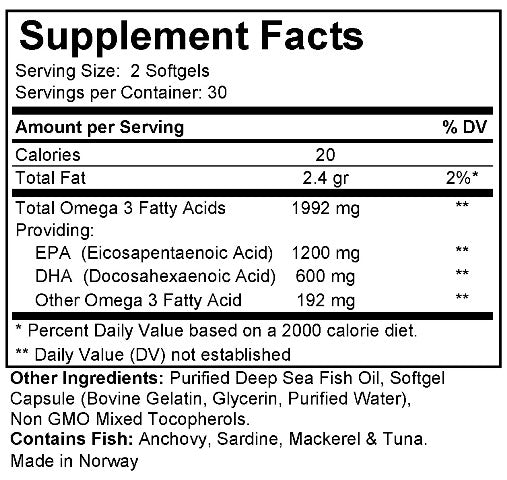
Supplement Facts
Serving Size: 2 Softgels
Servings per Container: 30
| Amount per Serving | % DV | |
|---|---|---|
| Calories | 20 | |
| Total Fat | 2.4 g | 2%* |
| Total Omega 3 Fatty Acids | 1,992 mg | ** |
| Providing: | ||
| EPA (Eicosapentaenoic Acid) | 1,200 mg | ** |
| DHA (Docosahexaenoic Acid) | 600 mg | ** |
| Other Omega 3 Fatty Acid | 192 mg | ** |
* Percent Daily Value based on a 2,000 calorie diet.
** Daily Value (DV) not established.
Other Ingredients: Purified Deep Sea Fish Oil, Softgel Capsule (Bovine Gelatin, Glycerin, Purified Water), Non GMO Mixed Tocopherols.
Contains Fish: Anchovy, Sardine, Mackerel & Tuna.
Panel transcribed from the printed Omega 3 TS label, also shown in the product images above. Suggested use: take 2 softgels daily with food, or as directed by your physician.
The short version
If you scrolled here first, this is the whole product. If you read the rest, this is the part to screenshot.
A triple-strength concentrated marine oil delivering 1,800 mg of EPA and DHA in two softgels, plus another 192 mg of naturally occurring omega-3 fatty acids from the same oil.
Anyone eating a modern Western diet, which means almost everyone. Especially useful if you rarely eat cold-water fish, if you train hard, or if you have already tried fish oil and quit because of the aftertaste.
Two softgels daily with food. Take it with the meal that has the most fat in it, because these are fat-soluble and food improves absorption. Do not exceed 3 grams of combined EPA and DHA per day without physician guidance.
Honest expectations
I am not going to promise you a feeling on a schedule. Omega-3 status is a slow-moving biological measure, and anyone telling you otherwise is selling something. Here is the honest sequence.
This is where most people find out whether they can live with a fish oil. Take both softgels with your largest meal. The absence of repeat and aftertaste is the thing our customers comment on most, and it is the reason people who quit this category once are willing to try again.
EPA and DHA are being built into cell membranes throughout the body. This part is invisible. There is nothing to feel and no milestone to hit. The only thing that determines whether it happens is whether you actually take it every day.
Red blood cell omega-3 levels are generally described in the research as taking on the order of three to four months of consistent intake to plateau. That is when a blood test becomes worth running. I would rather you measure than guess, and I would rather you measure than take my word for it.
What to look for
This is not a competitor comparison. It is a checklist of the specific places a fish oil label can mislead you, with our own numbers filled in so you can hold them to the same standard.
| What to check | The typical off-the-shelf fish oil | Omega 3 TS |
|---|---|---|
| EPA + DHA per serving | Often 300 to 600 mg | 1,800 mg |
| Softgels needed to reach 1,800 mg EPA + DHA | 6 at the standard 30% concentration | 2 |
| Omega-3 as a share of the fat in the serving | Roughly 30% | 83% total omega-3, 75% EPA + DHA |
| Fractions broken out and summing to the total | Frequently a single "total omega-3" figure only | EPA, DHA and other omega-3 stated separately, and they sum |
| Fish species named | Usually just "fish oil" | Anchovy, sardine, mackerel, tuna |
| Oxidation protection disclosed | Often not stated on the panel | Non-GMO mixed tocopherols, listed |
| Softgel shell composition disclosed | Sometimes omitted entirely | Bovine gelatin, glycerin, purified water |
| Calories carried to deliver 1,800 mg EPA + DHA | Roughly 54 | 20 |
Proof, not promises

Made in Norway
Origin
Turn over most bottles in this category and you will find no country of origin at all, or a "manufactured for" line that tells you who paid for it rather than where it was made. Our label says Made in Norway, printed on the panel, because that is where this oil is produced.
Norway sits on the cold-water fishery that built the marine oil industry, and it has been refining and concentrating fish oil at scale for more than a century. It is not a marketing country of origin. It is where the processing expertise actually lives, and Norwegian food production operates under Norwegian and European Economic Area regulatory oversight, where contaminant limits for marine oils are set in law rather than left to the producer's discretion.
Small, short-lived species out of cold water. Concentrated and deodorized in the place that has been doing it longest. That is the supply chain behind two softgels.
Straight talk
A country of origin is a reasonable signal. It is not a purity test. Norway has a serious regulatory framework and a serious fishery, and neither of those facts is the same thing as a certificate of analysis for the lot in your hand. We are telling you where it is made because you should know, not because origin substitutes for documentation.
Manufacturing and standardization
We do not carry claims across products. Everything below is specific to Omega 3 TS. If a certification is not named here, we are not claiming it here, and that silence is deliberate rather than an oversight.
EPA, DHA and the remaining omega-3 fraction are each printed with an exact milligram amount. No proprietary blend, no front-of-bottle number that quietly describes two servings.
Produced under current Good Manufacturing Practices in a facility registered with the FDA. FDA registers facilities, foreign and domestic. It does not approve them, and we will not tell you otherwise.
Made in Norway, printed on the label rather than left off it. Most of this category does not tell you, and in a category built on oil quality that omission is not an accident.
Our manufacturer performs testing at multiple stages of production. All IOH Nutrition formulas are required to meet or exceed cGMP quality standards.
Non-GMO mixed tocopherols are formulated into the oil to protect the fatty acids from oxidizing on the shelf. Concentrated fish oil is fragile. It needs the protection.
Anchovy, sardine, mackerel and tuna. Small, short-lived, fast-reproducing fish, named on the label rather than hidden behind the words "fish oil."
Bovine gelatin, glycerin and purified water. That matters if you avoid bovine-sourced gelatin, and you should not have to email us to find out.

Dr. Andreas Boettcher, B.S., D.C., C.F.M.P.
Founder, It's Only Halftime
Ironman Triathlete
Master's Men's Physique Competitor
Medication-Free at 56
33 Years of Clinical Practice
From my practice
In thirty-three years of clinical practice I have watched more patients quit fish oil over the aftertaste than over anything else. Not because it did not work. Because they could not stand taking it. That is a formulation failure, and we treated it like one.
When we built Omega 3 TS, the target was not a bigger front-of-bottle number. It was a smaller pill count and an oil clean enough and stable enough that you would still be taking it in month four, because month four is where this nutrient starts to matter.
This is what I reach for personally, every day, with dinner. I have taken it through Ironman training blocks and through physique prep, and it stays in the rotation in both, which is not true of much else in my cabinet. It is a foundation. I do not expect to feel it, and neither should you. I expect to see it on a blood panel, and that is a different and much more honest conversation.
If you are on a blood thinner, an antiplatelet drug, or you have surgery scheduled, talk to your prescribing physician before you start. That is not boilerplate. Read the safety question below.
The stack
Omega 3 TS is a foundation product. It is the base layer, and it does its best work underneath the things people actually notice. These three are the ones I run alongside it: the fat-soluble vitamins that need a fatty meal to absorb, the botanical side of inflammatory support, and antioxidant protection for the lipid compartment those fatty acids travel in.
Pairs with / Fat-soluble
Vitamin D3 and K2 are fat-soluble, which means they absorb better when there is fat in the meal. Taking them alongside two softgels of concentrated marine oil solves that problem without thinking about it. This is the pairing I use myself.
View D3 & K2Pairs with / Inflammatory response
InflaMend supports a healthy inflammatory response through botanical pathways rather than fatty acid pathways. Different mechanisms, same objective. This is the pairing for anyone whose primary reason for taking fish oil is joint comfort and recovery.
View InflaMendPairs with / Lipid protection
When you add highly unsaturated fatty acids to circulation, you want antioxidant protection in the same compartment they travel in. E Essentials Plus supplies vitamin E in its tocotrienol form, not the alpha-tocopherol found in most multivitamins, and tocotrienols are lipid-phase antioxidants that support the body's defenses against oxidative stress where fats actually live. The concern with circulating lipids has never really been the cholesterol itself. It is oxidative damage to it, and that is the layer this pairing covers.
View E Essentials PlusFAQ
Two softgels daily with food. That is one full serving, it delivers 1,800 mg of EPA and DHA, and a bottle gives you thirty days at that intake.
Some people work with a physician at higher intakes. If that is you, keep the total combined EPA and DHA at or below 3 grams per day unless your physician has specifically directed otherwise, and be aware that two servings of this product would put you at 3.6 grams. That is a conversation to have with your doctor, not a decision to make from a product page.
The fishy repeat almost always comes from oxidation, not from fish oil as a category. Fatty acids this unsaturated are chemically fragile, and once they begin to oxidize you get the taste and the reflux that made most people abandon this shelf years ago.
Two things address it here. The oil is deodorized during processing, and non-GMO mixed tocopherols are formulated in to slow oxidation on the shelf. It also helps that you are swallowing 2,400 mg of oil instead of 6,000 mg to get the same EPA and DHA. Less oil is simply less to sit in your stomach. Take it with food and most people report no aftertaste at all, which is the single most common thing our customers tell us about this product.
Ask your prescribing physician before you start, and do not treat this page as clearance. Higher intakes of EPA and DHA can affect platelet function, which means there is a real and well-documented reason to review this with the person managing your medication.
Drug classes worth raising specifically: anticoagulants such as warfarin and the direct oral anticoagulants, antiplatelet agents including clopidogrel and daily aspirin, and blood pressure medications, since omega-3 intake can have an additive effect on blood pressure. If you have surgery or a dental procedure scheduled, tell your surgeon you take fish oil and follow their instructions on when to stop.
If you are pregnant, nursing, or managing any medical condition, consult your physician before using this or any dietary supplement.
No. This product contains fish: anchovy, sardine, mackerel and tuna. If you have a fish allergy, do not take it. If you have a shellfish allergy only, that is a different allergen, but review it with your physician before starting.
Bovine gelatin, glycerin and purified water. It is not a vegetarian, vegan, or fish-gelatin shell, and we are not going to be vague about that. If bovine gelatin is not acceptable for you, this is not your product.
Flax and chia supply ALA, a shorter omega-3 that your body has to convert to EPA and then to DHA. The published conversion efficiency in humans is low and highly variable, and it is worse in men than in women. You would have to eat a great deal of flax to arrive at the EPA and DHA in two of these softgels.
Algae oil is a legitimate option and is the right answer for someone who does not eat fish for ethical reasons. It is typically DHA-dominant and generally costs considerably more per gram. Omega 3 TS is an EPA-dominant marine oil, and if you eat fish, it is the more direct and more economical route.
No. Store it in a cool, dry place out of direct sunlight and away from heat, and keep the cap closed. Some people prefer to refrigerate fish oil and that is fine, it does no harm. Do not leave it in a hot car or on a sunny windowsill, because heat and light are what drive oxidation.
It matters more than most people think. Take both softgels with a meal that contains fat. Fat in the stomach triggers the bile release that emulsifies these fatty acids for absorption, and taking fish oil on an empty stomach is the most common reason people report repeat.
Time of day does not matter. Consistency does. Attach it to the meal you never skip.
Ask for a fatty acid analysis, sometimes sold as an omega-3 index panel. It is a separate order from a standard lipid panel and it is not included in routine annual bloodwork, so you have to ask for it specifically. Several labs offer it direct to consumer as a finger-stick kit, and most functional medicine practitioners can order it for you.
Test before you start, or within the first week or two, then again after three to four months of consistent daily intake. One measurement tells you where you are. Two tell you whether anything is actually changing, and that is the part worth paying for.
Measure it. An omega-3 blood test is inexpensive and it removes the guesswork entirely. Test before you start or shortly after, then again after three to four months of consistent daily intake, which is roughly the timeframe the research describes for red blood cell levels to reach a plateau.
I would rather you have a number than a feeling. Feelings are not a great instrument for a structural nutrient, and this is a structural nutrient.
Omega 3 TS / Triple Strength
The reason most people are omega-3 deficient is not that they never bought fish oil. It is that they bought it once, took six softgels a day for two weeks, hated every one of them, and put the bottle in the back of the cabinet. Deficiency is usually a compliance problem wearing a nutrition costume.
We concentrated this oil so the daily count is two instead of six, and we built in the stability so the ones you take do not taste like the ocean floor. That is the whole design brief, and it is the reason the reviews on this product say the same thing over and over.
You are not going to feel this tomorrow. You are going to order a fatty acid panel, take two softgels with dinner every day for four months, order the panel again, and watch a ratio move that your annual physical was never going to show you in the first place. That is the only kind of evidence I have ever cared about, and it is available to anyone willing to draw the blood.
Fix the ratio. It is the one lever in this entire category where the mechanism, the measurement and the daily action all point the same direction.
Manufacturing. Made in Norway. Omega 3 TS is manufactured under current Good Manufacturing Practices in a facility registered with the U.S. Food and Drug Administration, as required of foreign and domestic facilities producing dietary supplements for the United States market. Testing is performed at multiple stages of production. All IOH Nutrition formulas are required to meet or exceed cGMP quality standards. FDA registers manufacturing facilities; it does not approve dietary supplements or the facilities that produce them.
Trademarks. No trademarked or branded ingredient is claimed in this formula. IOH Nutrition and It's Only Halftime are trademarks of IOH Nutrition LLC.
Allergen. Contains fish (anchovy, sardine, mackerel, tuna). Contains bovine-derived gelatin.
Use. Consult your physician before use, particularly if you are pregnant or nursing, taking any medication including anticoagulant, antiplatelet or blood pressure medication, have a scheduled surgical or dental procedure, or have a diagnosed medical condition. Keep out of reach of children. Do not use if the safety seal is broken.
These statements have not been evaluated by the Food and Drug Administration. This product is not intended to diagnose, treat, cure, or prevent any disease.
Tastes great! Great energy boost!
Great supplement to support my body. No GI side effects
I feel the boost it gives me. No weird stimulant effect, just more energy.
Easy on the gut with no weird taste or GI upset.
No weird or fishy taste or GI upset. I take several a day and feel great compared to other omega 3 supplements I have tried.
I take it daily and am glad to have a supplement to help with my cholesterol. No GI upset.
Great way to get needed minerals. No weird taste and no GI upset.
No weird taste and no gastric upset. Best MVI I have used.
Tastes great and it mixes up really well even with hot coffee.
I’ve tried many different omega 3/fish oil supplements and IOH’s has me at my best.
Based on Dr A’s coaching and advice, IOH creatine is a supplement must!
I've been consuming chocolate whey powder for a long time. I don't make particularly tasty protein drinks. However, I do with this!
If you are looking for high purity products with actual clinical doses and a product line that doesn't need a colorful, cartoon-like label to grab your attention, then IOH products are what you should be buying.
I tend to workout early AM, and used to pound a diet soda as my pre workout. I switched to this and have found it gives a much stronger and sustained energy boost without the jitters other caffeinated options have given me before.
I've tried many different pre-workout drinks over my years of lifting and for the most part have not been happy with them, loaded with toxic ingredients, jitters, the crash that comes after, etc.
I was introduced to IOH pre-workout from a friend and decided to give it a try. Prior to ordering an analyzed the ingredients and was impressed with the makeup of the product. The fact that there are no binders, fillers, artificial sweeteners and other common ingredients that are a far cry from healthy was encouraging.
After taking the supplement, I can confidently say it's a winner. Great clean energy, that is sustainable with no crash, no jitters or side effects from harsh stimulants. The energy and the increased time to fatigue, allowing me to push more reps and the pump you get was excellent.
I've added this to my routine and would encourage anyone looking for that clean energy performance added to their workouts, to give it a try.
Great job IOH team!


