5X Chelated Minerals - Ultra High Absorption Powder




Most mineral supplements are built around the cheapest raw material that will fit in a tablet. This one is built around a single question we kept coming back to in practice: what actually crosses the gut wall, and what just passes through? Every mineral here arrives as a fully reacted amino acid chelate — the same class of forms your body handles when minerals come in food.
We describe our manufacturing and our raw material specifications here rather than making a batch-verification claim. If you want the certificate of analysis for the lot you received, contact us with the lot number printed on your container and we will send what we have on file.
An unflavored powder delivering eleven minerals — calcium, magnesium, zinc, selenium, copper, manganese, chromium, molybdenum, potassium, boron and vanadium — every one of them as an amino acid chelate from Albion, plus 120 mg of malic acid carried in with the DimaCal calcium.
It is not a multivitamin and it is not a bone formula. It is the mineral cofactor layer that sits underneath both.
One level scoop, 3.650 g, once daily. Mix into 8 to 12 oz of water or a smoothie. Take it with a meal, or in the evening if you want the magnesium working while you sleep.
New to minerals or sensitive to them? Start at a half scoop daily for the first week, then move up.
Follow the Suggested Use printed on your container. Do not exceed one scoop daily unless your own physician has told you to.
Two bottles can both say magnesium 200 mg on the front and behave nothing alike inside you. The number on the label tells you what went into the batch. The form tells you what has a chance of reaching a cell.
Minerals are not a wellness accessory. They are the metal centers inside the enzymes that run your metabolism. Roughly three hundred enzymatic reactions need magnesium. Zinc participates in hundreds more. Selenium runs your glutathione peroxidases and the enzymes that activate thyroid hormone. When mineral status drifts, nothing breaks loudly — the whole system just gets quieter.
Magnesium is required to stabilize ATP itself. Manganese and copper sit inside mitochondrial enzymes. This is support for the machinery, not a stimulant sitting on top of it.
Zinc and selenium are the two minerals most consistently tied to normal immune function, and selenium is central to normal thyroid hormone conversion. Both are here at meaningful amounts.
Your own antioxidant defenses are enzymes, and those enzymes are built around metals — copper, zinc, manganese and selenium. Supply the cofactors and you support the system that already exists.
Magnesium bisglycinate supports normal muscle relaxation and restful sleep, and the glycine it is bound to is a calming amino acid in its own right. This is the one most people feel first.
Here is the part almost no mineral label explains. An inorganic mineral salt and an amino acid chelate do not enter you the same way. They use different doors. One of those doors is crowded, acid-dependent and easy to jam. The other one is the door your body built for food.
5X is the name of this product. It refers to the chelation platform, not to a promise that every one of these eleven minerals is absorbed exactly five times better than every alternative. That would not be true and we are not going to print it. What is well documented is the direction: amino acid chelates like magnesium bisglycinate have compared favorably against oxide forms in human absorption and tolerance research, and the size of the advantage varies by mineral, by comparator, by dose and by what else is in the meal. We could pull a flattering percentage off a study that used a different mineral at a different dose than what is in this scoop. We would rather tell you the mechanism, show you the forms, and let you judge.
Amounts below are per one level scoop, 3.650 g. Where an amount is a nutritional trace rather than a research dose, we say so in that ingredient's own block. That is the honest way to read a mineral panel and we would rather teach you to read it than hope you do not.
The workhorse of the formula and the reason most people notice something. Magnesium is required as a cofactor in several hundred enzymatic reactions, it is bound to ATP in the form the cell actually uses, and it participates in normal muscle relaxation, normal nerve signaling, and a healthy stress response. Bisglycinate is the form we chose for a specific reason: it is bound to two glycine molecules, and glycine itself is a calming amino acid. It also has the gentlest reputation in the category, which matters when the alternative is magnesium oxide and an urgent trip to the bathroom.
200 mg is a real supplemental amount, roughly half the Daily Value, but it is not a high-dose magnesium product. If you are specifically working on magnesium status under a clinician's direction, you may end up running additional magnesium on top of this. That is a legitimate thing to discuss with your own physician.
Calcium is here as a cofactor, not as a bone dose. It participates in normal muscle contraction, nerve transmission and cell signaling. DimaCal is a di-calcium malate, meaning two calcium ions carried on one malic acid molecule, which is what gives it an unusually high calcium density for an organic calcium form.
50 mg is 4% of the Daily Value. This is not a calcium supplement and we are not going to pretend it is. That is a design decision, not an oversight — loading calcium alongside eleven other minerals is exactly how you create the transporter competition we built the rest of this formula to avoid. If you need therapeutic calcium for bone density, that is a separate conversation and a separate product.
Zinc is a structural or catalytic component of hundreds of human enzymes and a large family of transcription factors. It supports a healthy immune response, normal skin integrity, normal wound healing, normal taste and smell, and normal testosterone production in men. Twenty-five milligrams is a genuine supplemental amount rather than a label-decorating sprinkle.
The Institute of Medicine sets the tolerable upper intake level for zinc at 40 mg per day for adults from all sources. One scoop of this puts you at 25 mg. Two scoops would put you at 50 mg, which is over that ceiling. That is a direct reason to keep this at one scoop a day unless your own physician has looked at your labs and told you otherwise.
Selenium is the mineral that sits inside your glutathione peroxidase enzymes and inside the deiodinases — the enzymes that convert thyroid hormone from its storage form into its active form. That makes it central to both normal antioxidant enzyme activity and normal thyroid function. It also supports a healthy immune response. Two hundred fifty micrograms is the amount most commonly used in the human thyroid and immune literature.
Selenium has one of the narrowest windows of any mineral. The upper intake level for adults is 400 mcg per day from all sources, and this scoop contributes 250 mcg of that. Add a second scoop and you are at 500 mcg, over the ceiling before you count food or any other supplement. If you are already taking a thyroid formula, a multivitamin, or Brazil nuts on a regular basis, add up your total selenium before you add this — and read the medication and safety question below.
Copper is required for normal iron metabolism, for the copper-zinc superoxide dismutase enzyme, for cytochrome c oxidase in the mitochondrial electron transport chain, and for lysyl oxidase, which cross-links collagen and elastin in connective tissue. It is here at 2 mg for a specific structural reason: it is the counterweight to the 25 mg of zinc.
This is the ingredient most competitor formulas drop, and dropping it is the single most common design mistake in the mineral category. Sustained supplemental zinc without matching copper induces intestinal metallothionein, which preferentially binds copper and can work against copper status over months. If a mineral product gives you zinc and no copper, that is not minimalism. That is a gap.
Manganese is the metal at the center of manganese superoxide dismutase, the antioxidant enzyme that works specifically inside the mitochondria. It is also required for prolidase and for the glycosyltransferases involved in building cartilage and connective tissue, which is why it shows up in joint discussions. It supports normal bone formation and normal carbohydrate and amino acid metabolism.
Chromium supports normal macronutrient metabolism and normal glucose metabolism. The nicotinate glycinate chelate form was chosen because niacin-bound chromium has been the better-absorbed and better-studied class compared with simple chromium chloride.
400 mcg is toward the upper end of what human research on chromium and glucose metabolism has used; trials in that literature have generally run somewhere between 200 and 1,000 mcg per day. We are telling you the range rather than quoting you a result, because the outcomes in that body of research have been genuinely mixed and depend heavily on the population studied. If you take insulin or any medication that lowers blood sugar, see the medication question below before you start this.
Molybdenum is one of the most-skipped minerals in the category and one of the more interesting ones. It is the cofactor for sulfite oxidase, xanthine oxidase and aldehyde oxidase — which in plain terms means it supports the body's own handling of sulfites, of purines, and of certain aldehyde compounds. It supports normal detoxification pathways in the liver in the specific, literal sense of being the metal those enzymes require to work.
500 mcg is roughly eleven times the RDA and about a quarter of the 2,000 mcg adult upper intake level. That is a deliberate functional amount rather than a token one, and it is well inside the ceiling. It is also more molybdenum than most people will find anywhere else, so if you are stacking another product that contains it, add up the total.
Potassium is the primary intracellular electrolyte and supports normal fluid balance, normal nerve conduction and normal muscle contraction, including the heart muscle. It is here in a chelated complex rather than as a chloride salt.
100 mg is 2% of the Daily Value. This is not a potassium supplement — the Daily Value is 4,700 mg and no capsule or scoop is going to meaningfully move that. Potassium is a food-quantity mineral. If hydration and electrolyte replacement is what you are actually after, that is what Catalyst is built for, and the two are designed to run together.
Boron influences how the body handles calcium, magnesium and vitamin D, and it supports normal bone metabolism. It has also drawn research interest around hormone metabolism and cognitive function.
The human research on boron and hormone markers has typically used 3 to 10 mg per day. This formula contains 1 mg, which is a nutritional trace amount in line with typical dietary intake, not a hormone-research dose. So we are not going to build a hormone claim on it, and if you see a page that does at this amount, be skeptical.
Vanadium is an ultratrace element that has drawn research attention for its interaction with insulin signaling and glucose metabolism.
This is the thinnest ingredient in the formula on human evidence and we are going to say so rather than dress it up. The vanadium research that generated the interest used vanadyl sulfate at doses in the tens of milligrams — orders of magnitude above the 500 mcg here — and those doses came with real tolerability problems, which is a large part of why vanadium never became a mainstream supplement. Five hundred micrograms is a nutritional trace amount that rounds out the mineral profile. Treat it as completeness, not as an active claim.
Malic acid is a genuine intermediate of the Krebs cycle, the pathway your mitochondria use to generate ATP. It also functions as a mild organic acid that assists mineral solubility in the gut.
The 120 mg of malic acid is here because it is the carrier half of the DimaCal calcium, not because we added it as a separate active. It is disclosed on the panel for transparency. Standalone malic acid research uses gram-level amounts, so we are not going to hang an energy or endurance claim on 120 mg. It is an honest byproduct of a good calcium form.
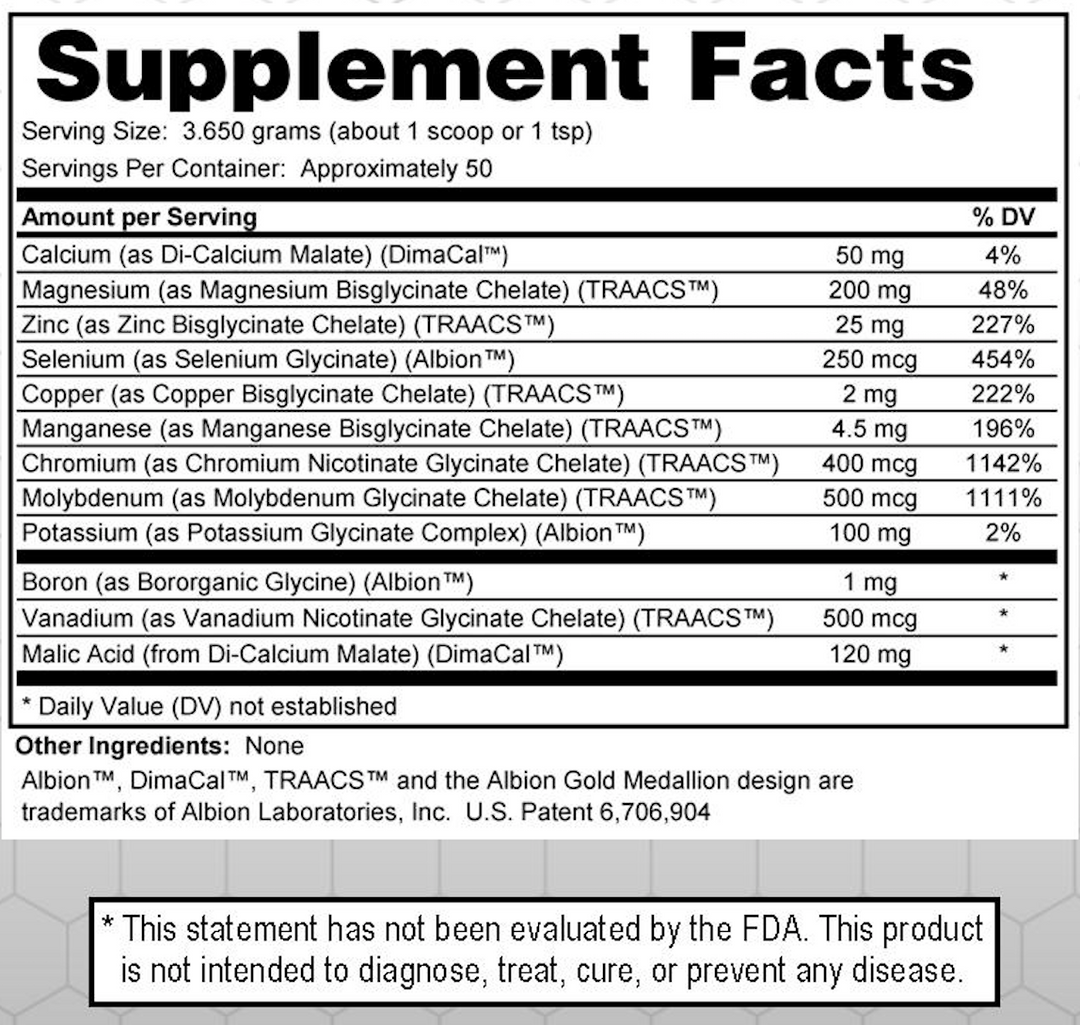
Supplement Facts
| Amount per Serving | % DV | |
|---|---|---|
| Calcium (as Di-Calcium Malate) (DimaCal) | 50 mg | 4% |
| Magnesium (as Magnesium Bisglycinate Chelate) (TRAACS) | 200 mg | 48% |
| Zinc (as Zinc Bisglycinate Chelate) (TRAACS) | 25 mg | 227% |
| Selenium (as Selenium Glycinate) (Albion) | 250 mcg | 454% |
| Copper (as Copper Bisglycinate Chelate) (TRAACS) | 2 mg | 222% |
| Manganese (as Manganese Bisglycinate Chelate) (TRAACS) | 4.5 mg | 196% |
| Chromium (as Chromium Nicotinate Glycinate Chelate) (TRAACS) | 400 mcg | 1142% |
| Molybdenum (as Molybdenum Glycinate Chelate) (TRAACS) | 500 mcg | 1111% |
| Potassium (as Potassium Glycinate Complex) (Albion) | 100 mg | 2% |
| Boron (as Bororganic Glycine) (Albion) | 1 mg | * |
| Vanadium (as Vanadium Nicotinate Glycinate Chelate) (TRAACS) | 500 mcg | * |
| Malic Acid (from Di-Calcium Malate) (DimaCal) | 120 mg | * |
* Daily Value (DV) not established.
Other Ingredients: None
Panel transcribed from the printed label, which is also shown in the product images above. Always follow the Suggested Use printed on the container you received.
This is an unflavored, unsweetened mineral powder with no flavor system and no filler. If you are used to a fruit-punch scoop, read this part before you order.
Glycine-bound minerals are faintly sweet on their own, and the 120 mg of malic acid gives the powder a light tartness. Underneath both there is a mineral note. In plain water it tastes like minerals, because that is what it is.
It is not a flavored drink mix and we did not want to add a sweetener system just to make the label read nicer. Most people find it easiest in a smoothie, in coffee, in a protein shake, or stirred into a flavored electrolyte drink.
One level scoop into 8 to 12 oz of liquid. Stir or shake for a few seconds. Magnesium bisglycinate is only partly water soluble, so expect a little cloudiness and some settling if the glass sits. Swirl and finish it — the settled portion is formula, not filler.
Take it with food if your stomach is at all sensitive to minerals. Evening works well if you want the magnesium and glycine on board before sleep.
If anything registers early it is usually on the magnesium and glycine side — easier evenings, better quality sleep, fewer muscle cramps after hard training. Some people notice nothing yet, and that is normal.
Trace mineral status does not change in a weekend. Zinc, selenium, copper and manganese work by occupying enzyme sites, and that pool refills gradually with consistent daily intake. Consistency matters more here than dose.
By the third month, if you want to know what actually changed, test rather than guess. Red blood cell magnesium, serum zinc with copper, and selenium are all measurable. I would rather you look at a number than trust a vibe.
You do not have to take our word for any of this. Pick up whatever mineral product is in your cabinet and run it down this list. The answers are all printed on the panel.
| What to check | Typical off-the-shelf mineral product | 5X Chelated Minerals |
|---|---|---|
| Mineral forms | Oxide, carbonate, sulfate or citrate salts | Albion amino acid chelates throughout, most carrying the TRAACS fully-reacted designation |
| Number of minerals | Three to five headline minerals | Eleven, including molybdenum, boron and vanadium |
| Copper alongside zinc | Frequently omitted, or present at a token amount | 2 mg copper against 25 mg zinc — a deliberate 12.5:1 ratio |
| Amounts disclosed | Often folded into a proprietary mineral blend | Every mineral and its chelate form listed with an exact amount |
| Other ingredients | Silica, magnesium stearate, maltodextrin, coatings, flavor systems | None |
| Dose flexibility | Fixed tablet or capsule | Powder — a half scoop is a real starting dose |
| Molybdenum | Usually absent, or present at a fraction of the RDA | 500 mcg, a functional amount well inside the upper intake level |
| Upper limits addressed | Rarely mentioned anywhere on the page | Zinc and selenium ceilings stated in plain language, with the dosing guidance to match |

"In thirty-three years of practice I have watched more people fail on mineral supplements than on almost anything else in the cabinet — and almost never because the dose on the label was too low. It was the form. They were swallowing oxide and carbonate, getting a stomach ache for their trouble, and concluding minerals did not work for them."
That is the problem we set out to solve when we formulated this one. We did not chase a bigger number on the front of the bottle. We went after the forms, the ratios, and the things most mineral formulas quietly leave out — the copper that belongs next to the zinc, the molybdenum almost nobody includes, the trace minerals that round out an actual mineral profile instead of a marketing one.
This is what I reach for personally, and I have a specific reason. Ironman training and stage prep both do the same thing to mineral status: they drain it, week after week, through sweat and through volume. One scoop in the evening is part of how I have stayed medication-free at fifty-six while still training like the second half matters. I built the page the same way I would explain it across the desk from you — including the parts, like the vanadium and the boron, where the honest answer is that the amount is nutritional and not a research dose.

Dr. Andreas Boettcher, B.S., D.C., C.F.M.P.
Founder, It's Only Halftime
Ironman Triathlete/Master's Men's Physique Competitor/Medication-Free at 56/33 Years of Clinical Practice
Minerals are cofactors. They do their most interesting work when the things they are cofactors for are also present. These three are the pairings that make the most physiological sense.
These two solve different halves of the same problem, and that is exactly why they pair well. Catalyst carries the macro-electrolytes you lose by the gram in sweat — sodium and potassium in bicarbonate form, plus magnesium glycinate, taurine and glycine — in a flavored, easy-drinking scoop. 5X carries the trace minerals you lose in milligrams and micrograms and cannot replace with a sports drink. Catalyst around training, 5X once a day with food or in the evening. Both contain magnesium and boron, so if you run them together you are stacking those totals deliberately rather than accidentally.
View Catalyst →This is the most underrated pairing in the line. B vitamins and minerals are not two separate categories — they work as a unit inside the same enzymes. Magnesium is required to convert thiamine into its active thiamine pyrophosphate form and participates in the activation of B6. Molybdenum and B vitamins both feed the sulfur and methylation side of metabolism. Running a methylated B complex without adequate mineral cofactors is like delivering the crew without the tools.
View Methylated B →If cellular energy is the reason you are here, this is the natural companion. Mitochondrial energy production is a mineral-dependent process from end to end — magnesium stabilizes ATP, manganese runs the mitochondrial superoxide dismutase, and copper sits inside cytochrome c oxidase in the electron transport chain. MitoHealth works on the pathway; 5X supplies the metals the pathway is built around.
View MitoHealth →One housekeeping note on stacking. This formula carries meaningful amounts of zinc and selenium. If you also take a multivitamin, a thyroid formula, or anything else containing those two minerals, add up your daily totals across everything before you start — and bring the list to your own physician. That is not a disclaimer. That is how you are supposed to run a mineral protocol.
It refers to the chelation platform this formula is built on, not to a guaranteed five-fold absorption multiplier for every mineral in it. Amino acid chelates as a class have compared favorably against inorganic salts like oxides in human absorption and tolerance research, but the size of that advantage depends on which mineral, which comparator, what dose, and what else is in the meal. We deliberately do not print a single absorption percentage on this page, because any number we chose would come from a study that used a different mineral or a different dose than what is in this scoop.
One level scoop, 3.650 g, once daily is the intended serving. If you are new to mineral supplementation or have a sensitive stomach, start at half a scoop for the first week. We would not run two scoops a day without physician oversight, and here is the specific reason: two scoops delivers 50 mg of zinc against a 40 mg adult upper intake level, and 500 mcg of selenium against a 400 mcg upper intake level. One scoop keeps both comfortably inside those ceilings. Always follow the Suggested Use printed on your container.
Minerals interact with more prescriptions than most people expect, mostly by binding them in the gut. Talk to your prescribing physician or pharmacist before starting this if any of the following apply.
Thyroid medication. Levothyroxine and related thyroid hormones bind to minerals — particularly calcium and magnesium — which reduces how much drug you absorb. Separate this product from thyroid medication by at least four hours. Selenium at 250 mcg daily can also influence thyroid hormone conversion, so if you are being managed for a thyroid condition your physician should know you are taking it.
Certain antibiotics. Tetracyclines such as doxycycline and fluoroquinolones such as ciprofloxacin and levofloxacin are chelated by divalent minerals and lose potency when taken together. Separate by at least four hours, or pause this product for the course.
Bisphosphonates. Alendronate and similar bone medications require a mineral-free window. Follow your prescriber's timing instructions exactly.
Potassium-sparing diuretics, ACE inhibitors and ARBs. These medication classes raise serum potassium. The 100 mg in this formula is small, but if you are on any of them, or have reduced kidney function, your physician should approve any added potassium and magnesium.
Insulin and oral glucose-lowering medications. Chromium at 400 mcg and vanadium may influence glucose metabolism. If you take insulin, metformin, a sulfonylurea or a GLP-1 medication, monitor your glucose closely when starting and let your physician know.
Penicillamine and levodopa. Both are affected by mineral binding and require separated dosing.
Kidney disease. If you have chronic kidney disease, do not start a multi-mineral product of any kind without your nephrologist's approval. Magnesium and potassium clearance both depend on kidney function.
This list covers the interactions we consider most relevant. It is not exhaustive, and it is not a substitute for a conversation with the clinician who knows your chart.
Sometimes, but you have to do the arithmetic first. The two minerals to add up are zinc and selenium, because this formula carries 25 mg and 250 mcg respectively and the adult upper intake levels are 40 mg and 400 mcg. If your multivitamin also contains a meaningful amount of either, you can push past those ceilings without ever feeling like you took too much. Bring both labels to your physician and let them do the math with you. If your multivitamin is mineral-heavy, this product may be a replacement for it rather than an addition to it.
Because this is a cofactor formula, not a bone formula, and because loading calcium into a multi-mineral product is counterproductive. Calcium in quantity competes for absorption with magnesium, zinc, iron and manganese. Putting 500 mg of calcium in this scoop would undercut everything else in it. The 50 mg here is present as DimaCal for its cofactor role and because the di-calcium malate form is what brings in the malic acid. If you need therapeutic calcium for bone density, take it separately and at a different time of day.
Like minerals, honestly. The glycinates are faintly sweet, the malic acid adds a light tartness, and there is a mineral note underneath. There is no flavor system, no sweetener and no filler in this product, which is a deliberate choice and also a real trade-off. Most people mix it into a smoothie, a protein shake, coffee, or a flavored electrolyte drink rather than plain water.
It is much less likely to, and the reason is mechanical. Most mineral-related gut distress comes from unabsorbed metal salt sitting in the intestine. Glycinate chelates are absorbed more readily and leave less behind, which is why they have the gentlest reputation in the category. If your stomach is still sensitive, take it with food and start at half a scoop.
Either works. Evening has a small edge for most people because the magnesium bisglycinate and the glycine it is bound to support restful sleep and muscle relaxation. If you take a morning thyroid medication, evening also makes the required four-hour separation easier to manage. If you would rather take it with breakfast, that is fine too — consistency matters more than clock time.
Albion Laboratories is the manufacturer that developed and patented much of the mineral amino acid chelate technology used in the supplement industry. TRAACS stands for The Real Amino Acid Chelate System, Albion's designation for chelates that have been verified as fully reacted — meaning the mineral is genuinely bound to the amino acid rather than simply blended with it. That distinction matters, because a mineral loosely mixed with an amino acid behaves in the gut like the salt it started as.
For completeness of the trace mineral profile. Vanadium is the ingredient in this formula with the thinnest human evidence base, and 500 mcg is a nutritional trace amount rather than the tens of milligrams used in the vanadyl sulfate research that generated interest in the mineral. We disclose it, we include it at a conservative amount, and we are not building a claim on it. If you would prefer a formula without any vanadium, that is a reasonable preference and this is not the product for you.
We are not going to promise you a timeline. What we can tell you is how the physiology tends to run: the magnesium side is what people report noticing first, usually in the sleep and muscle-relaxation department, while trace mineral status is a repletion process that moves over weeks to months. Individual response varies widely depending on where you started. If you want to know what actually changed, test — red blood cell magnesium, serum zinc with copper, and selenium are all measurable.
Do not start it without your obstetrician's approval. Several minerals in this formula sit well above their Daily Values, and pregnancy and lactation have their own upper intake levels that differ from the general adult numbers. This is a decision for the clinician managing your pregnancy, not for a product page.
Most people who tell me minerals never did anything for them were right about their experience and wrong about the reason. They were not taking too little. They were taking a form built for the manufacturer's cost sheet instead of for the human gut — and then blaming the mineral.
This is eleven minerals in fully reacted amino acid chelate form, at ratios chosen on purpose, in a scoop that contains nothing but the formula. No proprietary blend. No filler. No absorption percentage borrowed from a study that tested something else. Every amount printed, including the ones where the honest answer is that the number is nutritional and not heroic.
One scoop a day. It's Only Halftime.
Albion, DimaCal, TRAACS and the Albion Gold Medallion design are trademarks of Albion Laboratories, Inc. U.S. Patent 6,706,904. All other trademarks are the property of their respective owners.
Manufactured in the United States in an FDA-registered facility operating under current Good Manufacturing Practices (cGMP). We use the highest quality raw materials available, and testing is performed at various stages of production. All IOH Nutrition formulas are produced to meet or exceed cGMP quality standards.
Keep out of reach of children. Store in a cool, dry place with the lid tightly closed. Do not use if the safety seal is broken. Consult your physician before use if you are pregnant, nursing, have a medical condition, or take prescription medication — particularly thyroid medication, antibiotics, bisphosphonates, blood pressure medication, or any medication that lowers blood sugar. Discontinue use and contact your physician if you experience an adverse reaction.
These statements have not been evaluated by the Food and Drug Administration. This product is not intended to diagnose, treat, cure, or prevent any disease.
Tastes great! Great energy boost!
Great supplement to support my body. No GI side effects
I feel the boost it gives me. No weird stimulant effect, just more energy.
Easy on the gut with no weird taste or GI upset.
No weird or fishy taste or GI upset. I take several a day and feel great compared to other omega 3 supplements I have tried.
I take it daily and am glad to have a supplement to help with my cholesterol. No GI upset.
Great way to get needed minerals. No weird taste and no GI upset.
No weird taste and no gastric upset. Best MVI I have used.
Tastes great and it mixes up really well even with hot coffee.
I’ve tried many different omega 3/fish oil supplements and IOH’s has me at my best.
Based on Dr A’s coaching and advice, IOH creatine is a supplement must!
I've been consuming chocolate whey powder for a long time. I don't make particularly tasty protein drinks. However, I do with this!
If you are looking for high purity products with actual clinical doses and a product line that doesn't need a colorful, cartoon-like label to grab your attention, then IOH products are what you should be buying.
I tend to workout early AM, and used to pound a diet soda as my pre workout. I switched to this and have found it gives a much stronger and sustained energy boost without the jitters other caffeinated options have given me before.
I've tried many different pre-workout drinks over my years of lifting and for the most part have not been happy with them, loaded with toxic ingredients, jitters, the crash that comes after, etc.
I was introduced to IOH pre-workout from a friend and decided to give it a try. Prior to ordering an analyzed the ingredients and was impressed with the makeup of the product. The fact that there are no binders, fillers, artificial sweeteners and other common ingredients that are a far cry from healthy was encouraging.
After taking the supplement, I can confidently say it's a winner. Great clean energy, that is sustainable with no crash, no jitters or side effects from harsh stimulants. The energy and the increased time to fatigue, allowing me to push more reps and the pump you get was excellent.
I've added this to my routine and would encourage anyone looking for that clean energy performance added to their workouts, to give it a try.
Great job IOH team!


