NAD Catalyst




NAD Catalyst is a four-ingredient formula built on single, disclosed, standardized actives. No proprietary blends, no pooled totals, nothing you have to take on faith. Here is exactly what we can put our name behind on this specific product.
We only claim what we can show for this product. If a certification or batch document is not listed on this card, we have not claimed it anywhere on this page.
An NAD precursor formula dosed at the research level. Two capsules daily deliver 1,000 mg of nicotinamide riboside chloride and 300 mg of adenosine triphosphate, with niacinamide and a chelated magnesium cofactor alongside them.
Supplies the raw material your cells use to build NAD, the coenzyme sitting at the center of mitochondrial energy production and cellular repair signaling.
Adults past forty who still train, still compete, and still work. Anyone building a longevity protocol from the metabolic foundation upward instead of chasing a stimulant.
Two capsules daily with food. Both in the morning, or one with breakfast and one with dinner, which is exactly how the six-week trial dosed it. This is a daily-accumulation nutrient, not a pre-workout. Consistency across months is the whole game.

I have been a student of human performance since high school. Physiology, muscle development, body composition, recovery. I never stopped studying it, and I have never studied it from a chair.
Contest preparation is months of training in a caloric deficit, which is the exact condition where recovery capacity decides whether you hold muscle or lose it. Nothing about standing on that stage in the master's division is about willpower. It comes down to whether the machinery in your cells can still produce energy efficiently enough to train hard, recover, and keep lean tissue while you do it.
That machinery is mitochondrial. It is the same system behind everything else on this page, and it is the reason we built this formula the way we did.
Search "NAD supplement" and you will find hundreds of bottles making identical promises. Most are betting you will never read the panel or ask which dose produced the percentage on the front. We built this one assuming you would do both.
NAD is the electron carrier that moves fuel through the Krebs cycle and into the electron transport chain. Without adequate NAD the machinery still runs, but it runs poorly.
Sirtuins and PARP enzymes consume NAD as a substrate. These are the enzymes involved in DNA repair signaling and metabolic housekeeping, and they compete for the same pool.
Measured NAD in human tissue falls with age. That decline is one of the better-documented biochemical features of aging, and it sits upstream of a great deal.
Unlike most aging markers, blood NAD moves. Controlled human trials have measured dose-dependent increases in whole blood NAD after oral nicotinamide riboside.

Racing a motorcycle at speed demands total concentration for the entire time you are on it. Your body is working continuously and your mind cannot drift for a second. That combination, physical output plus sustained focus, is the most honest test of cellular energy I know.
Both of those run on the same currency. Muscle and brain are the two most mitochondria-dense tissues you have, and both depend on NAD to keep regenerating energy. When that system is well supplied you get output and clarity together. When it is not, you lose them together, and you feel the focus go before you feel the legs go.
This is where most NAD pages quote a percentage and hope you never ask what dose produced it. We are going to show you the whole published curve and mark exactly where the NAD Catalyst daily serving sits on it. It sits on the top rung, at the dose that produced the largest measured increase in the trial.
Whole blood NAD increase from baseline at two weeks
Conze, Crespo-Barreda and Brenner. Scientific Reports, 2019. Randomized, double-blind, placebo-controlled. 140 healthy overweight adults aged 40 to 60, 132 completing. Nicotinamide riboside chloride, NIAGEN brand material. Eight-week study. Increases appeared within two weeks and were maintained through the remainder of the trial.
Look at the right-hand bar, because that is the one this product is built on. The NAD Catalyst daily serving is two capsules, 500 mg each, for 1,000 mg of nicotinamide riboside chloride per day. That is not near the trial dose or a fraction of it. It is the trial dose, the highest arm of the study, the one that raised whole blood NAD by 142 percent within two weeks and held it there for the remaining six weeks of dosing. Most of this category sells you the first or second bar and quotes the third. We would rather just give you the third and show you where it came from. If a competitor quotes you a big NAD percentage, ask which dose produced it, then compare it to the amount in their own serving.
The second trial, at the same daily total, and worth reading the dosing line twice: a randomized, placebo-controlled crossover trial in 24 healthy adults aged 55 to 79 used 500 mg of nicotinamide riboside chloride twice daily, meaning 1000 mg per day, for six weeks. It measured roughly a 60 percent increase in NAD in peripheral blood mononuclear cells versus placebo, with no serious adverse effects reported. That regimen is one NAD Catalyst capsule with breakfast and one with dinner. Same amount, same form, same schedule. In fairness to you, that trial also found a trend toward lower systolic blood pressure and reduced aortic stiffness that did not reach significance after correction, and no change in exercise capacity, insulin sensitivity, or body composition in an already healthy group. The NAD increase is the reproducible part. Martens and colleagues, Nature Communications, 2018.
What that means in practice. The biochemistry here is not speculative. Oral nicotinamide riboside reliably raises blood NAD in humans, and it does so in proportion to dose. What the literature is still working out is how consistently that biochemical change translates into outcomes you can feel and measure, such as training capacity, cognition, and cardiovascular markers. Some trials found signals. Others found none. I would rather you hear that from me now than discover it on your own in three months.
Two primary actives and two supporting nutrients. Here is what each one does, at the amount it is actually present, with the trade-offs stated where they exist.
Nicotinamide riboside is a form of vitamin B3 that enters NAD synthesis through its own dedicated route. Nicotinamide riboside kinase phosphorylates it directly to nicotinamide mononucleotide, which is then converted to NAD. That short, dedicated path is what makes it interesting next to plain niacinamide, which has to route through a more crowded salvage pathway, and next to nicotinic acid, which brings the flushing problem at meaningful doses.
This is the most extensively studied NAD precursor in humans. Published trials have dosed it at 100, 300, and 1000 mg daily for eight weeks, at 500 mg twice daily for six weeks, and higher for longer in specific populations. Across that work blood NAD rose in a dose-dependent way, no flushing was reported, and no serious adverse events were attributed to it. It is the reason this formula exists and it is where the great majority of the cost of the capsule goes.
ATP is the molecule your cells actually spend. Every contraction, every ion pump, every synthesis reaction draws on it, and the body turns over an enormous quantity daily. Including it in a formula built around NAD has a clear logic, since NAD is the carrier that makes ATP production possible, so supplying adenine nucleotide substrate alongside the precursor is a reasonable formulation idea.
Here is where I will be straighter with you than this category usually is. Swallowed ATP does not arrive in your bloodstream as intact ATP. It is broken down in the gut, absorbed as its component parts, and reassembled downstream. Controlled human studies that looked specifically for a rise in circulating ATP after oral dosing, including at amounts many times larger than this one, did not find it. What some studies have observed instead are indirect effects: absorption of breakdown products, adenosine signaling, contribution to the red blood cell nucleotide pool, and in performance trials effects on blood flow and repeat-effort output.
Niacinamide is the classical entry point to the NAD salvage pathway, the route your cells use constantly to rebuild NAD after NAD-consuming enzymes break it down. At 8 mg NE per capsule, half the daily value, this is not the engine of the formula and we are not presenting it as one. It is here to cover the baseline B3 requirement in the non-flushing form and to keep the salvage pathway supplied while the nicotinamide riboside works its own route.
One thing worth knowing: neither niacinamide nor nicotinamide riboside causes the skin flush associated with nicotinic acid. At the two-capsule serving the niacinamide totals 16 mg NE, an even 100 percent of the daily value, which is a nutritional amount rather than a therapeutic one. Stacking a large separate niacinamide dose on top of 1,000 mg of NR would add methylation burden without a clear corresponding benefit, which is why this number is deliberately modest.
Magnesium is a required cofactor across a very large number of enzymatic reactions, including several in the ATP and NAD-handling machinery. ATP is functionally active inside the cell as a magnesium complex. There is a real formulation reason to pair a small amount of well-absorbed magnesium with these actives, and the malate form contributes an intermediate that feeds the Krebs cycle.
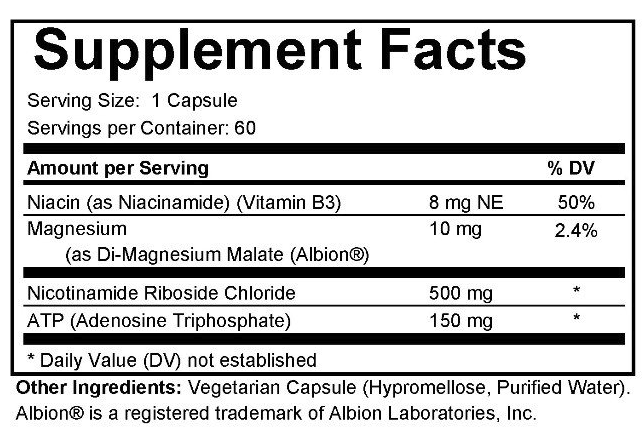
Serving Size: 1 Capsule
Servings per Container: 60
| Amount per Serving | % DV | |
|---|---|---|
| Niacin (as Niacinamide) (Vitamin B3) | 8 mg NE | 50% |
| Magnesium | 10 mg | 2.4% |
| (as Di-Magnesium Malate (Albion®)) | ||
| Nicotinamide Riboside Chloride | 500 mg | * |
| ATP (Adenosine Triphosphate) | 150 mg | * |
* Daily Value (DV) not established.
Other Ingredients: Vegetarian Capsule (Hypromellose, Purified Water).
Albion® is a registered trademark of Albion Laboratories, Inc.
Transcribed to match the printed label, which is also shown in the product images above. Panel amounts are per capsule. At the recommended two-capsule daily serving you are taking 1,000 mg nicotinamide riboside chloride, 300 mg ATP, 16 mg NE niacin and 20 mg magnesium per day. Sixty capsules is a thirty-day supply at two capsules daily, or sixty days if you choose to run one.
I am not going to promise you a timeline, because the published trials measured biomarkers and outcomes on schedules that have very little to do with how a person feels on a Tuesday afternoon. Here is how I frame it with patients instead.
In the published dose-response work, blood NAD rose within the first one to two weeks and then held steady. That part is documented. What most people notice in this window is nothing dramatic, and that is normal. This is not a stimulant and it does not behave like one.
If you are going to notice something, this is usually where it lands, and it tends to be unglamorous. Steadier afternoon energy. Recovering from a hard session in a day instead of two. Less drop-off in the last third of a long effort. Write it down, because it is easy to miss.
Two full bottles is a fair trial. If nothing has changed in energy, recovery, or training capacity by then, be honest with yourself and stop. I would rather you cycle off a product that is not working for you than keep buying it out of hope. That applies to my products too.

Long course is where you find out what your capacity really is, because across that many hours there is nowhere to hide and nothing left to spend. It is also how I evaluate anything I take. Not by how I feel in the first week, but by what happens in the last third of a long effort three months from now.
This one I got to do with my son, and that is the entire argument for the second half. Not looking backward at what you used to be able to do. Still showing up for what is in front of you.
If you want the number instead of the feeling, run a baseline NAD panel with your physician before you start and run it again at ninety days. That is what I would do, and it turns this from a hope into a measurement.
Use this next time you are comparing bottles. These are the rows where a formula either has nothing to hide or a great deal.
| What to check | Typical off-the-shelf NAD product | NAD Catalyst |
|---|---|---|
| Primary precursor named | Often a cellular energy or NAD complex blend with the individual precursor amounts pooled together | Nicotinamide riboside chloride listed as its own line item at 500 mg |
| Precursor dose disclosed | Frequently hidden inside a proprietary blend total | Every active carries its own printed milligram amount. No blends anywhere on the panel |
| How research is cited | Percentages quoted with no study dose given, often from trials run above the dose the product delivers | Study dose stated beside every figure, including where it differs from ours, and no percentage published for a dose that was never tested |
| Magnesium form | Magnesium oxide, chosen for cost and label weight | Albion Di-Magnesium Malate, a fully reacted mineral amino acid chelate |
| Where the serving size came from | Set so the bottle hits a price point, then defended with research run at higher doses than the serving delivers | Set to match a dose that appears in a published human trial: 1,000 mg of NR per day |
| Other ingredients | Magnesium stearate, silicon dioxide, dyes, titanium dioxide, rice flour bulking agents | Two other ingredients in total: hypromellose and purified water. That is the entire capsule shell |
| Flushing form of B3 | Some formulas still lean on nicotinic acid, which flushes at meaningful doses | Niacinamide and nicotinamide riboside only. Neither is associated with the niacin flush |


Dr. Andreas Boettcher, B.S., D.C., C.F.M.P.
Founder, It's Only Halftime
Ironman TriathleteMaster's Men's Physique CompetitorMedication-Free at 5633 Years of Clinical Practice
I have spent thirty-three years watching people in their forties and fifties accept decline as a scheduled event. It is not. But I will not stand here and tell you a capsule hands your thirties back, because that is the promise this entire category has been making for a decade and it is exactly why nobody trusts a supplement label anymore.
What I can tell you is what the research actually established. Oral nicotinamide riboside raises measurable NAD in humans, in proportion to how much you take. That is not marketing, that is a replicated finding with a dose-response curve behind it. What the field is still sorting out is how far that biochemical change carries into performance and healthspan. Some trials found signals. Some found nothing at all.
This is what I reach for, and I take it every morning with breakfast. Not because I expect to feel it like a pre-workout, because I do not and neither should you. I take it because NAD is one of the few age-related variables with real human dose-response data behind an oral intervention, and because at fifty-six, still racing long course and still stepping on a physique stage, I would rather supply the upstream cofactor than guess about it. I also run a separate mineral and electrolyte formula alongside it, which tells you exactly how I think about the small cofactor amounts in this capsule. If you want the number rather than the feeling, run a baseline panel with your physician before you start and run it again at ninety days. That is the version of this conversation I would rather have with you.
One thing I want said plainly, because photographs on a supplement page can imply something nobody should be implying. None of those images are a claim about this capsule. I did not race, train, or compete because of a supplement, I will not suggest that you will, and no product turns anyone into a triathlete.
What they are is the reason I formulate the way I do. When you have spent a lifetime pushing your own aerobic and anaerobic systems to the point where they quit, you develop a specific respect for the machinery underneath them, and very little patience for products that talk about cellular energy without disclosing a dose. That is why we built this one around the dose the research used rather than the dose that makes a bottle last longer.
NAD Catalyst is the upstream piece. It supplies the coenzyme substrate. These are the three formulas I run around it: one that works the mitochondria themselves, one that replaces what training costs you, and one that covers the daily foundation underneath both.
NAD Catalyst supplies the carrier. MitoHealth works on the mitochondria doing the carrying, approaching the same job from the other direction with a broader energy-support blend. This is the most natural pairing in the line.
View MitoHealthDifferent Catalyst, same job from the other end. NAD Catalyst supplies the coenzyme your cells build energy with. This one replaces what you sweat out while you use it. Every hard session, every long ride, every hot afternoon costs you minerals, and mineral status sits underneath the same enzymatic reactions this capsule is feeding. I run it on training days without exception.
View Catalyst ElectrolyteNAD Catalyst goes deep on one pathway. The Daily Multi covers the ground underneath it, built around micronutrient, mineral, and methylation support. That last part matters here, because B3 in any form draws on methyl donors as your body clears it, and running a daily NAD precursor is a good reason to keep methylation supported rather than assume it.
View Daily MultiThe molecule is the same. Nicotinamide riboside chloride is nicotinamide riboside chloride, and that is exactly what our panel declares. The trials cited on this page were conducted using ChromaDex's NIAGEN material, and I have told you that directly in the chart caption rather than letting you assume it.
Our label does not carry a branded-ingredient mark, so we are not claiming one. My view is that if a company claims a branded ingredient, that mark belongs on the Supplement Facts panel where you can verify it, not buried in body copy where you cannot.
Because 1000 mg per day is where the human evidence is strongest, and we would rather build the serving around the research than around the cheaper bottle. That daily amount is the top arm of the eight-week placebo-controlled dose-response trial, and it is the same daily total as the six-week crossover trial that ran 500 mg twice daily in adults aged 55 to 79, which was reported as well tolerated with no serious adverse effects. Higher daily amounts have been studied in humans for longer.
Nicotinamide riboside is by far the most expensive material in this capsule, so setting the serving at two costs us the longer days-supply number we could have printed on the front. We took that trade deliberately. A sixty-day bottle that quietly doses you under the studies on its own page is a marketing decision, not a formulation decision.
Not as circulating ATP, and I would be misleading you if I implied otherwise. Swallowed ATP is broken down in the digestive tract, absorbed as its components, and reassembled inside cells. Controlled human studies looking specifically for a rise in blood or plasma ATP after oral dosing, including at amounts many times larger than 150 mg, did not find one.
What the research points to instead is indirect: absorption of breakdown products, adenosine signaling, and contribution to the red blood cell nucleotide pool. The performance trials that reported effects used 400 mg per day. The two-capsule serving here delivers 300 mg, which brings you closer to that without reaching it, so we treat it as a supporting inclusion inside an NAD formula rather than the reason to buy the product. The 1,000 mg of nicotinamide riboside is the reason.
It should not. The flushing reaction is specific to nicotinic acid, which binds a receptor in the skin and triggers vasodilation. Neither B3 form in this capsule is nicotinic acid. Niacinamide does not flush, and across the published nicotinamide riboside trials flushing was not reported as a treatment effect.
If you have avoided B3 entirely because of a bad flushing experience, that was almost certainly a nicotinic acid product, and it is worth revisiting the category with the non-flushing forms.
Two capsules daily. I take one with breakfast and one with dinner, which is the same split the six-week trial used. Both at once in the morning is also fine and simpler to remember. Food is not strictly required, but taking it with a meal is easier on the stomach and is how the trials generally dosed it.
Earlier in the day is my preference on general principle for anything working on energy metabolism, though nicotinamide riboside is not a stimulant and there is no established reason it would disturb sleep. If you find it does, move it earlier.
This formula has a small number of real considerations, and I would rather name them specifically than hide behind a generic line. Talk with your prescribing physician or pharmacist before starting if any of these apply to you.
Discontinue use and consult a physician if you experience any adverse reaction. This product is not intended to replace a prescribed medication or a physician's care.
Generally yes, and most people are already getting B3 from one or both. The niacinamide here is 8 mg NE per capsule, so 16 mg NE and 100 percent of the daily value at the two-capsule serving, which will not push you anywhere unusual on its own. Add up your total across products so you know your real intake, which is good practice with any B vitamin.
Where I would slow down is if you are also taking a high-dose niacin product. That is a total-intake conversation with your physician rather than a simple stacking question.
Sixty capsules. At the two-capsule daily serving that is a thirty-day bottle, which works out to two dollars a day at the one-time price and a dollar seventy a day on subscription. If you choose to run one capsule daily, the same bottle covers sixty days at a dollar a day, or eighty-five cents on subscription.
I would rather show you that math here than let you work it out at checkout. A thirty-day bottle at the research dose is the honest version of this product. Stretching it to sixty by halving the dose and staying quiet about it is what most of the category does.
Yes, and it is a legitimate place to start rather than a compromise. One capsule is 500 mg a day, which sits above the 300 mg amount that produced a documented 51 percent rise in whole blood NAD in the eight-week trial, and above what the best-known branded NR product recommends. It also runs the bottle sixty days instead of thirty.
What you give up is the 1000 mg rung, which is the dose behind the largest measured increase and the reason the serving is set where it is. Plenty of people start at one and move to two. Because every amount is printed per capsule, you can make that call with real numbers instead of guessing.
Yes. The capsule shell is hypromellose, a plant-derived cellulose material, with purified water. There is no gelatin and no animal-derived ingredient in this formula. Those two items are the complete other-ingredients list, which you can verify on the panel above and on the printed label in the product images.
You have read the whole page. You know exactly what is in this capsule, exactly what the research measured, and exactly where our doses sit relative to the trials, including the two places where they sit below them. That is more than almost any bottle in this category will give you, and it is deliberate, because I would rather sell to someone who understands what they bought.
NAD sits underneath energy production and cellular repair signaling, and it is one of the very few age-related declines that measurably responds to what you put in your mouth. One thousand milligrams a day of the most-studied precursor in human research, which is the dose the research actually used. Two capsules. Thirty days. No claims about how fast you will feel it, because I do not have that number and neither does anyone else selling you one.
The second half is not the part where you manage decline. It is the part where you stop treating it as inevitable and start supplying what the machinery needs. Start today, stay consistent for ninety days, then judge it honestly.
Dr. Andreas Boettcher, B.S., D.C., C.F.M.P. · Founder, It's Only Halftime
Tastes great! Great energy boost!
Great supplement to support my body. No GI side effects
I feel the boost it gives me. No weird stimulant effect, just more energy.
Easy on the gut with no weird taste or GI upset.
No weird or fishy taste or GI upset. I take several a day and feel great compared to other omega 3 supplements I have tried.
I take it daily and am glad to have a supplement to help with my cholesterol. No GI upset.
Great way to get needed minerals. No weird taste and no GI upset.
No weird taste and no gastric upset. Best MVI I have used.
Tastes great and it mixes up really well even with hot coffee.
I’ve tried many different omega 3/fish oil supplements and IOH’s has me at my best.
Based on Dr A’s coaching and advice, IOH creatine is a supplement must!
I've been consuming chocolate whey powder for a long time. I don't make particularly tasty protein drinks. However, I do with this!
If you are looking for high purity products with actual clinical doses and a product line that doesn't need a colorful, cartoon-like label to grab your attention, then IOH products are what you should be buying.
I tend to workout early AM, and used to pound a diet soda as my pre workout. I switched to this and have found it gives a much stronger and sustained energy boost without the jitters other caffeinated options have given me before.
I've tried many different pre-workout drinks over my years of lifting and for the most part have not been happy with them, loaded with toxic ingredients, jitters, the crash that comes after, etc.
I was introduced to IOH pre-workout from a friend and decided to give it a try. Prior to ordering an analyzed the ingredients and was impressed with the makeup of the product. The fact that there are no binders, fillers, artificial sweeteners and other common ingredients that are a far cry from healthy was encouraging.
After taking the supplement, I can confidently say it's a winner. Great clean energy, that is sustainable with no crash, no jitters or side effects from harsh stimulants. The energy and the increased time to fatigue, allowing me to push more reps and the pump you get was excellent.
I've added this to my routine and would encourage anyone looking for that clean energy performance added to their workouts, to give it a try.
Great job IOH team!


