

How to Improve Mitochondrial Health After 40
Mitochondrial Health · Longevity · Healthspan
Energy Is Manufactured: How to Keep Your Mitochondria Running Into the Second Half
Mitochondrial health sits underneath nearly every marker of how well you age, from strength and walking speed to blood sugar, brain function and survival itself. It is also one of the most trainable systems you own. Here is the physiology, the human data, and the full playbook for keeping the machinery young.
It is 3:15 in the afternoon and he is on his second coffee. He is fifty-two, runs a company, still lifts four days a week, and tells me something I have heard in some version for thirty-three years: "I'm not tired, exactly. I just run out earlier." The last set of the workout stopped happening. The afternoon meeting gets about sixty percent of him. His sleep is fine on paper. His labs are "normal."
Then he shows me what he has been doing about it. An NAD drip every couple of months. A longevity powder with fifteen ingredients. A cold plunge. What he has not done in roughly a decade is a single hard interval.
He is not lazy and he is not uninformed. He is doing exactly what the market trained him to do, which is to shop at the top of the pyramid while the foundation underneath runs short on the most basic parts. What he is describing is not a willpower problem or a caffeine deficiency. It is mitochondrial health, and it is the most important conversation in longevity that almost nobody frames correctly. So let's start where I start with every patient: with the machine itself.
The Factory Inside Every Cell
Most of your cells contain hundreds to thousands of mitochondria. Their job is unglamorous. They take the carbohydrate and fat you eat, strip the electrons off them, and use the flow of those electrons to pump protons across a membrane, which drives a molecular turbine called ATP synthase. The product is ATP, the molecule every heartbeat, muscle contraction, nerve impulse and thought spends.
The scale is hard to picture. You turn over roughly your own body weight in ATP every day, yet you store only seconds of it at any moment. Energy is not a reserve you draw down. It is a production line that has to run continuously, every second you are alive, and when the line slows you feel it long before any lab value flags it.
Think of it as an assembly line with five stations. Fat has to be carried inside the mitochondrion. Carbohydrate has to pass through a gateway enzyme. The Krebs cycle has to strip the fuel down to its electrons. Electron carriers, chiefly NAD+, have to ferry that harvest to the electron transport chain. And the finished ATP needs a buffer for moments of peak demand.
Every station runs on parts your body cannot make from scratch. Two of the cycle's gatekeeper enzymes, pyruvate dehydrogenase and alpha-ketoglutarate dehydrogenase, each need five cofactors present at the same time, and four of those five are built from B vitamins: thiamine, riboflavin, niacin and pantothenic acid.1 Run short on any one of them and the whole line slows to the speed of its weakest station.
More than a power plant
Calling mitochondria the powerhouse of the cell undersells them. They also act as the cell's sensors and quality-control system. They signal when fuel is abundant or scarce, they help decide whether a damaged cell repairs itself or self-destructs, and they generate reactive oxygen species that are useful as signals in small amounts and damaging in large ones.
They are also constantly being rebuilt. When you train, a signaling cascade centered on a protein called PGC-1α tells the cell to build new mitochondria. This is called biogenesis. Meanwhile a cleanup process called mitophagy identifies worn-out mitochondria and recycles them. A healthy cell keeps both processes running, so the fleet stays young even as the person gets older. With age and inactivity, biogenesis slows and cleanup falls behind, and the cell fills with older, leakier mitochondria that produce less energy and more oxidative noise.4 That balance between building and clearing is the real target of everything in this article.
Why Mitochondria Are the Key to Healthspan
Lifespan is how long you live. Healthspan is how long you live well: strong, metabolically sound, mentally sharp and independent. Nearly every tissue that determines healthspan is a heavy mitochondrial user, which is why mitochondrial decline shows up everywhere at once. Your brain is about 2 percent of your body weight and consumes roughly 20 percent of your resting energy.2 Your heart beats about a hundred thousand times a day without a single day off. Your skeletal muscle is the largest metabolic organ you have.
Mitochondrial capacity in human muscle declines across the adult lifespan, which the Mayo Clinic biopsy work led by Short and Nair documented two decades ago.3 Mitochondrial dysfunction now sits among the hallmarks of aging in the framework researchers use to organize the field, alongside chronic inflammation, loss of protein maintenance and impaired nutrient sensing, all of which it feeds.4 NAD+ follows the same trend. A 2022 study of human muscle biopsies found it among the metabolites most reduced in older adults.5
Strength and function
Your legs run on mitochondria
In 38 adults aged 24 to 91 from the Baltimore Longitudinal Study of Aging, muscle mitochondrial respiration fell with age and tracked closely with cardiorespiratory fitness, and with grip and leg strength.6 In 37 adults averaging 78 years old, mitochondrial capacity and efficiency together with aerobic fitness explained about 65 percent of the variation in walking speed.7 Walking speed, in turn, is one of the more reliable predictors of survival in older adults.8
Metabolism
Blood sugar starts in the muscle
In a small Yale study, lean older adults matched to young adults for body composition and activity had about 40 percent lower mitochondrial activity in muscle, more fat stored inside their muscle cells, and more insulin resistance.9 When the mitochondria cannot burn fat fast enough, it accumulates inside muscle and interferes with insulin signaling. That is a mitochondrial road into type 2 diabetes.
Inflammation
Leaky mitochondria feed inflammaging
Damaged mitochondria release fragments of their own DNA and excess oxidants that the immune system reads as danger signals. That low-grade, chronic inflammation, often called inflammaging, is itself a hallmark of aging and accelerates damage in vessels, joints and brain.4
Survival
Fitness is a mitochondrial number
Cardiorespiratory fitness, which is largely a measure of how much oxygen your mitochondria can use, was one of the strongest predictors of survival in a cohort of more than 122,000 adults who underwent treadmill testing. There was no upper limit at which more fitness stopped helping.10
The Most Important Data Point in This Article
Here is the part that never makes it onto a supplement label. When researchers separate older adults who train from older adults who do not, much of what we call age-related mitochondrial decline turns out to be inactivity-related decline.
| Study | Who was compared | What they found | Key number |
|---|---|---|---|
| Lanza et al., Diabetes, 200811 | Young and older adults, sedentary versus endurance-trained | The age-related drop in mitochondrial ATP production seen in sedentary adults was absent in trained older adults, who also had better insulin sensitivity | No age effect when trained |
| Gries et al., J Appl Physiol, 201812 | Lifelong exercisers about 74 years old, non-exercisers about 75, exercisers about 25 | Lifelong exercisers had muscle capillary density and aerobic enzyme activity similar to the 25-year-olds | VO2max 34 vs 22 (men) |
| Janssens et al., Nat Aging, 20225 | Young adults versus trained, normally active and physically impaired older adults | Trained older adults had muscle NAD+ close to young levels. NAD+ tracked daily step count | Impaired lowest |
| Robinson et al., Cell Metab, 201713 | Adults 18 to 30 and 65 to 80, twelve weeks of training | High-intensity interval training raised mitochondrial capacity more in the older group than in the young group | +69% vs +49% |
| de Guia et al., Physiol Rep, 201914 | Adults 35 and under versus 55 and over, twelve weeks of aerobic or resistance training | Both training types raised NAMPT, the rate-limiting enzyme that recycles NAD in muscle | +28 to 30% (older) |
Most of these are small or cross-sectional studies, which limits how hard you can push any single number. The direction across all five is consistent.
In the Gries study, the lifelong exercisers did not stay twenty-five. Their VO2max still fell well below the young group's.12 Lanza found trained older adults still carried less mitochondrial DNA than trained young adults.11 Age is real. But the gap between a trained 74-year-old and an untrained 75-year-old was larger than most of what any pill on the market has ever been shown to close. The decline is real. A large share of it is also the decline of a machine that stopped being asked to work.
The Assembly Line · Weakest Station Sets the Speed
Where energy gets made, and what each station runs on
Fuel entry
Fatty acids ride the carnitine shuttle into the mitochondrion to be burned.
The gateway
Pyruvate dehydrogenase hands carbohydrate into the cycle.
The Krebs cycle
Alpha-ketoglutarate dehydrogenase, the cycle's choke point, needs the same five cofactors at once.
Electron carriers
NAD+ and FAD ferry the harvested electrons to the transport chain.
Output and buffer
ATP synthase makes the currency. Phosphocreatine recharges it in seconds.
Supplements stock the stations. Only training builds more lines. Twelve weeks of intervals raised mitochondrial capacity in adults aged 65 to 80.13
Training builds the factory. Nutrition keeps it from sitting idle, waiting on parts.
Where the Longevity Story Gets Oversold, Including by My Side
The people selling mitochondrial products are not wrong about the biology. The decline is documented and the cofactor chemistry is textbook. Where it goes wrong is in the numbers, and in what gets left out.
The "eight years younger" claim
Take the most-shared figure in this space: an alpha-ketoglutarate formula that "reversed biological age by eight years." That comes from a real paper.15 It was also a retrospective review of 42 people who chose to take the product, with no placebo group, measured with a saliva DNA methylation test, and the author list included people from the company that sells the test and the company that sells the formula. The authors themselves wrote that a placebo-controlled study is still needed. The lifespan data on AKG is real too, but it is mouse data.16 I cannot trace "eight years younger" to a controlled human trial, so I am not going to repeat it as one. The honest version is that AKG is a Krebs cycle intermediate with interesting animal data and no controlled human longevity result yet.
NAD: solid biochemistry, unsettled payoff
NAD precursors have the opposite problem. Oral nicotinamide riboside raises whole-blood NAD+ in a clean dose-response: 22 percent at 100 mg, 51 percent at 300 mg and 142 percent at 1,000 mg daily in an eight-week placebo-controlled trial of 140 adults.17 That part is not in dispute. But blood is not muscle. In a small trial in men in their seventies, three weeks of 1,000 mg shifted the muscle NAD metabolome and lowered inflammatory signaling without significantly raising muscle NAD+ itself.18 In healthy adults aged 55 to 79, NAD+ rose with no change in exercise capacity.19 In obese men, two grams a day did not improve insulin sensitivity.20 Raising the number in the blood is reliable. Turning that into something you can feel or measure in performance is still being worked out.
The false choice: exercise or NAD
Here is the framing I want to retire. Training raised NAMPT, the enzyme that recycles NAD in muscle, by 28 to 30 percent in adults over 55.14 A precursor supplies raw material. Training expands recycling capacity. Those are different jobs. A man who trains and supplies the raw material is not doing the same thing twice. He is working both ends of the same pathway.
Popular habits with thin human data
Cold plunges, sauna protocols, extended fasting and red light all have enthusiastic followings and some plausible mechanisms. Much of the mitochondrial evidence behind them comes from animals, cell cultures or short-term markers. I cannot point you to controlled human data showing any of them improves muscle mitochondrial capacity the way interval training does. If you enjoy them, keep them. Just do not let them take the place of the work that has the data.
What to Ask Your Physician
Persistent fatigue has a differential. Before you blame your mitochondria, rule out what mimics a slow assembly line:
- Fasting glucose, fasting insulin and HbA1c. Insulin resistance and mitochondrial dysfunction travel together.
- Ferritin and a full iron panel. The electron transport chain is built with iron, and both deficiency and overload matter.
- TSH, free T4 and free T3. Thyroid hormone sets the pace of the whole line.
- Vitamin B12 with methylmalonic acid, plus folate.
- 25-hydroxy vitamin D and RBC magnesium.
- CBC and a comprehensive metabolic panel for anemia, kidney and liver function.
- A lipid panel and hs-CRP as baseline cardiometabolic and inflammation markers.
- Total and free testosterone for men, since low energy and low testosterone often share the same metabolic root.
- A sleep evaluation if you snore or wake unrefreshed. Untreated sleep apnea defeats everything on this page.
- A medication review. Some commonly prescribed drugs are known to affect mitochondrial function or the nutrients it depends on, so ask your prescriber whether any of yours qualify.
One practical note: tell the lab if you take any biotin. High-dose biotin can distort thyroid and other immunoassays. The interference study used 10 mg a day, far above the 500 mcg in MitoHealth, but follow your lab's hold instructions anyway.21
How to measure your mitochondria without a biopsy
Nobody needs a muscle biopsy to track this. These four numbers move with mitochondrial health and are easy to retest every three to six months.
- VO2max. A cardiopulmonary exercise test gives the direct number, and many fitness centers and sports medicine clinics offer one. It is the single best mitochondrial proxy you can buy.
- Walking speed. Time yourself over a fixed distance at your normal pace. It is crude, free, and tied to both mitochondrial function and survival.7,8
- Grip strength. A hand dynamometer is inexpensive and tracks overall muscle function.6
- Resting heart rate and recovery. How fast your heart rate falls in the minute after a hard effort improves as aerobic fitness improves.
The Free Levers: Start Here
Every one of these costs nothing, and every one acts on the machinery directly. They are listed in order of the strength of the human evidence.
- Two to three interval sessions a week. In the Mayo Clinic trial, twelve weeks of high-intensity cycling intervals raised mitochondrial capacity 49 percent in adults 18 to 30 and 69 percent in adults 65 to 80, the largest gain of any training mode they tested.13 No supplement has produced a muscle number like that. The format is simple: hard efforts of two to four minutes, near the top of what you can sustain, with equal or slightly shorter recovery. Start with four rounds.
- Build an aerobic base. Two or three sessions a week of steady work at a pace where you can still speak in sentences, 30 to 60 minutes. This is the training behind the Lanza and Gries findings, where endurance-trained older adults kept mitochondrial capacity, capillaries and aerobic enzymes close to young levels.11,12 Intervals build the ceiling. Steady work builds the foundation underneath it.
- Lift two or three days a week. Resistance training raised the NAD recycling enzyme as much as aerobic work did in older adults.14 It also builds the muscle that houses your mitochondria in the first place. More muscle means more factory floor.
- Walk more than you think you need to. Daily step count tracked with muscle NAD+ in older adults.5 Walking after meals also blunts the blood sugar spike that strains the whole system.
- Stop flooding the line. Chronic caloric excess forces fuel into muscle faster than the mitochondria can burn it, which is exactly the fat-in-muscle pattern linked to insulin resistance.9 Losing visceral fat and fixing insulin resistance takes pressure off the entire system.
- Eat the parts. Protein at every meal. Meat, fish, eggs, dairy, legumes and whole grains supply the B vitamins. Red meat is the richest dietary source of carnitine. Colorful plants supply the antioxidants that buffer the oxidative byproducts of energy production.
- Treat alcohol as a mitochondrial tax. Alcohol raises thiamine demand and its metabolism competes directly for NAD+ in the liver. Less is better. None on most nights is better still.
- Protect seven to nine hours of sleep. Repair, hormone signaling and appetite regulation all depend on it, and training adaptations happen during recovery, not during the session.
The mitochondrial week
Here is what that looks like on a calendar. It is a template, not a prescription, and it assumes you have medical clearance for vigorous exercise.
MON
Intervals 4–6 rounds
TUE
Lift: lower body
WED
Steady aerobic 45 min
THU
Intervals 4–6 rounds
FRI
Lift: upper body
SAT
Long steady aerobic 60 min
SUN
Walk and recover
Daily walking after meals on every day. Add a third lifting session or third interval session only once recovery is solid.
You can act on this entire section without buying anything from me. Do only this, and you will be ahead of most men your age.
Where Targeted Support Earns Its Place
On a good day, food covers the parts. The trouble is that men over forty who train hard, travel and carry real cognitive load do not live on good days. Training also raises demand for exactly the cofactors the line runs on. That is who I built MitoHealth for: the daily layer that keeps every station stocked so the training you are already doing can pay off.
The core is the cofactor set from stations two and three, all at or above 100 percent of the daily value: thiamine 2 mg, riboflavin 2 mg with half supplied as already-activated riboflavin-5-phosphate, niacinamide 20 mg NE, pantothenic acid 5 mg and biotin 500 mcg, with vitamin A at 1,500 mcg RAE. Alongside them sit acetyl-L-carnitine 500 mg for the fuel shuttle at station one, AKG 100 mg as a Krebs cycle intermediate, creatine HCl 500 mg, nicotinamide riboside 20 mg, ATP 30 mg, mixed tocopherols 20 mg for the lipid membranes surrounding the mitochondria, and alpha-GPC 5 mg. No stimulants, every dose printed on the label, stevia-sweetened, one scoop of orange fruit punch in cold water.
The Daily Base Layer
Stock every station, every morning.
Six cofactor vitamins at full strength, every dose printed on the label, nothing borrowed from tomorrow's energy.
Shop MitoHealthThe pairing: MitoHealth and NAD Catalyst
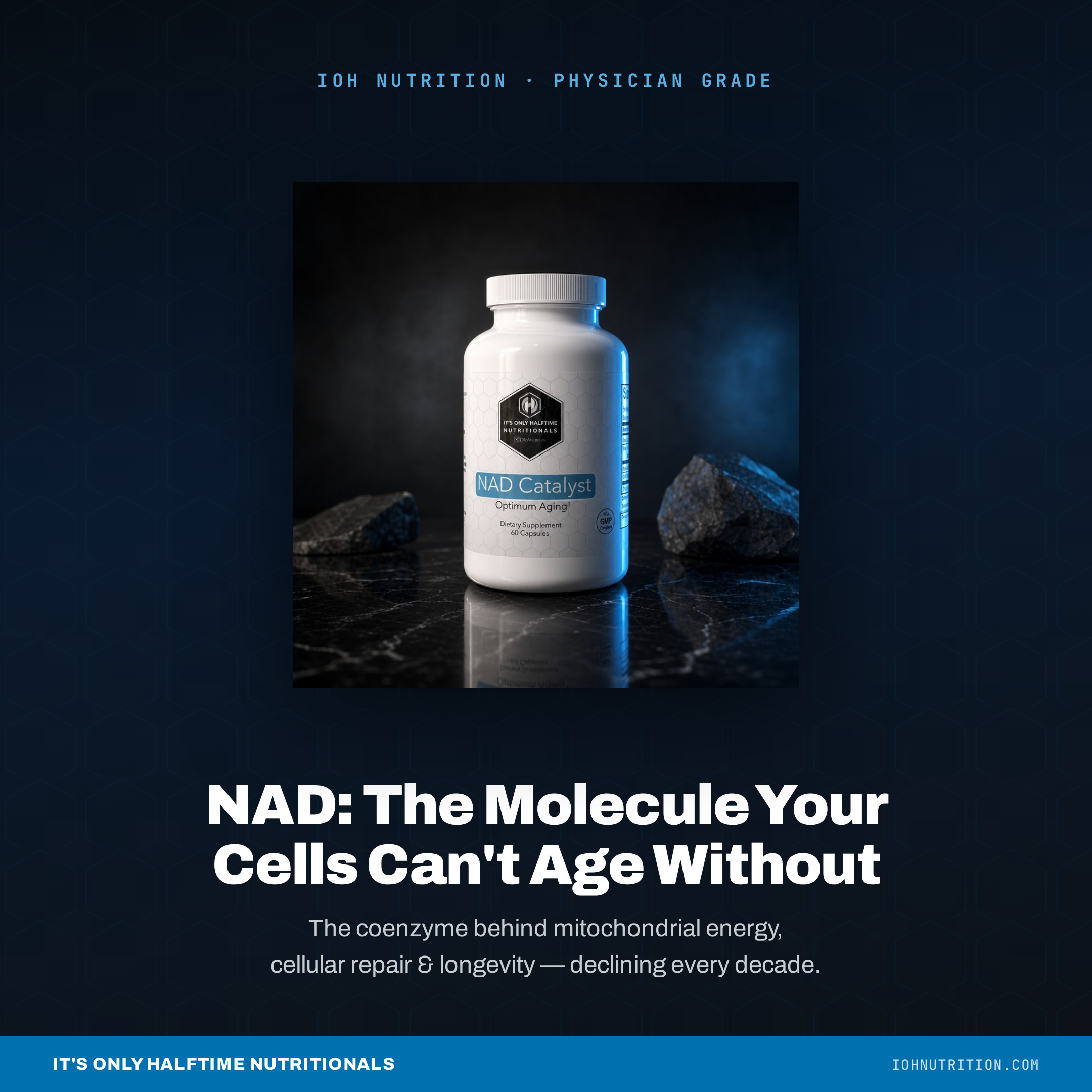
MitoHealth contains 20 mg of nicotinamide riboside. NAD Catalyst contains 500 mg per capsule, or 1,000 mg at the two-capsule serving, which is the top arm of the dose-response trial above. That is fifty times the amount, and I would rather you hear it from me than find it on the panel.
They are not competing for the same job. MitoHealth supplies the cofactors the entire line depends on, from the carnitine shuttle through the Krebs cycle. NAD Catalyst loads station four, the single carrier pool every station upstream feeds into, at the dose the research actually used. One keeps the factory supplied. The other targets its main conveyor belt. Add the training that expands NAD recycling, and you are working the pathway from all three directions: supply, cofactors and capacity.
My routine is one scoop of MitoHealth in the morning, one NAD Catalyst capsule with breakfast and the second with dinner, which is the split the six-week trial used.19
Station five has its own product. The 500 mg of creatine in MitoHealth is a contributing amount, while the researched daily dose is 3 to 5 grams.22 Creatine is also one of the few supplements with randomized trial data on cognition in healthy adults, though the effects are modest and the clearest signal was for short-term memory, particularly in older adults.23 Pure Creatine does that job, and it layers under both.

Honest Expectations
Here is what this stack will not do, stated plainly.
- MitoHealth will not give you a jolt. There is no stimulant in it. Cofactor repletion is a filling-the-tank process measured in weeks.
- It does not deliver a research dose of its specialty ingredients. Controlled trials of acetyl-L-carnitine in older adults generally used 1.5 to 3 grams a day,24 so 500 mg is the low end. Swallowed ATP is not absorbed intact,25 so the 30 mg is formulation support. The alpha-GPC is not the reason to buy it, and the 100 mg of AKG is not the "eight years."
- NAD Catalyst reliably raises blood NAD+. Whether that translates into how you feel, train or age is still being worked out, and some trials found nothing.
- Neither product builds new mitochondria. Intervals and aerobic training do that.
- Add up your vitamin A and B3 across products. MitoHealth carries 1,500 mcg RAE of preformed vitamin A against an adult upper limit of 3,000. Run with NAD Catalyst, total niacinamide is 36 mg NE, just over the 35 mg upper limit, which was set on the flushing caused by nicotinic acid. Niacinamide does not flush, but if you also take a multivitamin, count it.
What MitoHealth will do is supply the cofactors your mitochondria physically require, at full daily value, in a form you will actually take every morning. Give it eight to twelve weeks alongside the training, retest your VO2max or walking speed, then judge it honestly.
The Second Half Runs on What You Supply
Back to the man with the second coffee. He did not need a more exotic molecule. He needed his assembly line asked to work again: two interval sessions, two steady aerobic days, three lifting days, and every station kept stocked while it adapted. The drip was turning up the volume in a body that could not hear it.
Mitochondria are where longevity stops being an abstraction. They decide whether your legs carry you at eighty, whether your blood sugar holds, whether your brain gets the energy it asks for. And unlike your genes, they answer to what you do this week.
In the first half of life, the machine runs on youth. In the second half, it runs on what you demand of it and what you supply it with. Demand comes first, and it is free. Supply is where a daily scoop of MitoHealth earns its spot on the counter. It's only halftime, and the second half is where the game gets decided.
Build the Stack
The cofactor layer and the carrier layer, together.
MitoHealth stocks every station. NAD Catalyst loads the carrier pool at the research dose. Training does the rest.
Shop MitoHealth Add NAD CatalystStay Strong,
Dr. Andreas
Dr. Andreas Boettcher, B.S., D.C., C.F.M.P.
Ironman Triathlete · Master's Men's Physique Competitor
Medical Disclaimer
This article is for educational purposes only and is not medical advice. Fatigue, reduced exercise tolerance and declining energy can reflect serious underlying conditions, including thyroid disease, anemia, diabetes, sleep apnea, heart disease and depression, that warrant evaluation by a physician. Do not start or stop any medication or supplement based on this article. Obtain medical clearance before beginning vigorous exercise, including interval training. Consult your physician before supplementing, particularly if you are pregnant or nursing, have kidney or liver disease or gout, or take anticonvulsants such as carbamazepine or primidone, urate-lowering drugs such as allopurinol or febuxostat, prescription niacin, thyroid medication, anticoagulants or retinoid medications such as isotretinoin or acitretin.
These statements have not been evaluated by the Food and Drug Administration. These products are not intended to diagnose, treat, cure or prevent any disease.
NIAGEN is a registered trademark of ChromaDex, Inc. Rejuvant is a registered trademark of Ponce de Leon Health. Both are referenced solely to identify materials used in cited research and imply no endorsement of IOH Nutrition.
References
- Depeint F, Bruce WR, Shangari N, Mehta R, O'Brien PJ. Mitochondrial function and toxicity: role of the B vitamin family on mitochondrial energy metabolism. Chem Biol Interact. 2006;163(1-2):94-112.
- Raichle ME, Gusnard DA. Appraising the brain's energy budget. Proc Natl Acad Sci USA. 2002;99(16):10237-10239.
- Short KR, Bigelow ML, Kahl J, et al. Decline in skeletal muscle mitochondrial function with aging in humans. Proc Natl Acad Sci USA. 2005;102(15):5618-5623.
- López-Otín C, Blasco MA, Partridge L, Serrano M, Kroemer G. Hallmarks of aging: an expanding universe. Cell. 2023;186(2):243-278.
- Janssens GE, Grevendonk L, Perez RZ, et al. Healthy aging and muscle function are positively associated with NAD+ abundance in humans. Nat Aging. 2022;2(3):254-263.
- Gonzalez-Freire M, Scalzo P, D'Agostino J, et al. Skeletal muscle ex vivo mitochondrial respiration parallels decline in vivo oxidative capacity, cardiorespiratory fitness, and muscle strength: the Baltimore Longitudinal Study of Aging. Aging Cell. 2018;17(2):e12725.
- Coen PM, Jubrias SA, Distefano G, et al. Skeletal muscle mitochondrial energetics are associated with maximal aerobic capacity and walking speed in older adults. J Gerontol A Biol Sci Med Sci. 2013;68(4):447-455.
- Studenski S, Perera S, Patel K, et al. Gait speed and survival in older adults. JAMA. 2011;305(1):50-58.
- Petersen KF, Befroy D, Dufour S, et al. Mitochondrial dysfunction in the elderly: possible role in insulin resistance. Science. 2003;300(5622):1140-1142.
- Mandsager K, Harb S, Cremer P, et al. Association of cardiorespiratory fitness with long-term mortality among adults undergoing exercise treadmill testing. JAMA Netw Open. 2018;1(6):e183605.
- Lanza IR, Short DK, Short KR, et al. Endurance exercise as a countermeasure for aging. Diabetes. 2008;57(11):2933-2942.
- Gries KJ, Raue U, Perkins RK, et al. Cardiovascular and skeletal muscle health with lifelong exercise. J Appl Physiol. 2018;125(5):1636-1645.
- Robinson MM, Dasari S, Konopka AR, et al. Enhanced protein translation underlies improved metabolic and physical adaptations to different exercise training modes in young and old humans. Cell Metab. 2017;25(3):581-592.
- de Guia RM, Agerholm M, Nielsen TS, et al. Aerobic and resistance exercise training reverses age-dependent decline in NAD+ salvage capacity in human skeletal muscle. Physiol Rep. 2019;7(12):e14139.
- Demidenko O, Barardo D, Budovskii V, et al. Rejuvant, a potential life-extending compound formulation with alpha-ketoglutarate and vitamins, conferred an average 8 year reduction in biological aging, after an average of 7 months of use, in the TruAge DNA methylation test. Aging (Albany NY). 2021;13(22):24485-24499.
- Asadi Shahmirzadi A, Edgar D, Liao CY, et al. Alpha-ketoglutarate, an endogenous metabolite, extends lifespan and compresses morbidity in aging mice. Cell Metab. 2020;32(3):447-456.
- Conze D, Brenner C, Kruger CL. Safety and metabolism of long-term administration of NIAGEN (nicotinamide riboside chloride) in a randomized, double-blind, placebo-controlled clinical trial of healthy overweight adults. Sci Rep. 2019;9:9772.
- Elhassan YS, Kluckova K, Fletcher RS, et al. Nicotinamide riboside augments the aged human skeletal muscle NAD+ metabolome and induces transcriptomic and anti-inflammatory signatures. Cell Rep. 2019;28(7):1717-1728.
- Martens CR, Denman BA, Mazzo MR, et al. Chronic nicotinamide riboside supplementation is well-tolerated and elevates NAD+ in healthy middle-aged and older adults. Nat Commun. 2018;9:1286.
- Dollerup OL, Christensen B, Svart M, et al. A randomized placebo-controlled clinical trial of nicotinamide riboside in obese men: safety, insulin-sensitivity, and lipid-mobilizing effects. Am J Clin Nutr. 2018;108(2):343-353.
- Li D, Radulescu A, Shrestha RT, et al. Association of biotin ingestion with performance of hormone and nonhormone assays in healthy adults. JAMA. 2017;318(12):1150-1160.
- Kreider RB, Kalman DS, Antonio J, et al. International Society of Sports Nutrition position stand: safety and efficacy of creatine supplementation in exercise, sport, and medicine. J Int Soc Sports Nutr. 2017;14:18.
- Avgerinos KI, Spyrou N, Bougioukas KI, Kapogiannis D. Effects of creatine supplementation on cognitive function of healthy individuals: a systematic review of randomized controlled trials. Exp Gerontol. 2018;108:166-173.
- Montgomery SA, Thal LJ, Amrein R. Meta-analysis of double blind randomized controlled clinical trials of acetyl-L-carnitine versus placebo in the treatment of mild cognitive impairment and mild Alzheimer's disease. Int Clin Psychopharmacol. 2003;18(2):61-71.
- Arts IC, Coolen EJ, Bours MJ, et al. Adenosine 5'-triphosphate (ATP) supplements are not orally bioavailable: a randomized, placebo-controlled cross-over trial in healthy humans. J Int Soc Sports Nutr. 2012;9:16.


